North
American English Dialects, Based on Pronunciation Patterns
|
(12-Aug.-2014) |
Individual
Words |
Most Common Second and Third Languages by State in the U.S. The following page is interesting, and was pointed out to me by several people, although it really has no direct correlation to the data presented here: gizmodo.com/the-most-common-languages-spoken-in-the-u-s-state-by-1575719698. Adj. 4-Oct.-2017 Web-Based Survey now completed A group of linguists had been gathering data on North American English dialects using a web-based survey. They asked for our help, and some of you helped with this survey. This survey is now closed, with 3903 total responses in December 2012. You can see some preliminary results at: pantheon.yale.edu/~clb3/NorthAmericanDialects. However, I find that some of their samples definitely do not represent the local dialect! 26-Dec.-2012 |
This is just a hobby of mine, that I thought might be interesting to a lot of people. Some people collect stamps. Others collect coins. I collect dialects. - Rick Aschmann. (Page last updated: May 2, 2018.
Thanks to all of you who have written expressing appreciation for the page! I don’t promise to respond to every e-mail, but I am still trying to answer all those who sent in a sample or other information, or even a complaint. Unfortunately, my life is always very busy, and I can only dedicate a small portion of my time to this, so I have trouble even keeping up with current correspondence about this page. Worse yet, from time to time this page gets posted to another popular blog, and I get a new surge of e-mail, so I have doubts of ever being able to answer it all. But I’ll keep working at it! 12-Aug.-2014 There are 8 major
English dialect areas in North America, listed below the map at left. These
are shown in blue, each with its number, on the map and in the Dialect Description Chart below, and are
also outlined with blue lines on the map. The first 6 of these begin at the eastern seaboard and proceed west,
reflecting western settlement patterns. The many subdialects are
shown in red on the map and in the chart, and are outlined with red lines on
the map. All of these are listed in the margins of the map as well.
In the Dialect Description Chart additional
features not shown on the map are provided for distinguishing the dialects. Recent additions • I did quite a bit of cosmetic adjustment to place name positioning and other things to make the map more readable. New! 5-Oct.-2017 • I adjusted the name of the Mat-Su Valley dialect in Alaska from Mat-Su Valley to Mat-Su Valley (North Central) to better clarify its status, as an Island of North Central in Alaska. New! 4-Oct.-2017 • Because native French speakers do not typically have the Canadian raising, I have now explicitly shown the pink Canadian-raising line as excluding the French-speaking area in Canada. (Earlier I had simply not shown it in this area, but the result was confusing even to me, so I put it in.) I also adjusted a few lines running across Hudson Bay. Adj. 4-Oct.-2017 • I adjusted the main map to match the New Orleans inset in its southeast corner and added St. Bernard Parish, reflecting the fact that apparently all of St. Bernard Parish has the same dialect. New! 13-Sep.-2017 • I have now finished reducing the size of the dots for cities and towns, except for the larger population centers, to reduce the clutter on the map. I have now completed this for all U.S. states and Canadian provinces. Adj. 13-Sep.-2017 • Oops! At some point I accidentally changed the color of the El Paso dialect from white to pink. It is now fixed. New! 13-Sep.-2017 • I made a number of cosmetic adjustments to the dialect descriptions and lines on the right side of the map (in the Atlantic Ocean), none of which affect the content of the map. New! 13-Sep.-2017
• Continuing survey: I only discovered in 2011 that many if not most Americans pronounce the “l” in words like “calm” and other words ending in “-alm”, which surprised me very much, since I don’t. Some also pronounce the “l” in “folk”, and even a few may pronounce the “l” in “talk”. See The Pronunciation of “-alm” and “-olk” and “-alk” for more details. I would love to know if you do or do not pronounce the “l” in such words, and where you grew up! Yes, I know many of you have sent in data, and I am still trying to get it all compiled. One thing that has discouraged me is that so far no very discernible pattern is emerging! 8-Dec.-2014
What’s New? All additions or changes within the last few months are marked with “ New! ” and the date, or with “ Adj. ” (for “Adjusted”.) To see this new information, simply search for these words.
Map Format I have made a number of adjustments to the map format based on comments and suggestions from people who write in. However, the main complaint, that the map is too complicated and confusing, I can’t really fix: the subject is complicated, and I am well aware that I have tried to include too many features. However, if people have ideas on how to make the map or web page less confusing, I am all ears! 8-May-2013 One thing that may help is that you can now view the file in layers. 16-Sep.-2014 Dialect Survey of Individual Words Many of you have written in to ask, “What about such-and-such a word? What is its distribution across North America?” And my answer has always been, “That’s not what this map is about, it’s about sound patterns affecting many words at once, it’s about phonemic patterns.” Not that I’m not interested, I am, it’s just that there is no place for this sort of information on my map. (The only such word that does appear on the map is the “on” line.) 17-Dec.-2015 However, finally someone has done just what many of you have wanted, they have mapped the distribution of lots of these individual words, as well as some grammatical constructions, and you can enjoy browsing through them here. If you don’t want to struggle through the whole list, a selection of some of the most interesting with whimsical comments can be found here. 21-Aug.-2013 The link for this site was sent in by Joshua Katz. Thanks! Also, Joshua has redone the maps to make a lot of them more readable, as for example his map of words for carbonated beverage. (Oops, these links seem to be obsolete. He still has this page, but most of the links on it do not work, though the one for the poster does, and this does have the carbonated beverage map and a few others. The last link in the previous paragraph shows several more, though some of the links don’t work there either.) 17-Dec.-2015 Sadly, they still don’t have
some of the ones I’m interested in, like “greasy/greazy”,
which has a north-south distribution similar to “on”! Does anyone know of a
map of this? 11-Nov.-2015 |
|
|||||||||||||
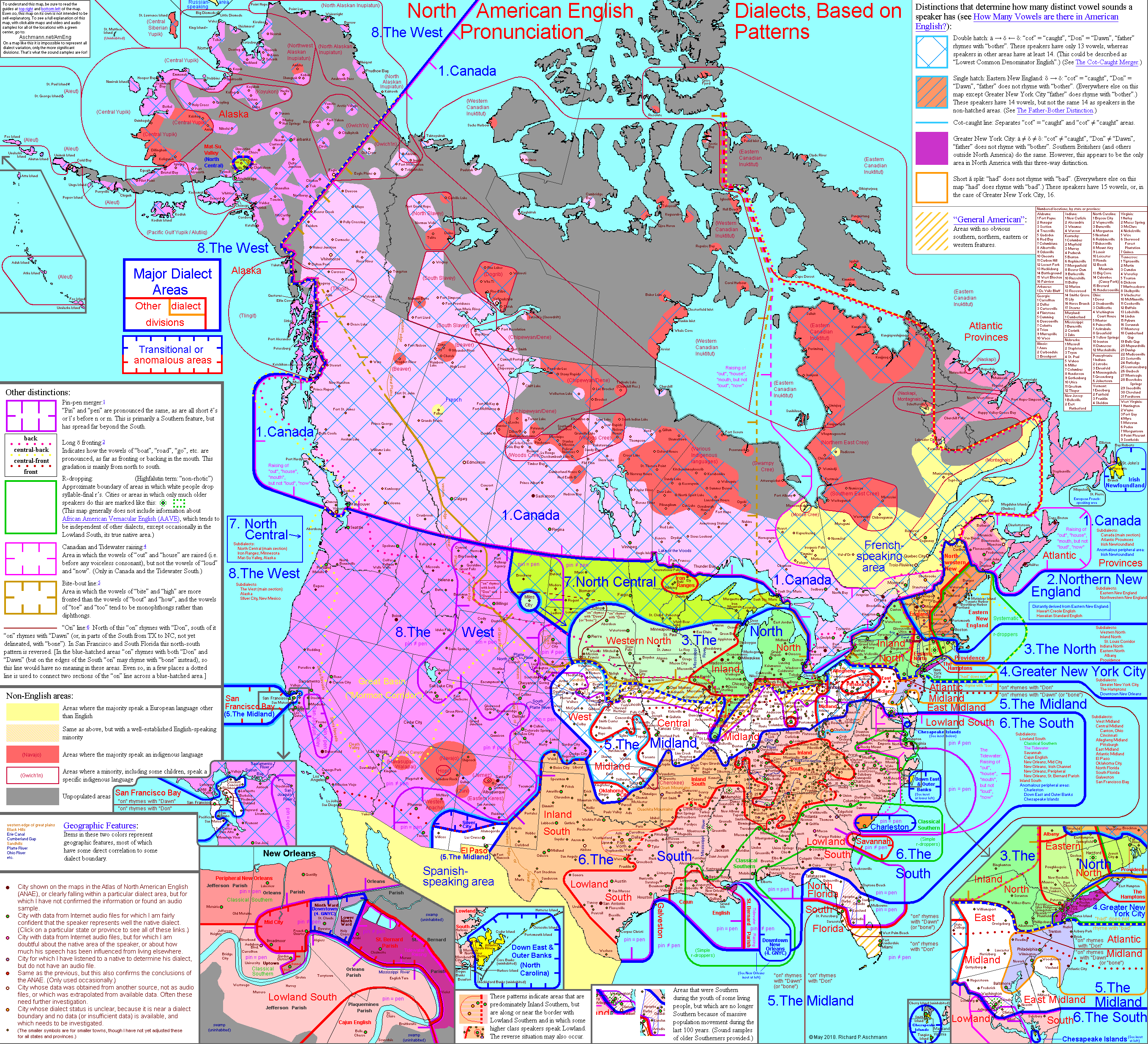
Small-Scale Dialect Map
The small map below is the same as the Full-Scale Dialect Map that follows, but shows the entire width of the map (on most monitors). 24-Aug.-2010
Click on any part of this map to move to the equivalent part of the Full-Scale Dialect Map. (For now this only moves to the far left or the far right of the Full-Scale Dialect Map, so unfortunately it doesn’t work well for the middle portions, and you will just have to scroll over.) 24-Aug.-2010

Full-Scale Dialect Map
Instructions
For many of the cities or towns on this map, you can listen to an audio or video sample of speech of a native (more specifically, someone who was raised there, though not necessarily born there, and whose dialect clearly represents that place). All of the cities or towns with a green center have such an audio or video sample that can be listened to (and a few of the ones with pink centers do also). I will continue adding new audio and video samples, so check back from time to time. So far there are over 900 samples listed, more and more of which are from contributors! Thanks! 1-Sep.-2014
The cities and towns with a large dot are those which are larger or more important in each state or province. New! 13-Sep.-2017
Use the scroll bars to move around on this map, or, even simpler, start at the tiny map above and click the country (U.S. or Canada) that you want to look at. This will take you to the Small-Scale Dialect Map. Click again to zoom in further on your location. (For now this only moves to the far left or the far right of the Full-Scale Dialect Map, so unfortunately it doesn’t work well for the middle portions, and you will just have to scroll over.) 24-Aug.-2010
The entire map is clickable, taking
you to the list of samples for that state or province. Only those locations
with green centers, and a few with pink centers, have a sample so far. There will be
a few areas of the oceans and the legends that are not clickable, but all of
the states and provinces now are. Place the mouse over a particular state or
province to see its name. (The map
guides, showing the meaning of all the colors, are on the top right and bottom left of the map.) 25-Sep.-2013
Help! For many places I haven’t found an audio sample yet. If you know of an audio or video sample on the Internet that features a speaker who was raised in a particular place, and whose dialect clearly represents that place, please let me know, whether that place is currently listed or not! Although many of the people in these samples are prominent people, I actually prefer ordinary local people, but anyone at all will do, as long as their pronunciation represents the local dialect. (The ones I especially need, and cannot find, are those with an orange-yellow center.) Also, if you think that one of the audio examples does not truly represent the local dialect, please let me know in the same way. (Oh, but please keep the samples clean. I have a policy of not using a sample if it uses a word you can’t say on TV in the U.S.!) I will normally list your name as the contributor, to make this more of a community project, unless you’d rather I didn’t, in which case I will use initials. However, I will not publish anyone’s e-mail address. 10-May-2011
Numbered Locations: A number
of states (17 so far) now have so many locations mapped that there was no
longer room for all the names, so I was forced to go to a numbering system for such areas, since the scale of
the map is already big enough! I put the key to the numbers off the east coast of Canada. The area with the most
numbers is much of Kentucky and Tennessee and
neighboring areas, which are about as thoroughly mapped as they possibly
can be, thanks in part to enthusiastic contributor Eli K. in 2010. That’s the
kind of help needed to really fill out this map! Adj.
2-Oct.-2017
|
|
|
|
|


Data from the Atlas of North American English (ANAE)
I am grateful to the Atlas of North American English (ANAE) by William Labov, Sharon Ash, and Charles Boberg, for a good part of the data on which this map was based. Specifically, much of the information on the map above and in the Dialect Description Chart below was obtained from ANAE chapter 11 (a draft version available on the Internet), as well as from many other chapters of the same work, with a few ideas from a much older version of the same: ling.upenn.edu/phono_atlas/home.html. (The Table of Contents of the draft version of the atlas can be seen at: www.ling.upenn.edu/phonoatlas/ANAE_ToC.pdf, but this does not link directly to the chapters. Links to each chapter are: 1, 2, 3, 4, 5, 6, 7, 8, 9, 10, 11, 12, 13, 14, 15, 16, 17, 18, 19, 20, 21, 22, 23.) 11-Nov.-2015
However, the names of a number of the dialects are my own, and I have made many adjustments to their borders (especially Inland and Lowland South, West Midland, and Allegheny Midland). Also, a lot of the data is from my own research and analysis. - Rick Aschmann
I discovered in late 2011 that much or all of the audio data upon which the atlas was based is now available on the Internet, on this website (select North American English Dialects). (Replaced bad link.) I will be adding samples from this site as I have time, marked as “ANAE info and audio”. 26-Jan.-2013
Map Notes
The following notes refer to numbers on the map, and show the corresponding section of the ANAE:
1: Pin-pen merger: See Map 9.5 in ANAE chapter 9 and www.ling.upenn.edu/phono_atlas/maps/Map3.html. This is the only feature in which I find myself in significant disagreement with the ANAE: I have found that the pin-pen merger area is much larger than they show, especially in the west.[1] (See The Pin-Pen Merger, The Kansas-Nebraska Act, and the Texas Cattle Drives below.) 6-Aug.-2011
2: Long /ō/ [oʊ] fronting: See Map 20.2 in ANAE chapter 20. 2: The boundary between central-back and central-front (the yellow dots) was used by the ANAE to define the boundary between North and Midland, but this line then extends into the West. The deep dip that it takes southwards in Utah and Nevada would seem to indicate settlement of these areas by Northerners, probably represented by the Mormon settlement. Thus this dip corresponds to a large degree to the “Mormon Corridor”. Many of these settlers were originally from the Palmyra, New York, area and from Kirtland, Ohio. Another northern contribution may have been the early northeastern organized crime influence in Las Vegas. Now I’m not saying that people in these areas sound like northeasterners: they don’t, they sound like westerners, with this one feature being dragged south because of this origin. 20-Jan.-2010
3: R-dropping: See Map 7.1 in ANAE chapter 7. R-droppers are also called non-rhotic English speakers, though I find this term rather obscure and academic, and prefer not to use it on a site like this, which is not for academics. There are two types of r-droppers, which I call Systematic R-droppers and Simple R-droppers. 11-May-2015
Systematic R-droppers are found in the northeastern U. S., in much of England, and in Australia, New Zealand, South Africa, India, much of the Caribbean, and other places. Systematic R-droppers have linking and intrusive r’s. John F. Kennedy is an excellent example of a Systematic r-dropper. In a speech he gave prior to being elected, he says “The hungry children I sawr in West Vaginia.” This quote has one intrusive r, and one dropped r, both highlighted in red. In another speech during the Cuban missile crisis he says, starting at 4:55: “...Soviet foreign minista Gromyko told me in my office that he was instructed to make it cleah once again, as he said his govament had already done, Soviet assistance to Cubar, and I quote, ...”, which again has one intrusive r, and three dropped r’s, again highlighted in red. 11-May-2015
Simple R-droppers are found in parts of the Lowland South. As a general rule, they do not have linking and intrusive r’s. All of the areas in the South marked as r-droppers on my map are Simple R-dropper areas, though New Orleans shows some tendency to retain final r’s before a vowel, though not enough to make it systematic. (It turns out that Hawai’i Creole English is also of this type.) 11-Mar.-2016
Numerous examples of both kinds of r-droppers are given in the audio samples below. This pattern is receding, so occasionally only much older speakers retain the r-dropping in a given location. These are surrounded on the map by a dotted green circle, and in the chart below will be indicated with the phrase “Older r-dropper”. 3-Apr.-2010
4: Canadian and Tidewater raising: See Map 15.5 in ANAE chapter 15, noting only the info for the /ou/ [aʊ] vowel (which he writes /aw/), not the /ī/ [aɪ] vowel (which he writes /ay/). The ANAE does not show this information on any map for the Tidewater South, so I have gleaned the info from various sources, including stray comments in ANAE. This is also found in one, and apparently only one, of the New Orleans subdialects, St. Bernard Parish, which is far away from either Canada or the Tidewater South! Why this should be the case is a mystery. Adj. 16-Sep.-2017
5: Bite-bout line: See Map 14.1 in ANAE chapter 14.
6: “On” line: See Map 14.2 in ANAE chapter 14. This is the only lexical item included in this analysis, but it seems to correlate with the phonological data, and as the ANAE points out, largely follows the North-Midland boundary. Why it turns north at its western end in the Dakotas and does some contortions is unclear. (The ANAE did not have Mitchell, SD or Ashley, ND, which are the surprises. I had earlier thought Mitchell was north of the line, but actually it is south of it.) Miles City, Montana, an outlier of Western North, is also below the line. In San Francisco the pattern seems to be reversed, with the “Don” group possibly representing a later influx of some type. 17-Dec.-2015
Dialect Description Chart
(17-Aug.-2015)
|
|
vowel of “lot” /ŏ/ [a] almost as much as vowel of “let” /ĕ/ [ɛ] |
vowel of “cot” /ŏ/ [a] more fronted than vowel of “cut” /ŭ/ [ʌ] |
vowel of “too” /ōō/ [ᵿʉ] much more fronted than vowel of “toe” /ō/ [o(ʊ)] |
Vowel of “far” /är/ [aɹ] fronted |
Vowel of “caught” /ô/ [oə] strongly raised |
“hoarse” = “horse”, “mourning” = “morning”, “four” = “for” |
Unique Features |
Chapter and map in ANAE |
|
Chapter and map in ANAE |
||||||||
|
|
yes |
Like Western North, but “cot”=“caught”. |
||||||
|
|
yes |
Subtle differences from the
rest of the North Central, particularly /ŧħ/
[ð] becomes /d/ [d]. |
||||||
|
Mat-Su Valley, Alaska * |
yes |
|
yes |
Strongly like North Central, but with some admixture from the main Alaska dialect. (See Sarah Palin.) |
||||
|
yes |
|
yes |
Vowel of “too” significantly more fronted than vowel of “toe”, “cot”=“caught”. |
|||||
|
Alaska |
yes |
|
yes |
Same as West (ANAE chapter 11 says there are significant differences, but does not make clear what they are.) |
||||
|
Silver City, NM |
yes |
|
yes |
Same as West, but “cot”≠“caught”. |
||||
|
yes |
very little |
|
yes |
Same as West, plus Canadian vowel shift, vowel of “cat” central, raising of “bite”, “bout”, Canadian raising. Adj. 2-Oct.-2017 |
||||
|
Atlantic Provinces |
mixed? |
yes |
|
yes |
Vowel of “far” fronted (but not “father”). Canadian raising only partial. Adj. 2-Oct.-2017 |
|||
|
yes |
yes |
|
yes |
Like the Atlantic Provinces, but with a strong Irish component. |
||||
|
Eastern New England (ENE) |
yes |
|
no |
“far” & “father” fronted to [a], systematic r-dropping, “cot”=“caught”, “father” [a] & “bother” [ɒə] don’t rhyme. |
||||
|
NW New England |
very little |
very little |
yes |
|
yes |
Vowel of “far” fronted (but not “father”), “cot”=“caught”. |
||
|
mixed |
mixed |
mostly |
|
almost all |
Back vowels strongly backed, defined as the “cot”≠“caught” area north of the line of yellow dots, except for the St. Louis Corridor.[2] |
|||
|
Western North |
mixed |
mixed |
mostly |
|
yes |
Least distinctive dialect of the North, some sections are “General American”. |
||
|
Inland North |
yes |
yes |
mostly |
|
almost all |
Northern Cities Shift: /ă/ in “bat” strongly raised to [eə], most short vowels shifted. |
||
|
St. Louis Corridor |
yes |
yes |
Mixed |
|
mixed |
Northern Cities Shift: /ă/ in “bat” strongly raised to [eə], most short vowels shifted, but many other vowels like Midland. |
||
|
Indiana North[3] |
no |
no |
yes |
Very similar to Western North, but separated from it geographically[4]. |
||||
|
Eastern North |
yes |
yes |
very little |
mixed |
yes |
Mostly like Western North, but some similarities to Greater New York City. |
||
|
Albany |
yes |
yes |
very little |
yes |
yes |
Many vowels like Greater New York City, but no r-dropping. |
||
|
Providence |
yes |
|
no |
/ă/ in “cat” central [a], systematic r-dropping, “cart”=“cot”, which is not seen anywhere else in the world! |
||||
|
yes |
yes |
Various unusual vowels, systematic r-dropping, “bad” [eə] & “had” [æ] don’t rhyme, and “father” [ɑə] & “bother” [a] don’t rhyme for many speakers. For more details, see New York City and Its Offspring. 11-Mar.-2016 |
||||||
|
The Hamptons |
|
yes |
A lot like Greater New York City, but more research needed! |
|||||
|
Downtown New Orleans |
|
no? |
More like Greater New York City than anything else, although “bad” & “had” probably rhyme, and “on” rhymes with “Dawn”. For more details, see New Orleans. 11-Mar.-2016 |
|||||
|
|
almost all |
In many ways is intermediate between Northern and Southern[5]. |
||||||
|
Central Midland |
|
almost all |
Least distinctive dialect in the U.S., many sections are “General American” |
|||||
|
Canton, Ohio |
|
yes |
“bat” strongly raised, “on” rhymes with “Don”, not “Dawn” |
|||||
|
|
yes |
Many vowels are pronounced like Greater New York City, “pin”≠“pen”, unlike the surrounding area[6]. |
||||||
|
West Midland * |
|
yes |
“cot”=“caught”, unlike most of Midland. |
(19) |
||||
|
Allegheny Midland[7] |
|
yes |
“cot”=“caught”, unlike most of Midland. |
|||||
|
Pittsburgh |
|
yes |
Pittsburgh vowel shift: “out” is pronounced [ˈat], with no diphthong, the way a Bostonian says “art”. |
|||||
|
Oklahoma City * [8] |
|
yes |
Like the parts of the Central Midland south of the pin-pen line. |
|||||
|
East Midland * |
yes |
yes |
Like the Central Midland, with influences from Atlantic Midland. |
|||||
|
Atlantic Midland[9] |
yes |
yes |
“bad” does not rhyme with “had”, like Greater New York City, but otherwise like East Midland. |
|||||
|
North Florida |
|
yes |
Like Central Midland, “pin”=“pen”. |
|||||
|
South Florida |
|
yes |
Like Central Midland, “pin”≠“pen”. |
|||||
|
El Paso |
|
yes |
“cot”≠“caught” like Central Midland, “pin”=“pen”. |
|||||
|
Galveston * |
|
yes |
Very similar to East Midland, or even to Atlantic Midland, except that “bad” rhymes with “had” |
|||||
|
yes |
yes |
Very similar to East Midland, or even to Atlantic Midland, except that “bad” rhymes with “had” |
(11) |
|||||
|
|
mixed |
Partial to full Southern shift: vowels of “ride” and “buy” have no diphthong: long /ī/ is [a]. In almost entire area “pin”=“pen”, except as noted below or on map. |
||||||
|
Lowland South |
|
mixed |
Partial Southern shift: long /ī/ vowels of “ride” and “buy” have [a], with no diphthong, but “right” is [aɪ]. |
|||||
|
|
mixed |
Outlined in dark green rather than red, a catch-all for all R-dropping dialects in the South, includes or cuts across some of the dialects below. |
||||||
|
|
mixed |
Outlined in pink rather than red, a catch-all for those parts of the coastal southeast that have the Tidewater raising, as explained on the map. It actually includes two areas that lack the Southern shift, Down East & Outer Banks, and Charleston. Adj. 2-Oct.-2017 |
||||||
|
Savannah |
|
yes |
R-dropping, “pin”≠“pen”. |
|||||
|
|
yes |
East is R-dropping, west apparently not, “pin”=“pen”, French influence, th > t,d. |
||||||
|
New Orleans, Mid City |
|
yes |
See the New Orleans inset on the map and the New Orleans section below. Adj. 14-Sep.-2017 |
|||||
|
New Orleans, Irish Channel |
|
yes |
See the New Orleans inset on the map and the New Orleans section below. Adj. 13-Sep.-2017 |
|||||
|
New Orleans, St. Bernard Parish |
|
yes |
See the New Orleans inset on the map and the New Orleans section below. Adj. 14-Sep.-2017 |
|||||
|
New Orleans, Peripheral |
|
yes |
See the New Orleans inset on the map and the New Orleans section below. Adj. 14-Sep.-2017 |
|||||
|
Inland South |
|
almost all |
Full Southern shift: vowels of “ride”, “buy”, and “right” all have [a], with no diphthong. |
|||||
|
Anomalous peripheral areas in the southeast that resisted the Southern shift: |
|
|||||||
|
Charleston |
|
yes |
No Southern shift, R-dropping, vowels of “bait” and “boat” are not diphthongs, but simple [e] and [o]. |
|||||
|
Down East & Outer Banks * |
|
|
|
|
|
yes |
No Southern shift, long /ī/ [ɒɪ] vowel often almost like /oi/ [ɔɪ], “pin”=“pen”[11]. |
|
|
Chesapeake Islands * |
|
|
|
|
|
yes |
No Southern shift, long /ī/ [ɒɪ] vowel less like /oi/ [ɔɪ] than Down East & Outer Banks, “pin”≠“pen”. |
|
* Those dialects marked with an asterisk are not in the Atlas of North American English (ANAE).
|
Colors: |
|
|
Transitional areas within
main dialects |
Distinctive or innovative features of a given dialect |
|
Transitional areas
outside main dialects |
Intermediate or partial features |
Other Sources
I have added and adjusted a lot of the information on the
map based on the following audio and non-audio data. - Rick Aschmann
Regional non-audio data
|
Location |
Source |
|
English, French, and indigenous mother-tongue areas of
Canada |
atlas.nrcan.gc.ca/site/english/maps/population.html#language 25-Sep.-2013 |
|
French mother-tongue areas of Maine |
|
|
Indigenous languages |
ethnologue.com/region/NAM 9-Sep.-2013 |
|
the eastern boundary of Inland North |
|
|
Greater New York City |
|
|
Eastern boundary between Eastern New England and Providence |
ling.upenn.edu/~johnson4/pwpl_draft.pdf 30-Mar.-2010 |
Multiple-region audio samples found on the Internet
|
Location |
Source |
Comment |
|
Samples from almost all U. S. states and a few from
Canada |
International
Dialects of English Archive (IDEA) (or new clickable map: www.dialectsarchive.com/globalmap) |
This site has been completely redone, perhaps in 2013, and is vastly improved, since it now provides a lot more information about the speakers, including place of birth and sometimes a list of places where they have lived, plus a lot of other information! However, I still find that many of the samples do not represent well the bedrock pronunciation of the area, but instead represent those who have tried to sound less “local”. Also, locations are often limited (though I see that more have been added recently), and often only urban locations are given. Even so, in many cases the data is useful, and I have used it in the sound samples below, especially when clearer indications are given of “nativeness”, and now that more information has been provided, I will probably add more. If anyone finds any of these that I have left out and shouldn’t have, please let me know! (Because
this site changed its entire structure, none of the old links worked anymore,
and I have redone them all. The original site was web.ku.edu/~idea or web.ku.edu/~idea.) 8-Nov.-2013 |
|
Samples only from north-central U. S. |
Again, it is not always clear if the speakers are natives
of the area in which they were interviewed, or if they represent well the
local dialect. However, it includes rural speakers, which can help fill in
holes. Used occasionally. If anyone finds any of these that I have left out
and shouldn’t have, please let me know! 11-Mar.-2016 |
Guide to the Sounds of North American English
In many places on this web page the pronunciation of a name or other word will be given after it. These pronunciation guides will have two forms: a phonemic guide between slashes / /, based on the Traditional Dictionary Pronunciation System (TDPS) that is found in many dictionaries, especially American ones[12], and a phonetic guide (providing the phonetic details) between square brackets [ ], based on the International Phonetic Alphabet (IPA). (Thanks, Maria Mikkonen![13]) 26-Aug.-2013
The advantage of the phonemic guide is that it allows different dialects to use the same pronunciation key and get the right result for each dialect. For this guide I have mostly followed the TDPS system used in the American Heritage Dictionary[14], rather than the one used by Merriam-Webster or others, since it is more complete and applies to more dialects. 31-Aug.-2015
However, I have included the phonetic guide as well, partly to give a more precise phonetic pronunciation of local variants, and partly because many have complained that they prefer the IPA or are familiar only with it. (This guide includes allophonic variation such as aspiration on voiceless consonants, which is conditioned by stress and word position. However, it would be impractical to represent all the fine detail, such as the rounding that many English consonants have, or the differences between “clear l” [l] and “dark l” [ɫ].) 18-July-2013
In the phonemic guide I have followed the American Heritage Dictionary system (a more complete analysis can be found on this Wikipedia page) to the letter, except for a few minor adjustments in the vowel system[15] and one in the consonant system (/ŧħ/ instead of /th/), and the following differences: 11-Mar.-2016
1. I write the syllable with primary stress using bold and underline, and syllables with secondary stress with just bold, rather than using an apostrophe after it like the AHD. In other words, I show the pronunciation of “underneath” as /ŭndərnēth/, whereas the AHD does it as /ŭn'dər-nēth'/. 31-Aug.-2015
2. I do not separate syllables with a hyphen except when absolutely necessary, as in “cartridge” /kärtrij/ versus “cartwright” /kärt-rīt/, or “mission” /mĭshən/ versus “mishap” /mĭs-hăp/; although technically in these two cases the underlining of the primary-stressed syllable gives enough information, even so the hyphens help to clarify.
3.
I show the pronunciation of
words like “needle” and “sudden” as /nēdəl/ and /sǔdən/, rather
than treating them as having syllabic /l/ or /n/, which they clearly have phonetically: [ˈniɾl̩, ˈsʌdn̩]. 2-Jan.-2012
The ANAE does not use either the TDPS or the IPA, but instead uses a completely different transcription
system, described in ANAE chapter 2. This system is phonemic, like
the TDPS.[16] 31-Aug.-2015
How Many Vowels are there in American English?
No, the answer is not: “Five: a, e, i, o u.” Granted, in traditional English spelling those are the vowel letters, yes, but I’m talking about our spoken language: How many significant vowel sounds are there? Well, if you consult any popular American English dictionary, and study the Pronunciation Key, there will be a long list of vowels. In the Pronunciation Key to the American Heritage Dictionary, 19 different vowel symbols are listed (not counting the ones only used in foreign words)! However, some of these are special vowels that only occur before the /r/ sound, which are “colored” by the /r/, so these can be separated out as special cases. And one of these vowels, /ə/, only occurs in weak syllables (completely unstressed syllables), never in stressed syllables, so it also can be separated out as a special case. This leaves us with 15 Ordinary Vowels that can occur in stressed syllables. Very few North American English speakers have all of these vowels: Many have 14 (lacking the /ä/ vowel), and many have only 13 (lacking both /ä/ and /ô/). Greater New York City has 16 Ordinary Stressed Vowels, the 15 in the American Heritage list plus one that is not usually listed in dictionary pronunciation guides, found in the word “bad”, which it makes sense to spell /â/, since in this dialect it is the same as the r-colored vowel that occurs before /r/ in words like “bearing”! This vowel also occurs in the Atlantic Midland dialect. (I had initially spelled this vowel as /ăə/, but there is no need to use additional symbols when this is not necessary.) 31-Aug.-2015
These 16 vowels are listed below in the second column, with sample words shown in the first column. Those with a breve ˘ over them, /ă,ĕ,ĭ,ŏ,ŭ,ŏŏ/, are those vowels that historically were short vowels in English (and still are in British English), while those with a macron ˉ over them, /ā,ē,ī,ō,ōō/, are those vowels that historically were long vowels in English (and still are in British English). In American English these vowels are no longer phonetically long or short, though the “short” ones tend to be phonetically lax, and the “long” ones tense. As a general rule the short/lax ones do not occur at the end of a word or syllable, only before a consonant; this rule has no exceptions in British English, though it does seem to have a few in American English. (The remaining Ordinary Stressed Vowels /ä/, /â/ (in Greater New York City and Atlantic Midland), /ô/, /oi/, and /ou/ fit in more with the long/tense group in terms of their pronunciation, history, and distribution.) (See also the section How I Use the IPA (and how I don’t) for more discussion about this.) 10-Nov.-2015
The remaining columns show what happens to vowels before final r, showing the “R-colored” vowels used in most of North America, and showing the Southern System in the final column, representing the system used in much of the South, which does not have “R-colored” vowels.
(I have included the IPA equivalents of these vowels in brackets [ ] as well. However, keep in mind that the actual pronunciation of a given phonemic vowel may vary greatly from region to region. For example, the /ŏ/ vowel is pronounced as [a], an open front unrounded vowel, in much of the Inland North, but is pronounced as [ɔ], an open-mid back rounded vowel, in England. A whole gamut of vowel sounds in between these two occurs somewhere in North America: in much of Canada and in some other “cot”=“caught” areas the pronunciation is [ɒ], whereas most others use [ɑ] or [a] or something in between. Many other vowels have similar variants. The most distinctive Southern pronunciation is shown in a separate column. However, keep in mind that I have not listed all possible variants for any region.) 3-July-2010
If anyone finds that any of the symbols in the chart do not display properly on their web browsers, please let me know. Most of them are standard Unicode characters.
On Android phones and tablets: up until Android version 4.3 in 2013, in the standard Android browser and in Chrome the symbols /ȯ/, one of the R-colored vowels below, and uppercase /Ə/, used in the phonemic respelling section, did not display correctly. And up until version 5 they still hadn’t fixed a few of the IPA characters, like [ᵿ], which I use to show the Southern pronunciation of the vowel in “boot”, nor had they fixed other font problems, like for Ancient Greek, leaving me frustrated with my Android phone for a long time! However, now in version 5 they finally seem to have fixed all of these issues. However, if you have an older version of Android the solution is simple: just use the Firefox browser, which displays these characters properly in spite of Android. 31-Aug.-2015
|
Ordinary Stressed Vowels |
|
“R-colored” Stressed Vowels |
||||||||||
|
Final Wells (sample words) |
phonemic |
IPA |
|
|
IPA South †† |
|
keepers |
droppers |
Southern System |
|||
|
beat bee fleece feel |
ē |
[i] |
|
|
[ɪi] |
|
fear, pier, |
îr |
[ɪɹ] |
[ɪə] |
intermediate |
/ēər/ [ɪiə(ɹ)], rhymes with “skier” |
|
bit kit fill |
ĭ |
[ɪ] |
|
|
[iə] |
|
||||||
|
1 |
|
|
|
|
|
|
|
|
|
|
|
|
|
bait bay face fail |
ā |
[eɪ/e] |
|
|
[ɛɪ] |
|
fair, bear, |
âr |
[eɹ] |
[eə] (British [ɛə]) |
For most speakers |
/ăr/ [æɹ/æə]: “hairy”=“Harry” /hărĭ/ [ˈhæɹɪ] which rhyme with “marry” /mărĭ/ [ˈmæɹɪ], but “merry” /mĕrĭ/ [ˈmeɹɪ] and “Mary” /mārĭ/ [ˈmɛɪɹɪ] are different. |
|
bet dress fell |
ĕ |
[ɛ] |
|
|
[e] |
|
||||||
|
bat trap had |
ă |
[æ] |
┐ |
|
[æ(ɪə)] |
|
||||||
|
bad man |
â |
[eə] |
┘ |
(GNYC, Atlantic Midland) |
|
|
||||||
|
1 |
|
|
|
|
|
|
|
|
|
|
|
|
|
ah palm father Bach’s |
ä |
[a/ɑə] |
┐ |
(E. New England [a], GNYC [ɑə]) |
|
|
far, farther, |
är |
[aɹ/ɑɹ/ɒɹ] |
[a/ɑ/ɑə] |
Nearly everyone has this![17] |
/är/ [ɑɹ/ɑə(ɹ)/ɒɹ] for many speakers, /ôr/ [ɔə(ɹ)] for others |
|
cot lot bother box |
ŏ |
[a/ɑ/ɒ/ɒəENE] |
┤ |
|
[ɑ] |
|
|
|
|
|
|
|
|
caught awe thought balks |
ô |
[ɒ/ɔ/oə/ɒəENE] |
┘ |
(Eastern U.S. See map.) |
[ɒʊ] |
|
for, horse, |
ôr
** |
[ɔɹ] |
[ɒəENE] |
See ANAE map 8.2 |
/är/ [ɑɹ/ɑə(ɹ)/ɒɹ] for many speakers, /ôr/ [ɔə(ɹ)] for others |
|
1 |
|
|
|
|
|
|
|
|
|
|
|
|
|
boat toe goat foal |
ō |
[o(ʊ)] |
|
|
[əʊ] |
|
four, hoarse, |
ȯr
** |
[oɹ] |
[oə] |
For most speakers, |
/ôər/ [ɒʊə(ɹ)], rhymes with “rawer” /ȯr/ [oə(ɹ)] in much of New Orleans |
|
1 |
|
|
|
|
|
|
|
|
|
|
|
|
|
cut strut rush, love, rough |
ŭ |
[ʌ] |
|
|
[ə] |
|
fur, urge, nurse, |
ûr |
[ɝ] |
[ɝ/ɜ/ɜɪ] |
Varies. |
/ûr/ [ɝ] or /ŭr/ [ʌɹ] or /ŏŏy/ [ɜɪ] |
|
1 |
|
|
|
|
|
|
|
|
|
|
|
|
|
foot foot full, took, put, bush |
ŏŏ * |
[ʊ] |
|
|
[ʏ] |
|
poor, tour cure, pure |
ŏŏr (yŏŏr)
† |
[ʊɹ], etc. ([jʊɹ]) |
[ʊə], etc. ([jʊə]) |
Many lack this, |
/ōōər/ [ᵿʉə(ɹ)], “poor” often /pôər/ [ˈpʰɒʊə(ɹ)] |
|
boot true goose fool, spook |
ōō * |
[u] |
|
|
[ᵿʉ] |
|
||||||
|
(cute) cue beauty |
(yōō) † |
[ju] |
|
|
[ɪʊ] |
|
||||||
|
1 |
|
|
|
|
|
|
|
|
|
|
|
|
|
bite by price |
ī |
[aɪ/ɑɪ] |
|
|
[a/aɛ/aɪ] |
|
|
|
|
|
|
|
|
bout now mouth |
ou |
[æʊ/aʊ/ɑʊ] |
|
|
[æə] |
|
|
|
|
|
|
|
|
Hoyt boy choice noise |
oi |
[ɔɪ] |
|
|
[ɒʊɛ/ɔɛ] |
|
|
|
|
|
|
|
|
|
|
|
|
|
|
|
|
|
|
|
||
|
Vowel that Only Occurs in Weak (Completely Unstressed) Syllables |
|
“R-colored” Vowel that Only Occurs in Weak (Completely Unstressed) Syllables |
||||||||||
|
about, item, civil, gallop, circus |
ə |
[ə] |
|
|
[ə] |
|
butter, motor, solar |
ər |
[ɚ] |
[ə] |
|
Same |
|
|
|
|
|
|
|
|
|
|
|
|
||
|
Other Vowels that Can Occur in Weak (Completely Unstressed) Syllables |
|
|
||||||||||
|
permit (noun), colic, impose |
ĭ |
[ɪ] |
|
|
[ɪ] |
|
|
|
|
|
|
|
|
funny, linear |
ē (ĭ) ºº |
[i] ([ɪ]) |
|
|
[i/ɪ] |
|
|
|
|
|
|
|
|
situate, fruition, issue |
ōō º |
[u/ʊ] |
|
|
[u/ʊ/əw/ə] |
|
|
|
|
|
|
|
|
billowing, pillow, potato |
ō º |
[o/ʊ] |
|
|
[o/ʊ/əw/ə] |
|
|
|
|
|
|
|
(17-Dec.-2015)
Black: The black vowels are those which all Americans have as distinct vowels.
Red: The red vowels are those which many but not all Americans have, as distinguished from the other vowels. I decided to make /ŏ/ the default vowel of the /ä/ŏ/ô/ group for all but Eastern New England, since for those who make the distinction it is by far the most common. In other words, for those who say all three the same, only /ŏ/ will be used in the phonemic spelling. However, in Eastern New England it makes more sense to make the default vowel /ô/, because of the way it interacts with a following dropped r; e.g. “wad” and “ward” are pronounced the same in Eastern New England, but nowhere else in the world! They both come out [ˈwɒəd], which phonemically would be /wôd/ or perhaps /wô(r)d/. 17-Dec.-2015
Green: The green vowels are those which a small minority of Americans have, as distinguished from the other vowels, in particular regions or dialects.
†† The pronunciation given here shows the most distinctive Southern pronunciation, specifically those areas which have experienced both Stage 2 and Stage 3 of the Southern Shift, as shown on Map 18.6 in ANAE chapter 18. Stage 2 covers most of the South, whereas Stage 3 only covers much of Alabama and parts of neighboring states. These stages are independent of and cut across the boundary between Inland Southern and Lowland Southern. 8-July-2013
* These two
sounds are actually spelled as / /
and /
/
and / / instead of /ŏŏ/
and /ōō/ in the AHD and most other dictionary pronunciation systems, but
since there is not a practical way to display such a combination in Unicode,
I have followed the example of this web site (part of reference.com, though they do not now use the AHD
pronunciation system), and this Wikipedia page, which is one of the most complete
treatments of the system. (Technically there is a way to do // and //
in Unicode, as contributor Brian Ewins showed me[18],
but I have tried them in various browsers, and they will not display
consistently.) 11-Mar.-2016
/ instead of /ŏŏ/
and /ōō/ in the AHD and most other dictionary pronunciation systems, but
since there is not a practical way to display such a combination in Unicode,
I have followed the example of this web site (part of reference.com, though they do not now use the AHD
pronunciation system), and this Wikipedia page, which is one of the most complete
treatments of the system. (Technically there is a way to do // and //
in Unicode, as contributor Brian Ewins showed me[18],
but I have tried them in various browsers, and they will not display
consistently.) 11-Mar.-2016
** Actually, some speakers have /ôr/ instead of /ȯr/, but all speakers have one or the other! See The horse-hoarse Merger and the card-cord merger. 17-Dec.-2015
† The /yōō/ sound is not a single sound, but is simply /y/ followed by /ōō/.[19] Thus, there really is no “long /ū/” vowel. Similarly, /yŏŏr/ is simply /y/ followed by /ŏŏr/.
ºº This vowel is often pronounced as /ĭ/ [ɪ] by Southern Americans and Britishers. 8-Feb.-2013
º According to Merriam-Webster, these two vowels are actually pronounced
the same, and are more properly represented as a neutral weak diphthong /əw/. They may be right for many speakers, and
are probably right for me in many cases, but no other dictionary that I have
found agrees with them. They are probably right for most Southerners, and
possibly for most Britishers. 8-Feb.-2013
[ENE] Pronunciations marked with this are only found in Eastern New England. 17-Dec.-2015
How Many Consonants are there?
(1-Aug.-2012)
The answer to this one is a bit less complicated, but again the answer is not based on the traditional English alphabet. Most English speakers have 24. (The /hw/ [ʍ] sound, which is usually spelled “wh” in English, is really just a combination of /h/ followed by /w/, and was originally spelled this way in Old English. Most English speakers no longer have this sound, though I and many other older speakers do in many parts of North America, and in certain regions, particularly the South, nearly all speakers do.) 8-July-2013
The AHD uses /th/, in italics, for the voiced “th” sound, as in “this” (which is different from the voiceless “th” sound, as in “thin”), and for a long time I did the same on this page, but I am now using /ŧħ/ for this sound, for several reasons, one of which is that using a formatting feature like italics limits the places this writing system can be used, and anyway I would prefer to keep italics for their usual purpose. 31-Aug.-2015
Note that the letters c, q, and x are not listed. This is because they are simply different ways of spelling sounds already listed: /k/ or /s/, /kw/, and /ks/ or /gz/. I show the comparison below:
|
|
1 |
2 |
3 |
4 |
5 |
6 |
7 |
8 |
9 |
10 |
11 |
12 |
13 |
14 |
15 |
16 |
17 |
18 |
19 |
20 |
21 |
22 |
23 |
24 |
|
|
|
b |
ch |
d |
f |
g |
h |
j |
k |
l |
m |
n |
ng |
p |
r |
s |
sh |
t |
th |
ŧħ |
v |
w |
y |
z |
zh |
|
(hw) |
|
|
IPA |
b |
tʃ* |
d |
f |
ɡ |
h |
dʒ |
k* |
l |
m |
n |
ŋ |
p* |
ɹ |
s |
ʃ |
t* |
θ |
ð |
v |
w |
j |
z |
ʒ |
|
(ʍ) |
|
|
|
“church”, “nature” |
|
|
|
|
“judge” |
|
|
|
|
“sing”, “singer”, “finger” |
|
|
|
“shush”, “nation” |
|
“thin”, “bath” |
“this”, “bathe” |
|
|
|
|
“pleasure”, “vision”, “genre”, “rouge” |
|
(“which”, “whale”) |
*These often have an aspirated allophone, e.g. [kʰ], which I have represented in the phonetic guide for many names, though not in the phonemic guide.
(31-Aug.-2015)
The Stress Pattern of English,
and How it Messes with the Pronunciation
(8-Feb.-2013)
American English (and most other varieties of English) has three levels of stress on each syllable of a word, primary stress, secondary stress, or no stress. Only one syllable in the word can have primary stress, and this is the syllable that is pronounced with the greatest intensity or loudness. The other syllables can have either secondary stress or no stress. An example is the word “counterrevolutionary”, pronounced /kountərrĕvəlōōshənârē/ [ˌkʰaʊɾ̃ɚˌɹɛvəˈluʃəˌneɹi]. This word has 8 syllables, divided with hyphens as /koun-tər-rĕv-ə-lōō-shə-nâr-ē/ [ˌkʰaʊ-ɾ̃ɚ-ˌɹɛv-ə-ˈlu-ʃə-ˌneɹ-i]. It has one syllable with primary stress, /lōō/ [ˈlu], marked with bold and underline in the dictionary spelling and with [ˈ] before it in the IPA. It has three syllables with secondary stress, syllables 1, 3, and 7, marked with bold in the dictionary spelling and with [ˌ] before them in the IPA, and four with no stress, syllables 2, 4, 6, and 8. As is true with many words in English, especially long ones, every other syllable is weak (unstressed). 10-Aug.-2013
In stressed syllables (whether primary or secondary) all of the Stressed Vowels in the chart above can occur, but in completely unstressed syllables (weak syllables) in English a phenomenon called vowel weakening or neutralization occurs. As a result, most of the vowels in these syllables are weakened or neutralized to the vowel /ə/, and the rest of the vowels are weakened or neutralized to a very small group, listed under “Other Vowels that Can Occur in Weak (Completely Unstressed) Syllables” above. This vowel weakening is a characteristic of English in particular (though it does occur in other languages as well), but it does not occur at all in some languages, like Spanish, which makes it especially hard for English speakers to speak good Spanish or vice versa, since they are each always subconsciously trying to apply their own pattern to the other language. 22-Mar.-2013
We can see this weakening process in action in many groups of words in English. For example, “melody”, “melodious”, and “melodic” are spelled as if they should have the same vowel sounds, but in fact they do not, being /mĕlədē/ [ˈmɛlədi], /məlōdēəs/ [məˈloʊdiəs], and /məlŏdĭk/ [məˈlɑdɪk]. The vowel in the second syllable has three pronunciations, two stressed and one unstressed (weak), and the vowel in the first syllable has two. Spanish has equivalents of these three words, “melodía, melodioso, melódico”, but unlike English, the vowels are pronounced exactly as they are spelled in IPA, with no changes at all in the vowel quality, even though the stress falls on a different syllable in each word. 22-Mar.-2013
So, just to see if you’ve got the idea, take the word “supercalifragilisticexpialidocious”, invented for the Walt Disney movie Mary Poppins. How many syllables does it have? Which syllables are completely unstressed (weak)? Which syllable has the primary stress? The answers can be found in the endnote.[20] 22-Mar.-2013
R-coloring
(8-July-2013)
In the vowel section above, we saw that there are a limited number of vowel sounds that can come before /r/ at the end of a word, or when the /r/ comes before another consonant, and that these are usually “colored” by the /r/, that is, they are changed so that they don’t really match any of the ordinary vowels. (These vowels are also known as “r-controlled vowels”.[21]) Some speakers have as few as 5 of these r-colored vowels in stressed syllables, others have 6 or 7, and this variation is found in both North America and Great Britain. 11-Mar.-2016
What about words like “hire” or “sour”? Aren’t these additional vowels that can come before /r/? At first glance it might seem so, but in fact, in most if not all English dialects, these words actually rhyme with words like “higher” and “power”, meaning that they are actually two-syllable words pronounced /hīər/ [ˈhaɪɚ] and /souər/ [ˈsaʊɚ], so no new vowel before /r/ occurs.
For r-droppers the /r/ itself is usually dropped, but the vowel still remains unique, in most cases different from the ordinary vowels.
Vowels Before /r/ in One-syllable Words[22]
|
r-colored vowels → |
îr |
âr |
är |
ôr |
ȯr |
|
ûr |
|
ŏŏr |
(yŏŏr) |
|
word final: |
fear jeer beard fierce |
fair mare there their |
far card barn heart |
for war cord horse |
four bore cored hoarse |
her were heard fern |
fir bird first dirt |
fur curd burn purse |
poor tour boor lure |
(cure) (pure) (demure) |
|
Scottish
pronunciation, not r-colored → |
ēr |
ār |
ăr |
ôr |
ōr |
ĕr |
ĭr |
ŭr |
ōōr |
(yōōr) |
|
(original system) |
[iɾ] |
[eɾ] |
[aɾ] |
[ɔɾ] |
[oɾ] |
[ɛɾ] |
[ɪɾ] |
[ʌɾ] |
[ʉɾ] |
[jʉɾ] |
(11-Mar.-2016)
Originally these r’s were not colored, but were just like all the other vowels, and at least one dialect retains this old system, Scottish English, which does not color these vowels at all, pronouncing them instead very much the way they are spelled. This system can be seen at the bottom of the table above. 11-Mar.-2016
Thus in Scotland “bird” has a vowel close to that of “beard” for many Americans, whereas “beard” has the same vowel as “beet”! (I have shown all of the /r/s in the Scottish pronunciation in the preceding chart as [ɾ], an alveolar flap, though the [ɹ] used in North America is also common in Scotland.) 11-Mar.-2016
The following chart shows how this system works in a selection of dialects, both in and outside of North America. Those items in dark red have a one-syllable r-colored vowel. Those items in orange have a two-syllable r-colored vowel sequence (these do not actually add any new distinct vowels to the system). Those items in blue are not r-colored in the indicated dialect, but are r-colored by many Americans. In each column the number and nature of the one-syllable r-colored vowels is given at the top of the column. As always on this page, if you know for sure that I have the pronunciation of one of these words wrong, please let me know. 11-Mar.-2016
|
|
Standard British: 6 r-colored vowels: /îr,âr,är,ôr,ûr,ŏŏr/ (Older and regional has 7, like Eastern New England.†) |
Greater New York City: 6 r-colored vowels: /îr,âr,är,ôr,ûr,ŏŏr/ |
Eastern New England: 7 r-colored vowels: /îr,âr,är,ôr,ȯr,ûr,ŏŏr/[23] |
Scottish: No r‑colored vowels |
Older Southern:[24] No distinct one‑syllable r‑colored vowels except sometimes /ûr/ |
New Orleans |
My pattern, General American: 6 r-colored vowels: /îr,âr,är,ôr,ûr,ŏŏr/[25] |
My wife, West Midland: 5 r-colored vowels: /îr,âr,är,ôr,ûr/
[25] |
|
|
fear, jeer, beard, fierce |
/fîr/ [ˈfɪə][26] |
/fîr/ [ˈfɪə] [26] |
/fîr/ [ˈfɪə] [26] |
/fēr/ [ˈfiɾ] |
/fēə(r)/
[ˈfɪiə(ɹ)] |
/fîr/ [ˈfɪə] [26] |
/fîrər/ [ˈfɪɹɚ] |
/fîrər/ [ˈfɪɹɚ] |
|
|
fair, mare, there, their |
/fâr/ [ˈfɛə] |
/fâr/ [ˈfeə] |
/fâr/ [ˈfeə] |
/fār/ [ˈfeɾ] |
/făr/ [ˈfæɪ]
or [ˈfæə] |
/fâr/ [ˈfeə] |
/fâr/ [ˈfeɹ] |
/fâr/ [ˈfeɹ] |
|
|
far, card, barn, heart |
/fär/ [ˈfɑː] |
/fär/ [ˈfɑə] |
/fär/ [ˈfa] |
/făr/ [ˈfaɾ] |
/fôr/ [ˈfɒɹ]†
or /fô/ [ˈfɒʊ]† |
/fôr/ [ˈfɔə]† |
/fär/ [ˈfɑɹ] |
/fär/ [ˈfɑɹ] |
|
|
for, war, cord, horse |
/fôr/ [ˈfoː] |
/fôr/ [ˈfoə] |
/fôr/ [ˈfɒə] |
/fôr/ [ˈfɔɾ] |
/fôr/ [ˈfɒɹ]†
or /fô/ [ˈfɒʊ]† |
/fôr/ [ˈfɔə]† |
/fȯr/ [ˈfoɹ] |
/fȯr/ [ˈfoɹ] |
|
|
four, bore, cored, hoarse |
/fôr/ [ˈfoː] |
(or
/fȯr/ [ˈfoə]†) |
/fôr/ [ˈfoə] |
/fȯr/ [ˈfoə] |
/fōr/ [ˈfoɾ] |
/fôə/ [ˈfɒʊə(ɹ)]† |
/fȯr/ [ˈfoə]† |
/fȯr/ [ˈfoɹ] |
/fȯr/ [ˈfoɹ] |
|
her, were, heard, fern |
/hûr/ [ˈhɜː] |
/hûr/ [ˈhɝ] |
/hûr/ [ˈhɝ] |
/hĕr/ [ˈhɛɾ] |
/hŭr/ [ˈhʌɹ] or /hûr/ [ˈhɝ] |
/hûr/ [ˈhɝ] |
/hûr/ [ˈhɝ] |
/hûr/ [ˈhɝ] |
|
|
fir, bird, first, dirt |
/fûr/ [ˈfɜː] |
/fûr/ [ˈfɝ] |
/fûr/ [ˈfɝ] |
/fĭr/ [ˈfɪɾ] |
/fŭr/ [ˈfʌɹ] or /fûr/ [ˈfɝ] |
/fûr/ [ˈfɝ] |
/fûr/ [ˈfɝ] |
/fûr/ [ˈfɝ] |
|
|
fur, curd, burn, purse |
/fûr/ [ˈfɜː] |
/fûr/ [ˈfɝ] |
/fûr/ [ˈfɝ] |
/fŭr/ [ˈfʌɾ] |
/fŭr/ [ˈfʌɹ] or /fûr/ [ˈfɝ] |
/fûr/ [ˈfɝ] |
/fûr/ [ˈfɝ] |
/fûr/ [ˈfɝ] |
|
|
poor |
/pŏŏr/ [ˈpʰʊə] |
/pŏŏr/ [ˈpʰʊə] |
/pŏŏr/ [ˈpʰʊə] |
/pōōr/ [ˈpʰʉɾ] |
/pôə(r)/ [ˈpʰɒʊə(ɹ)] |
/pŏŏr/ [ˈpʰʊə]?? |
/pŏŏr/ [ˈpʰʊɹ] |
/pȯr/ [ˈpʰoɹ] |
|
|
tour, lure |
/tŏŏr/ [ˈtʰʊə] |
/tŏŏr/ [ˈtʰʊə] |
/tŏŏr/ [ˈtʰʊə] |
/tōōr/ [ˈtʰʉɾ] |
/tōōə(r)/ [ˈtʰᵿʉə(ɹ)] |
/tŏŏr/ [ˈtʰʊə] |
/tŏŏr/ [ˈtʰʊɹ] |
/tōōər/ [ˈtʰuɚ] |
|
|
(cure), (pure), (demure) |
/kyŏŏr/
[ˈkʰjʊə] |
/kyŏŏr/
[ˈkʰjʊə] |
/kyŏŏr/
[ˈkʰjʊə] |
/kyōōr/ [ˈkʰyʉɾ] |
/kyōōə(r)/ [ˈkʰjᵿʉə(ɹ)] |
/kyŏŏr/
[ˈkʰjʊə] |
/kyŏŏr/
[ˈkʰjʊɹ] |
/kyōōər/ [ˈkʰjuɚ] |
|
|
fire, tire |
/fīər/ [ˈfaɪə] |
/fīər/ [ˈfɑɪə] |
/fīər/ [ˈfaɪə] |
/fīr/ [ˈfʌɪɾ]?? |
/fīr/ [ˈfaɹ]
or /fīər/ [ˈfaɪə] |
/fīər/ [ˈfaɪə] |
/fīər/ [ˈfaɪɚ] |
/fīər/ [ˈfaɪɚ] |
|
|
sour, hour |
/souər/ [ˈsaʊə] |
/souər/ [ˈsaʊə] |
/souər/ [ˈsaʊə] |
/sour/
[ˈsʌʊɾ] |
/souər/ [ˈsæʊə(ɹ)] |
/souər/ [ˈsæʊə] |
/souər/ [ˈsæʊɚ] |
/souər/ [ˈsæʊɚ] |
|
(11-Mar.-2016)
† See The horse-hoarse Merger and the card-cord Merger. 11-Mar.-2016
R’s
Between Vowels: To Color or Not to Color
(8-July-2013)
Okay, but what about r’s in the middle of words, with a vowel on both sides? Are the vowels before the /r/ still limited to these few r-colored vowels in the dialects that color their r’s? Well, no, certainly not, we can have words like “rerun”, “payroll”, and “prorate”. In other words, vowels that commonly occur at the end of a word, especially the historically long vowels, can freely occur before an /r/ in the middle of a word, when there is a clear syllable break before the r. 17-Dec.-2015
But what about the historically short vowels like /ă,ĕ,ĭ,ŏ,ŭ/? Surprisingly, these do occur in many dialects, especially in Britain but also in parts of eastern North America, but most Americans replace them with the r-colored vowels. Thus, the word “marry” is pronounced /mărē/ [ˈmæɹi] by Britishers and by many speakers in the Eastern U.S., From Maine to the South (and apparently also in Montreal), and most of these speakers would pronounce the words “marry”, “merry”, and “Mary” with three different vowels, but most Americans pronounce all three of these exactly the same, as /mârē/ [ˈmeɹi]. This feature of allowing /ă,ĕ,ĭ,ŏ,ŭ/ to occur before /r/ in the middle of a word (but not at the end) is one of the features that makes speakers from the east coast sound different from other Americans, even in the case of radio and television personalities who have otherwise modified their speech to General American. So how many vowels can come before an r followed by another vowel? It varies hugely from one dialect to the next! 17-Dec.-2015
The following chart shows a lot of these variations, though there are certainly others. Those items in black are not r-colored in any dialect. Those items in dark red have a one-syllable r-colored vowel. Those items in orange have a two-syllable r-colored vowel sequence (these do not actually add any new distinct vowels to the system). Those items in blue are not r-colored in the indicated dialect, but are r-colored by many Americans. In each column the number and nature of the one-syllable r-colored vowels is given at the top of the column. This does not count “tiring”, in which the r-coloring is two syllables, not one. As always on this page, if you know for sure that I have the pronunciation of one of these words wrong, please let me know. 21-Aug.-2013
|
|
Standard British: 6 r-colored vowels: /îr,âr,är,ôr,ûr,ŏŏr/ (Older and regional has 7, like Eastern New England.†) |
Greater New York City: 6 r-colored vowels: /îr,âr,är,ôr,ûr,ŏŏr/ |
Eastern New England: 7 r-colored vowels: /îr,âr,är,ôr,ȯr,ûr,ŏŏr/
[23] |
Scottish: No r‑colored vowels |
|
Older Southern: [24] No distinct one‑syllable r‑colored vowels except sometimes /ûr/ |
|
My pattern, General American: 6 r-colored vowels: /îr,âr,är,ôr,ûr,ŏŏr/
[25] |
My wife, West Midland: 5 r-colored vowels: /îr,âr,är,ôr,ûr/
[25] |
|
|
Rerun |
/rērŭn/
[ˈɹiːˌɹʌn] |
/rērŭn/
[ˈɹiˌɹʌn] |
/rērŭn/
[ˈɹiˌɹʌn] |
/rērŭn/
[ˈɾiˌɾʌn] |
|
/rērŭn/
[ˈɹɪiˌɹʌn] |
|
/rērŭn/
[ˈɹiˌɹʌn] |
/rērŭn/
[ˈɹiˌɹʌn] |
|
|
hero, zero, Nero |
/hîrō/ [ˈhɪəɹəʊ] |
/hîrō/ [ˈhɪəɹoʊ] |
/hîrō/ [ˈhɪəɹoʊ] |
/hērō/ [ˈhiˌɾo] |
|
/hērō/ [ˈhɪiˌɹəʊ] |
|
/hîrō/ [ˈhɪɹoʊ] |
/hērō/ [ˈhiɹoʊ] |
|
|
hearer, weary, nearing |
/hîrə/ [ˈhɪəɹə] |
/hîrə/ [ˈhɪəɹə] |
/hîrə/ [ˈhɪəɹə] |
/hērər/ [ˈhiɾəɾ] |
|
/hērə(r)/ [ˈhɪiɹə(ɹ)] |
|
/hîrər/ [ˈhɪɹɚ] |
/hîrər/ [ˈhɪɹɚ] |
|
|
mirror, miracle, pirouette |
/mĭrə/ [ˈmɪɹə] |
/mĭrə/ [ˈmɪɹə] |
/mĭrə/ [ˈmɪɹə] |
/mĭrər/ [ˈmɪɾəɾ] |
|
/mĭrə/ [ˈmiəɹə] |
|
/mîrər/ [ˈmɪɹɚ] |
/mîrər/ [ˈmɪɹɚ] |
|
|
|
|
|
|
|
|
|
|
|
|
|
|
payroll |
/pārōl/
[ˈpʰeɪˌɹəʊl] |
/pārōl/
[ˈpʰeɪˌɹoʊl] |
/pārōl/
[ˈpʰeɪˌɹoʊl] |
/pārōl/
[ˈpʰeˌɾol] |
|
/pārōl/
[ˈpʰɛɪˌɹəʊl] |
|
/pārōl/
[ˈpʰeɪˌɹoʊl] |
/pārōl/
[ˈpʰeɪˌɹoʊl] |
|
|
Mary, vary, Sarah, pharaoh |
/mârĭ/ [ˈmɛəɹɪ] |
/mârē/ [ˈmeəɹi] |
/mârē/ [ˈmeəɹi] |
/mārĭ/ [ˈmeɾɪ] |
|
/mārĭ/ [ˈmɛɪɹɪ] |
|
/mârē/ [ˈmeɹi] |
/mârē/ [ˈmeɹi] |
|
|
scary, hairy, parent, caring |
/skârĭ/ [ˈskɛəɹɪ] |
/skârē/ [ˈskeəɹi] |
/skârē/ [ˈskeəɹi] |
/skārĭ/ [ˈskeɾɪ] |
|
/skărĭ/ [ˈskæɹɪ] |
|
/skârē/ [ˈskeɹi] |
/skârē/ [ˈskeɹi] |
|
|
merry, very, heritage |
/mĕrĭ/ [ˈmeɹɪ] |
/mĕrē/ [ˈmɛɹi] |
/mĕrē/ [ˈmɛɹi] |
/mĕrĭ/ [ˈmɛɾɪ] |
|
/mĕrĭ/ [ˈmeɹɪ] |
|
/mârē/ [ˈmeɹi] |
/mârē/ [ˈmeɹi] |
|
|
marry, Harry, narrow, parish |
/mărĭ/ [ˈmæɹɪ] |
/mărē/ [ˈmæɹi] |
/mărē/ [ˈmæɹi] |
/mărĭ/ [ˈmaɾɪ] |
|
/mărĭ/ [ˈmæɹɪ] |
|
/mârē/ [ˈmeɹi] |
/mârē/ [ˈmeɹi] |
|
|
|
|
|
|
|
|
|
|
|
|
|
|
starry, sparring |
/stärĭ/ [ˈstɑːɹɪ] |
/stärē/ [ˈstɑəɹi] |
/stärē/ [ˈstaɹi] |
/stărĭ/ [ˈstaɾɪ] |
|
/stärĭ/ [ˈstɑɹɪ] |
|
/stärē/ [ˈstɑɹi] |
/stärē/ [ˈstɑɹi] |
|
|
sorry, borrow |
/sŏrĭ/ [ˈsɔɹɪ] |
/sŏrē/ [ˈsaɹi] |
/sôrē/ [ˈsɒəɹi] |
/sŏrĭ/ [ˈsɔɾɪ] |
|
/särĭ/ [ˈsɑɹɪ] |
|
/särē/ [ˈsɑɹi] |
/särē/ [ˈsɑɹi] |
|
|
foreign, coral, horrible, Florida |
/fŏrĭn/ [ˈfɔɹɪn] |
/fŏrən/ [ˈfaɹən] |
/fôrən/ [ˈfɒəɹən] |
/fŏrən/ [ˈfɔɾən] |
|
/färən/ [ˈfɑɹən] |
|
/fȯrən/
[ˈfoɹən] |
/fȯrən/
[ˈfoɹən] |
|
|
drawing, sawing[27] |
/drôrĭng/ [ˈdɹoːɹɪŋ] |
/drôrĭng/ [ˈdɹoəɹɪŋ] |
/drôrĭng/ [ˈdɹɒəɹɪŋ] |
|
|
|
|
|
|
|
|
boring, choral, story, glory |
/bôrĭng/ [ˈboːɹɪŋ] |
(or
/bȯrĭng/
[ˈboəɹɪŋ]†) |
/bôrĭng/ [ˈboəɹɪŋ] |
/bȯrĭng/
[ˈboəɹɪŋ] |
/bōrĭng/ [ˈboɾɪŋ] |
|
/bôrēng/ [ˈbɒʊɹiŋ] |
|
/bȯrĭng/
[ˈboɹɪŋ] |
/bȯrĭng/
[ˈboɹɪŋ] |
|
prorate |
/prōrāt/
[ˈpʰɹəʊˌɹeɪt] |
/prōrāt/
[ˈpʰɹoʊˌɹeɪt] |
/prōrāt/
[ˈpʰɹoʊˌɹeɪt] |
/prōrāt/
[ˈpʰɾoˌɾet] |
|
/prōrāt/
[ˈpʰɹəʊˌɹɛɪt] |
|
/prōrāt/
[ˈpʰɹoʊˌɹeɪt] |
/prōrāt/
[ˈpʰɹoʊˌɹeɪt] |
|
|
|
|
|
|
|
|
|
|
|
|
|
|
hurry, worry, courage, nourish |
/hŭrĭ/ [ˈhʌɹɪ] |
/hŭrē/ [ˈhʌɹi] |
/hŭrē/ [ˈhʌɹi] |
/hŭrĭ/ [ˈhʌɾɪ] |
|
/hŭrĭ/ [ˈhʌɹɪ] or /hûrĭ/ [ˈhɝɪ] |
|
/hûrē/ [ˈhɝi] |
/hûrē/ [ˈhɝi] |
|
|
furry, blurry, whirring |
/fûrĭ/ [ˈfɜːɹɪ] |
/fûrē/ [ˈfɝi] |
/fûrē/ [ˈfɝi] |
/fŭrĭ/ [ˈfʌɾɪ] |
|
/fŭrĭ/ [ˈfʌɹɪ] or /fûrĭ/ [ˈfɝɪ] |
|
/fûrē/ [ˈfɝi] |
/fûrē/ [ˈfɝi] |
|
|
|
|
|
|
|
|
|
|
|
|
|
|
touring, curing |
/tŏŏrĭng/ [ˈtʰʊəɹɪŋ] |
/tŏŏrĭng/ [ˈtʰʊəɹɪŋ] |
/tŏŏrĭng/ [ˈtʰʊəɹɪŋ] |
/tōōrĭng/ [ˈtʰʉɾɪŋ] |
|
/tōōrēng/ [ˈtʰᵿʉɹɪŋ] |
|
/tŏŏrĭng/ [ˈtʰʊɹɪŋ] |
/tōōərĭng/ [ˈtʰuəɹɪŋ] |
|
|
Blu-ray |
/blōōrā/
[ˈbluːˌɹeɪ] |
/blōōrā/
[ˈbluˌɹeɪ] |
/blōōrā/
[ˈbluˌɹeɪ] |
/blōōrā/
[ˈblʉˌɾe] |
|
/blōōrā/
[ˈblᵿʉˌɹɛɪ] |
|
/blōōrā/
[ˈbluˌɹeɪ] |
/blōōrā/
[ˈbluˌɹeɪ] |
|
|
eurhythmics |
/yōōrĭŧħmĭks/ [ˌjuːˈɹɪðmɪks] |
/yōōrĭŧħmĭks/ [ˌjuˈɹɪðmɪks] |
/yōōrĭŧħmĭks/ [ˌjuˈɹɪðmɪks] |
/yōōrĭŧħmĭks/ [ˌjʉˈɾɪðmɪks] |
|
/yōōrĭŧħmĭks/ [ˌjᵿʉˈɹiəðmɪks] |
|
/yōōrĭŧħmĭks/ [ˌjuˈɹɪðmɪks] |
/yōōrĭŧħmĭks/ [ˌjuˈɹɪðmɪks] |
|
|
|
|
|
|
|
|
|
|
|
|
|
|
tiring |
/tīərĭng/ [ˈtʰaɪɚɪŋ] |
/tīərĭng/ [ˈtʰɑɪɚɪŋ] |
/tīərĭng/ [ˈtʰaɪɚɪŋ] |
/tīrĭng/ [ˈtʰʌɪɾɪŋ]?? |
|
/tīrēng/ [ˈtʰaɹiŋ] |
|
/tīərĭng/ [ˈtʰaɪɚɪŋ] |
/tīərĭng/ [ˈtʰaɪɚɪŋ] |
|
|
pirate, gyrate, siren |
/pīərĭt/ [ˈpʰaɪɚɪt][28] |
/pīrət/
[ˈpʰɑɪɹət] |
/pīrət/
[ˈpʰaɪɹət] |
/pīrĭt/
[ˈpʰʌɪɾɪt] |
|
/pīrĭt/
[ˈpʰaɹɪt] |
|
/pīrət/
[ˈpʰaɪɹət] |
/pīrət/
[ˈpʰaɪɹət] |
|
|
tie-rack |
/tīrăk/
[ˈtʰaɪˌɹæk] |
/tīrăk/
[ˈtʰɑɪˌɹæk] |
/tīrăk/
[ˈtʰaɪˌɹæk] |
/tīrăk/
[ˈtʰʌɪˌɾæk] |
|
/tīrăk/
[ˈtʰaˌɹæɪk] |
|
/tīrăk/
[ˈtʰaɪˌɹæk] |
/tīrăk/
[ˈtʰaɪˌɹæk] |
|
|
cowrie |
/kourĭ/
[ˈkʰaʊɹɪ] |
/kourē/
[ˈkʰaʊɹi] |
/kourē/
[ˈkʰɑʊɹi] |
/kourĭ/
[ˈkʰʌʊɾɪ] |
|
/kourĭ/
[ˈkʰæʊɹɪ] |
|
/kourē/
[ˈkʰaʊɹi] |
/kourē/
[ˈkʰaʊɹi] |
|
|
Moira |
/moirə/
[ˈmɔɪɹə] |
/moirə/
[ˈmɔɪɹə] |
/moirə/
[ˈmɔɪɹə] |
/moirə/
[ˈmɔɪɾə] |
|
/moirə/
[ˈmɔɛɹə] |
|
/moirə/
[ˈmɔɪɹə] |
/moirə/
[ˈmɔɪɹə] |
|
(11-Mar.-2016)
† See The horse-hoarse Merger and the card-cord Merger. 11-Mar.-2016
As you can see, the first three columns have an almost identical system, differing only in a few minor details. The same is true of the last two columns. Southern and Scottish stand entirely on their own, and in fact have more similarities with each other than they have with any of the others. 17-Dec.-2015
The horse-hoarse Merger and
the card-cord Merger
(11-Mar.-2016)
|
As was seen in the R-Coloring section above, originally in English the sets of words in each row of the chart on the right were all pronounced differently, with distinct vowel sounds before the “r”. A very limited number of speakers, both in and outside of North America, still maintain this three-way distinction. However, most speakers of English, both in and outside of North America, have merged the pronunciations of the second and third columns. This is called the horse-hoarse merger. However, in quite a variety of dialects, again both in and outside of North America, this merger did not take place, and these word pairs are still distinguished. This is explained in great detail in this Wikipedia article in the horse-hoarse merger section, as well as on ANAE map 8.2 and in the information describing it. On the other hand, a small percentage of speakers, apparently only found in parts of the United States, have merged the pronunciations of the first and second columns. This is called the card-cord merger. However, in quite a variety of dialects, again both in and outside of North America, this merger did not take place, and these word pairs are still distinguished. This is explained in some detail in this Wikipedia article in the card-cord merger section, as well as in ANAE chapter 8 on pages 52 and 53, though in both cases there is no map, and the description is incomplete. 30-Sep.-2016 For most of those who still make this three-way distinction, the vowel sound used is that shown at the top of the column in each case. However, for those who have one or the other of the mergers, the situation is somewhat complicated, and North American speakers and most others fall into five groups, as shown in the chart below. |
|
|
merger |
far |
for |
four |
Diagnosis and Description |
Where |
“cot”=“caught”? |
|
horse- hoarse |
/är/ [aɹ/ɑɹ/ɒɹ] |
/ȯr/ [oɹ] |
1) You fall into this group if the second and third columns in the chart at upper right are pronounced the same, but the vowel before the r is not the same as the vowel sound in “caught” or “lawn” or “saw”. |
Most speakers in North America and England (but not Scotland or Ireland), except as specified below. |
can be same or different |
|
|
merger |
/är/ [aɹ/ɑɹ/ɒɹ] |
/ôr/ [ɔɹ] |
2) You fall into this group if the second and third columns in the chart at upper right are pronounced the same, and the vowel before the r is the same vowel sound as in “caught” or “lawn” or “saw”. |
Includes Greater New York City, Atlantic Midland, probably some surrounding areas, and perhaps parts of South. |
“cot”=“caught” |
|
|
no merger |
/är/ [aɹ/ɑɹ/ɒɹ] |
/ôr/ [ɔɹ] |
/ȯr/ [oɹ] |
3) You fall into this group if all three columns in the chart at upper right are pronounced differently. |
The only area I am certain about in North America is Eastern New England. In the British Isles it occurs in Scotland and Ireland, and formerly and perhaps currently in parts of England, though much of England is now group 1. Possibly other parts of the U.S., but see group 4. If you have the three-way distinction, and you grew up in some other parts of the U.S., I would love to know that! |
can be same or different |
|
card- cord |
/är/ [aɹ/ɑɹ/ɒɹ] |
/ȯr/ [oɹ] |
4) You fall into this group if the first and second columns in the chart at upper right are pronounced the same, but the vowel before the r is not the same as the vowel sound in “caught” or “lawn” or “saw”. |
ANAE map 8.2 only shows areas that do not have the horse-hoarse merger, but the discussion on pages 52 and 53 suggests that many of these same areas have the card-cord merger, and I know of other areas that have this merger that are not mentioned in either of my sources mentioned above. In particular, I know for a fact that the merger occurs around Birmingham, Alabama,[29] and the New Orleans samples show that it occurs there also. I suspect that it covers all of the areas on ANAE map 8.2 except New England, plus Salt Lake City. |
can be same or different |
|
|
merger |
/ôr/ [ɔə(ɹ)] |
/ȯr/ [oə(ɹ)] |
5) You fall into this group if the first and second columns in the chart at upper right are pronounced the same, and the vowel before the r is the same vowel sound as in “caught” or “lawn” or “saw”. |
Probably only in the South. Many New Orleans dialects, probably other r-dropping dialects in the South, though probably not most r-keeping dialects in the South. |
“cot”=“caught” |
|
|
both mergers? |
? |
It is very unlikely that there is sixth group in which all three columns are pronounced the same, since this would tend to reduce too many distinctions. In this Wikipedia article in the card-cord merger section this idea is stated as a fact: “Dialects with the card–cord merger don’t have the horse–hoarse merger,” though no evidence is set forth. 30-Sep.-2016 |
If you have both mergers, or know of areas that do, please let me know! |
? |
||
For some Southerners “four” may rhyme with “rawer”, in which case “four” would be /fôər/ [ˈfɒʊɚ], and they would not actually have the /ȯr/ [oɹ] vowel (however, I need to test this further, since initial testing with some Alabamians did not show this to be true).
Writing the Way We Speak
In the phonemic texts below, the dialect provided is my own, without any of the blue vowels in the table in R’s Between Vowels: To Color or Not to Color. In the phonemic texts below, any vowels that would be one of these blue vowels for one of the first two columns above (British or GNYC) is marked in dark red. 17-Dec.-2015
|
Sō kŏŏd
wē rīt ŧħə wā wē spēk, yōōzĭng
dĭkshənârē sĭmbəlz? Wē
sûrtənlē kŏŏd, ăz ī ăm dōōĭng
nou! Ĭn kənĕktəd tĕkst ŧħâr ĭz
nō nēd tōō ĭndəkāt hwĭch sĭləbəl
ĭz strĕst, sĭns ŧħĭs wĭl yōōzhəlē
bē ŏbvēəs. Ăz yōō kən sē, Ĭngglĭsh
hăz ə lŏt əv soundz, bət ĕvrē wŭn əv
ŧħəm ĭz nēdəd! |
Soh kuud wee riyt thə
way wee speek, yoozing just playn letərz? Wee surrtənlee kuud, az iy am dooing now! In kənektəd
tekst thair iz noh need too indəkayt hwich siləbəl iz strest,
sinss this wil yoozhəlee bee obveeəs. Az yoo kən see, Ingglish
haz ə lot əv sowndz, bət evree wun əv thəm iz needəd! |
|
Ĭt
wŏŏd shûr bē ēzēər tə rīt līk ŧħĭs
ĭf ŧħâr wûrnt sō mĕnē spĕshəl kârəktərz! Fȯrchənətlē
ŧħâr ĭz ə wĕbsīt ŧħət prəvīdz ə
kēbȯrd fər är pûrpəsəz, ăz yōō wĭl
sē ĭf yōō klĭk ĭn ŧħə bŏks
bəlō ănd trī tīpĭng. Ăz
ŧħə kēbȯrd chärt shōz, shȯrt voulz är prəsēdəd
bī ə *, ănd lông voulz bī ə -. Tə gĕt “ə”
yōō tīp “=e”, ănd tə gĕt “ŧħ” yōō
tīp “-t-h”. Tə pŏŏt ə ˆ ōvər ə voul, sĭmplē tīp “^” bəfȯr ĭt, ănd tə pŏŏt ə
¨ ōvər ə voul, tīp “:” bəfȯr ĭt. Ĭf
ĭt jŭst sēmz tōō kŭmbərsəm
tōō ăd ĕvrē sĭnggəl wŭn əv ŧħēz
märks, yōō kŏŏd ăkshəlē lēv ôf ŧħə
brĕv märks ( ˘ ) ŏn ŧħə shȯrt voulz,
ăz sŭm dĭkshənârēz dōō! |
(Akshəlee, thair iz wun letər thət iy am yoozing thət
izənt ə playn letər, thə letər “ə”, hwich iz ə
speshəl kairəktər, bət
thats not too haard tə kopee intə yər tekst. Thee ohnlee
thhing not in theez chaarts thət iy səjest yoo doo iz tə riyt
thə fiynəl “s” sownd az “ss” in sum kaysəz tə keep peepəl
frəm thhingking its a “z” sownd. Thair aar sevrəl igzampəlz əv
this in theez pairəgrafs.) |
|
Sŭm əv yōō mā thĭngk “Ī sûrtənlē dōnt sā sŭm əv ŧħōz wûrdz ŧħə wā hē dŭz!” Əv kȯrs yōō dōnt: ŧħâr wĭl bē lŏts əv vârēāshən, ăz ŧħĭs wĕb pāj ănd măp shō! Nō prŏbləm, yōō spĕl thĭngz ŧħə wā yōō sā ŧħəm, ănd īl spēl ŧħəm ŧħə wā ī sā ŧħəm! Ŧħē
ōnlē bĭg prŏbləm mĕnē əv
yōō wĭl ĭkspîrēəns wĭl bē ŧħē
ĭntərfîrəns əv ŧħə stăndərd spĕlĭng,
ŧħō sĭmplē lûrnĭng ôl əv ŧħə
spĕlĭngz wĭl ôlsō tāk səm tīm. |
Sum əv yoo may thhingk “Iy surrtənlee dohnt say sum əv
thohz wurrdz thə way hee duz!” Əv koarss yoo dohnt: thair
wil bee lots əv vaireeayshən, az this web payj and map shoh! Noh
probləm, yoo spel thhingz thə
way yoo say thəm, and iyl speel thəm thə way iy say thəm! Thee ohnlee big probləm menee əv yoo wil ikspihreeənss
wil bee thee intərfihrənss əv thə standərd speling,
thoh simplee lurrning awl əv thə spelingz wil awlsoh tayk səm
tiym. |
|
Ănd ĭf Ĭngglĭsh
wûr ən ŭnrĭtən lănggwĭj, līk sō mĕnē
thouzəndz əv lănggwĭjəz spōkən əround
ŧħə wûrld tədā, ŧħĕn ŧħĭs
ĭz ŧħə kīnd əv spĕlĭng sĭstəm
ŧħət wŏŏd bē nēdəd tə rīt ĭt,
wŭn ĭn whĭch ēch sound ĭz ôlwāz spĕld ŧħə
sām wā. Ŧħə rēzən Ĭngglĭsh ĭz
nŏt spĕld ĭn ə
kənsĭstənt wā ĭz bəkŭz ĭt hăz ə
lông hĭstərē, ănd hăz bärōd
ə lŏt əv wûrdz frəm ŭŧħər lănggwĭjəz,
wĭŧħout əjŭstĭng ŧħâr spĕlĭngz! |
Now pleez undərstand mee, iym not səjesting thət wee
chaynj the speling əv Ingglish. Menee hav prəpoezd this thhroo thə
yihrz, but in enee kayss it aynt gənə hapən, and wee rilee
wuudənt wont it too, sinss it wuud mayk awl thee Ingglish buuks in thə
wurrld obsəleet. But its fun tə mes ərownd with! And if Ingglish wurr ən unritən langgwij, liyk soh menee
thhowzəndz əv langgwijəz spohkən ərownd thə
wurrld təday, then this iz thə kiynd əv speling sistəm thət
wuud bee needəd tə riyt it, wun in which eech sownd iz awlwayz
speld thə saym way. Thə reezən Ingglish iz not speld in ə kənsistənt
way iz bəkuz it haz ə lawng histəree, and haz baarohd ə lot əv wurrdz frəm uthər
langgwijəz, withowt əjusting thair spelingz! |
|
|
Iym surrtənlee not thə furrst tə triy it. It turrnz
owt thət menee ətempts tə reespel Ingglish fəneemiklee
yoozing just thə twunteesiks letərz uv thə standərd alfəbet
(withh ə vairee fyoo ədishənz
liyk “ə”) hav bin triyd and yoozd, biy dikshənaireez, nooz ayjənseez,
and uthər oargənəzayshənz. Ə laarj numbər əv
theez aar listəd on this web siyt. Miy sistəm izənt
igzaktlee liyk enee əv thəm, but iz kwiyt simələr too ə
lot əv thəm, ispeshəlee tə thə koləmz laybəld
“Wikipedia²”, “MECD”, “WPRK”, “BBC”, and
“POD”. Iy yooz a few spelingz thət aarnt fownd eneehwair in thə kəmpairətiv chaart, in pərtikyələr “iy”, “oar”, “urr”, “uur”, “th”, and “thh”[30], bəkuz iy thhingk thay aar simplee eezeeər tə reed thən thee awlturrnətivz səjestəd. (Iy akshəlee kiynd əv liykt “igh” for /ī/, but in akshooəl yoosəj it looks klunkee.) |
(11-Mar.-2016)
Click in the box below and try typing,
using either of the spelling systems explained above: 1-July-2013
(Move the pop-up keyboard around if it gets in your way. You can also resize the box.) 11-Jan.-2013

|
This text entry tool (KeymanWeb) is provided by Tavultesoft (www.tavultesoft.com). You can type any of these characters or any of over 1,000 languages in any Windows application with Keyman Desktop and any web page with KeymanWeb. Visit www.tavultesoft.com/eurolatin/ for more details. |
|

Key to the Spelling Systems
21-Aug.-2013
The following chart compares the two spelling systems. As explained in How Many Vowels are there in American English?, the black vowels are ones all speakers have, many other have the red ones, and a few also have the green ones. (For more details see How Many Vowels are there in American English?.) 8-July-2013
Vowels:
|
ē |
ĭ |
ā |
ĕ |
ă |
â |
ä |
ŏ |
ô |
ō |
ŭ |
ŏŏ |
ōō |
(yōō) |
ī |
ou |
oi |
|
ə |
|
îr |
âr |
är |
ôr |
ȯr |
ûr |
ŏŏr |
(yŏŏr) |
ər |
|
|
Plain letters: |
ee |
i |
ay |
e |
a |
ae |
aa |
o* |
aw |
oh |
u |
uu |
oo |
(yoo) |
iy |
ow |
oy |
|
ə |
|
ihr |
air |
aar |
awr |
oar |
urr |
uur |
(yuur) |
ər |
|
Traditional: |
beat |
bit |
bait |
bet |
bat |
bad |
father |
cot |
caught |
boat |
cut |
foot |
boot |
(cute) |
bite |
bout |
boy |
|
item |
|
fear |
fair |
far |
for |
four |
fur |
poor |
(cure) |
sinner |
(31-Aug.-2015)
|
Dictionary symbols: |
*For those speakers who have this vowel {o} but not {aa},
in other words for those who rhyme “father” with “bother” (most North
Americans), at the end of a word this vowel must be spelled as {aa} instead of {o}. It should also be spelled {aa} before {h}.
Thus “aha” would be spelled {aahaa}
rather than {oho}, “ah” would be
spelled {aa} rather than {o}, and “la” would be spelled {laa} rather than {lo}. To be consistent we really should
spell them all as {aa} rather than {o}, but that would make for far too many
cases of {aa}, and this would really
end up looking different from our traditional spelling. Since {o} is far more common than {aa} in those dialects that have them both,
doing it this way will reduce difficulties for all concerned. 21-Aug.-2013 |
Consonants:
|
b |
ch |
d |
f |
g |
h |
j |
k |
l |
m |
n |
ng |
p |
r |
s |
sh |
t |
th |
ŧħ |
v |
w |
y |
z |
zh |
|
(hw) |
|
|
Plain letters: |
b |
ch |
d |
f |
g |
h |
j |
k |
l |
m |
n |
ng |
p |
r |
s |
sh |
t |
thh |
th |
v |
w |
y |
z |
zh |
|
(hw) |
|
Traditional: |
|
church, nature |
|
|
|
|
judge |
|
|
|
|
sing, singer, finger |
|
|
|
shush, nation |
|
thin, bath |
this, bathe |
|
|
|
|
pleasure, vision, genre, rouge |
|
(which, whale) |
(31-Aug.-2015)
You may notice in
the above phonemic writing samples that I write several very common words in more
than one way. I do this because I pronounce them more than one way, according
to some fairly clear rules, and so do most English speakers. All of these are
what linguists call function words rather than content words. 14-Jan.-2013
The simplest group
of these is shown in the chart below. The unstressed form always has the weak
vowel /ə/, whereas the stressed form can have various
vowels. This is not an exhaustive list, though such words are quite a small
group. 19-June-2013
(8-Nov.-2013) |
A second group of
these words has a special pattern when unstressed (weak), depending on whether
the following word starts with a vowel or a consonant. In one case the
traditional spelling represents this pattern, that of “a” before a consonant,
and “an” before a vowel. But at least two
other words have a similar pattern, but because the standard spelling does not
represent it, we are usually unaware of it. These are listed in the following
chart. Examples of most are found in the sample above, or in the footnotes. The
following list is probably complete.
22-Mar.-2013
|
|
Dictionary |
Symbols |
|
Plain |
Letters |
|
|
|
|
|
|
|
|
|
|
|
|
Standard Spelling |
usual pronun- ciation, without stress, before consonant |
usual pronun- ciation, without stress, before vowel |
with special emphasis |
usual pronun- ciation, without stress, before consonant |
usual pronun- ciation, without stress, before vowel |
with special emphasis |
Comments |
|
“the” |
ŧħə |
ŧħē |
ŧħē * |
thə |
thee |
thee * |
For most Britishers and many Southern Americans the second one would usually be /ŧħĭ/. I assume that the third one will generally be /ŧħē/ in British English. However, in the preface to A. A. Milne’s Winnie the Pooh he says “Winnie ther Pooh”, where “ther” would rhyme with “fur”, but only the way an r-dropper would say it, with no actual r-sound! Britishers, please let me know which would be normal for you. Compare also the Bill Murray line quoted in the previous footnote, and consider how an r-dropping Britisher would be likely to say it. 9-July-2013 |
|
“to” |
tə |
tōō |
tōō |
tə |
too |
too |
The third case would be like when a taxi driver says, “Where to?” The words “do” and “you” also sometimes follow this pattern, though not as consistently as “to”. Compounds ending in “to” also work like “to”, e.g. “into”, “onto”. |
|
“a” |
ə |
|
ā * |
ə |
|
ay * |
|
|
“an” |
|
ən |
ăn |
|
ən |
an |
|
(19-June-2013)
* Like when Bill Murray in the movie Groundhog Day says, “I’m a god. I’m not the God.” /Īm ā gŏd. Īm nŏt ŧħē Gŏd./ (Iym ay god. Iym not thee God.)
How I Use the IPA (and how I don’t) 2-Feb.-2011
When I show the pronunciation of a place, I try to always show how someone from that place would actually pronounce it. However, occasionally even the natives can’t agree. For instance, many Chicagoans say /shĭkôgō/ [ʃɪˈkʰɒˌɡo] or even /shĭkôgə/ [ʃɪˈkʰɒɡə], but there are also many who say /shĭkŏgō/ [ʃɪˈkʰaˌɡo], and the latter group may be growing. (I had originally had the impression that the former group was larger, but contributor and native Chicagoan Richard R. says that they are about evenly matched. He says, ‘I suspect that this is a North Side versus South Side and/or West Side thing, as my Cubs fan friends tend to say “ah”, but my Sox fan friends (and Richard Daley) say “aw”. FWIW, I grew up in the western suburbs saying “ah”.’) Keep in mind that all of these speakers definitely have “cot”≠“caught”. I have always called it /shĭkŏgō/ [ʃɪˈkʰɑˌɡoʊ], with a couple of slight vowel differences, since I don’t have an Inland North accent! 18-July-2013
I have noticed that many people who use the IPA to show the pronunciation of place names on Wikipedia do several things that I have chosen not to do.
For one thing, they often write both [ə] and [ɨ] in showing the pronunciation of the weak vowel /ə/ in American English. Now this is not incorrect, since for me the word “sofa” /sōfə/ would usually be phonetically [ˈsoʊfə], whereas the word “broken” /brōkən/ would be phonetically [ˈbɹoʊkɨn]. However, it should be understood that this is a phonetic difference, not a phonemic one, so that the difference is incidental rather than significant. And in actual practice I find I have a lot of variation: for instance, “sofa bed” /sōfə bĕd/ would usually come out [ˈsoʊfɨˌbɛd], and “sofas” /sōfəz/ could come out [ˈsoʊfəz] or [ˈsoʊfɨz] depending on how deliberately I am speaking, or its position in the sentence. And I find that others have the same problem: in the Appalachian Mountains article the pronunciation is given as “/ˌæpəˈleɪʃɨn/ or /ˌæpəˈlætʃɨn/”; for me the vowels shown as [ə] and [ɨ] in these pronunciations are exactly the same for me, probably both [ɨ]. So for strictly practical purposes I am writing both [ə] and [ɨ] as [ə]. 18-July-2013
Another thing I find people doing is using British phonetic transcription to show the pronunciation of American place names. For instance, in the Lafayette, Indiana article the pronunciation is given as “/ˌlɑːfiːˈɛt/”. Now, in British English there truly are phonetically long and short vowels: “beat” is phonetically [ˈbiːt], where the vowel [iː] is phonetically long, whereas “bit” is phonetically [ˈbɪt], where the vowel [ɪ] is phonetically short. However, in nearly all North American English dialects, this is not the case: both “beat” [ˈbit] and “bit” [ˈbɪt] have vowels which are phonetically the same length, in spite of the fact that the first has what is traditionally called a “long e”, while the second has what is traditionally called a “short i”. Scottish English is like American English in this respect. And it turns out that the “/ˌlɑːfiːˈɛt/” pronunciation given in the Wikipedia article is wrong for both British and American English: in British it would usually be [ˌlɑːfɪˈɛt] or [ˌlɑːfiˈɛt], the [ɪ] or [i] being short because it is unstressed (weak), whereas in American English (at least in West Lafayette, Indiana) it would be [ˌlɑfiˈɛt], phonemically /lŏfēĕt/. 18-July-2013
John Wells’s Lexical Sets
Words in pink in the chart in the How Many Vowels are there in American English? section above are from John Wells’s Standard Lexical Sets. Note that he has a sample word for each of the 15 Ordinary Stressed Vowels and the 7 “R-colored” Stressed Vowels in the American Heritage Dictionary’s list, but not for the more localized /â/ vowel found in “bad” in GNYC and Atlantic Midland. I have included all of the words in John Wells’s list except for the following two words, which we could call Skew Words, since they have different vowels in different regions: 18-July-2013
|
Skew Word |
Most Americans |
|
Southern England |
|
|
bath |
/băth/ [ˈbæθ] |
|
/bäth/ [ˈbɑ:θ] |
(Also Eastern New England [ˈbaθ].) |
|
cloth |
/klôth/ [ˈkʰlɒθ] |
(for those who distinguish cot, caught) |
/klŏth/ [ˈkʰlɔθ] |
(Also possibly Greater New York City??, other places in northeast??) |
|
|
|
|
|
|
|
|
|
Compare the above with: |
|
|
|
|
|
|
|
|
|
math |
/măth/ [ˈmæθ] |
|
/măth/ [ˈmæθ] |
|
|
Goth |
/gŏth/ [ˈɡaθ/ɡɑθ/ɡɒθ] |
|
/gŏth/ [ˈɡɔθ] |
|
1-Oct.-2010
This skewing of the /ŏ/ and /ô/ vowels between the British and American systems is typically seen only before the consonant phonemes /f/, /th/, and /g/ ([f], [θ], and [ɡ]), as can be seen in the chart of Other Examples in The Cot-Caught Merger article, comparing the blue items with those in the preceding column. 10-Aug.-2013
However, it seems to me that John Wells’s list above was not well selected to show contrasts in a similar environment. Instead, I would draw your attention to all of the words in blue below, all of which end in /t/, and most of which begin with /b/, and also to the words in dark red, which similarly show contrasts in other environments. Thus, my lexical sets would be the following: 1-Oct.-2010
|
Main set: |
beat, bit, bait, bet, bat, cot, caught, boat, cut, foot, boot, bite, bout, Hoyt |
This list lacks only two of the Ordinary Stressed Vowels, /â/ as in “bad” (GNYC and Mid Atlantic) and /ä/ as in “father” (GNYC and ENE), which do not occur in native words before /t/ (except where an /r/ has been dropped, as in “part” /pät/ (ENE [ˈpʰat], GNYC [ˈpʰɑət]). These two vowels are also lacking in most North American English dialects. I could have used “quoits” in place of “Hoyt”, which is a surname, but I suspect that many more people are familiar with Hoyt than with quoits! 18-July-2013 |
|
R‑Colored set: |
fear, fair, far, for, four, poor, tour, fur |
For determining how many R-colored vowels a speaker has. (No one has more than 7, though I have listed 8 here. Those who have /ŏŏr/ usually say /tŏŏr, pŏŏr/, but others often do not rhyme these words, many saying them as /tōōər, pȯr/ [ˈtʰuɚ, ˈpʰoɹ].) 9-July-2013 |
|
Skew sets: |
bath, math; Goth, cloth |
For checking for what I call “skewing”. |
|
Other sets: |
had, bad; father, bother; Bach’s, box, balks |
For determining if various pairs of Ordinary Stressed Vowels are distinguished by a given speaker. |
Record Your Own Voice! 26-Mar.-2011
If you want to help me complete this map, or even to provide more sound samples for locations that already have them, there is an easy way: record your own voice and post it on YouTube. Nora Young, host of the program Spark on CBC radio, and a native of Toronto, Ontario, has done a sample recording of her own voice, and has set up a YouTube page where others can do the same.
She did this after interviewing me on her program in March of 2011, where I explained the need for more samples of this kind. To listen to the interview, go to www.cbc.ca/spark/2011/03/spark-142-march-27-30-2011, then scroll down till you see “YouTube Dialects Map”, or search for “YouTube Dialects Map” or “Rick Aschmann”. The interview can be heard by clicking the link below the paragraph.
If you grew up in one particular place in Canada or the U.S., then I would very much like a sample from you. In particular, if you lived in one town for most of your childhood, in particular between the ages of 5 and 15, and speak like people from that place, then you should be a great sample. (That is, unless you tried to consciously change your accent after that: I know a gal who moved from the South to the Midland before her senior year of high school, and she was subjected to so much ridicule that she completely changed her way of speaking.) And obviously, if you moved around a lot throughout your childhood, then you won’t really work for my map.
You can do just a simple recording, like Nora did, as short or as long as you like, just telling a bit about yourself and where you grew up. Or, if you want to be quite thorough about it, or just don’t know what to say, I have prepared a version of Goldilocks and the Three Bears (slightly expanded to include certain key words) that you can read. This way if I need to check a particular word to nail down the dialect of your hometown I will be able to. Either way, please be sure to say where you grew up, and if only for part of your childhood, from what age to what age.
All of your clips sent in like this will be labeled “(Self-recording for this site. Thanks!)” in the table below, so that will make them easy to find. 30-Mar.-2011
Note to Canadians: Nora points out that Canadians are currently underrepresented on the map. So, this is your chance to change that! Send in your samples!
Audio Samples of Local Dialects
Here you can hear audio
samples of different local dialects. These are all found on the Internet:
As far as possible these have been restricted to people who were raised in the location, and in many cases have lived there nearly all their lives, and have presumably retained the local dialect, except where indicated. (For most of these people, their birthplace and life history can be found on en.wikipedia.org, or at the links provided.) Items in pink are doubtful as to whether they represent accurately the dialect indicated, or, in the case of the rejected samples at the bottom of the chart, definitely do not represent their local dialect. 1-July-2010
DISCLAIMER: I do not necessarily agree with all of the people speaking here: I have simply selected them as good examples of their dialect! Nor does the fact that many of them are politicians indicate that I particularly like politicians: The fact is that politicians tend to retain their local dialect more than other public professions (actors, artists), to maintain their identity with the locals. Also, they talk in public a lot, so the data is readily available. Country singers and southern gospel singers also tend to be reliable,[31] and I like them better than politicians. Somewhat surprisingly to me, NASCAR racers seem to be very reliable, also: even though they travel a lot for the races, they tend to raise their families in their old home town, from generation to generation, and don’t care in the least how they talk! 4-Aug.-2010
You may also notice that I prefer older people to younger people. This is simply because there has been a lot more dialect mixing among the younger generation than in previous generations.
As mentioned above, the pronunciation
of some of the names is given after the name. If anyone thinks I have the
pronunciation of a place wrong, please let me
know! 3-July-2010
Some of these links may not be current. Please let me know about any bad links. - Rick Aschmann
|
|
Person(s) |
Location |
State or Province |
Source |
|
1
|
Unnamed woman, tornado survivor |
Albertville |
Alabama |
YouTube video Extremely pure example of Inland Southern! 19-Mar.-2012 |
|
2
|
Bobby Edwards, country singer |
Anniston |
Alabama |
YouTube video (Clearly Lowland, occasional “northern” long /ī/ [aɪ] vowels) 16-Mar.-2010 |
|
3
|
White male, student, born 1988 |
Auburn |
Alabama |
IDEA audio (source) 8-Nov.-2013 |
|
4
|
Eric Bennett, southern gospel singer |
Battleground |
Alabama |
YouTube video (clip at 1:16), YouTube video, YouTube video, YouTube video (more info). He is completely consistent when he speaks, every single /ī/ vowel is [a], but occasionally he comes out with [aɪ] when he sings, though I only hear it on the last clip. What an amazing bass voice! 16-Sep.-2014 |
|
5
|
U.S. representative Spencer Bachus |
Birmingham |
Alabama |
YouTube video (Replaced bad link.) 31-Dec.-2011 |
|
6
|
Bobby Bowden, football coach |
Birmingham |
Alabama |
|
|
7
|
U.S. senator Richard Shelby |
Birmingham |
Alabama |
YouTube video 7-Nov.-2009 |
|
8
|
White male, student, born 1980 |
Brewton |
Alabama |
IDEA audio (source) This speaker does not drop r’s, suggesting that the younger generation no longer speaks Classical Southern. However, I visited Brewton in February of 2012, and spent quite a bit of time with an older gentleman who was born and raised there, and who does speak Classical Southern, and talked briefly with others who also do, making it clear that this is part of the Classical Southern area with older r-droppers. 15-Sep.-2014 |
|
9
|
Governor Robert Bentley |
Columbiana |
Alabama |
YouTube video 11-July-2011 |
|
10
|
Governor George Wallace |
Clio |
Alabama |
YouTube video Classical Southern! 8-Dec.-2014 |
|
11
|
Charlie Hodge, Elvis associate |
Decatur |
Alabama |
YouTube video 30-Jan.-2010 |
|
12
|
William Bradford Huie, journalist & writer |
Decatur (Hartselle) |
Alabama |
YouTube video (Older r-dropper retaining Classical Southern, although younger ones have apparently completely lost it!) 12-Dec.-2011 |
|
13
|
Governor Jim Folsom, Sr. |
Elba |
Alabama |
audio links 30-Jan.-2010 |
|
14
|
White male, student, born 1981 |
Elberta |
Alabama |
IDEA audio (source) 8-Nov.-2013 |
|
15
|
Chris Yeager, high school football coach |
Fairview |
Alabama |
YouTube video (more info) Inland Southern. 4-Nov.-2015 |
|
16
|
Sam Phillips, record producer |
Florence |
Alabama |
YouTube video 30-Jan.-2010 |
|
17
|
Ron Sparks, Alabama Commissioner of Agriculture and Industries |
Fort Payne |
Alabama |
|
|
18
|
Randy Owen, country singer |
Fort Payne |
Alabama |
YouTube video I could obviously have picked any of 100 other songs, but besides being a cool song this one clearly demonstrates his Inland Southern, also heard in this interview: YouTube video (His clip starts at 3:10.) 12-July-2011 |
|
19
|
Steve Grissom, NASCAR driver |
Gadsden |
Alabama |
YouTube video (clip at 9:30) (more info) 19-Mar.-2012 |
|
20
|
Sonny James Loden, country singer |
Hackleburg |
Alabama |
YouTube video 7-Nov.-2009 |
|
21
|
City council meeting |
Hamilton |
Alabama |
YouTube video All speakers clearly Inland North! 7-Nov.-2009 |
|
22
|
Charlie Louvin, country singer |
Henagar |
Alabama |
YouTube video 10-Mar.-2010 |
|
23
|
Jimmy Means, NASCAR driver |
Huntsville |
Alabama |
YouTube
video Born and raised in Huntsville, and clearly speaks Inland
Southern, whereas Bud Cramer in the next sample was also born and raised
here, but speaks Lowland Southern. This suggests that the difference depends
on the Possible
Southern Class Distinction? (I had previously doubted if Jimmy Means
really was raised here, but I have seen various web sites that make it clear
that he was.) 4-Nov.-2015 |
|
24
|
U.S. representative Bud Cramer |
Huntsville |
Alabama |
|
|
25
|
Butch Foster, salesman at the Carl Cannon auto dealership |
Jasper |
Alabama |
YouTube video 19-Mar.-2012 |
|
26
|
Larry, salesman at the Carl Cannon auto dealership |
Jasper |
Alabama |
YouTube video 19-Mar.-2012 |
|
27
|
White female, born and raised in Lanett |
Lanett |
Alabama |
IDEA audio (source) 8-Nov.-2013 |
|
28
|
Eugene Walter, writer |
Mobile |
Alabama |
YouTube video 7-Dec.-2009 |
|
29
|
Robert Lightfoot, Marshall Space Flight Center director |
Montevallo |
Alabama |
YouTube video 10-Mar.-2010 |
|
30
|
Lt. Gov. Jim Folsom, Jr. |
Montgomery |
Alabama |
|
|
31
|
Robby Franklin, tornado survivor |
Odenville |
Alabama |
YouTube video Short, but clearly Inland. 19-Mar.-2012 |
|
32
|
Steve Patton, football coach |
Oneonta |
Alabama |
|
|
33
|
Tammy Wynette, country singer |
Redbay |
Alabama |
YouTube video (Replaced bad link, after contributor Ben Moore advised me that it was bad. Thanks!) This is an early interview, and is quite consistently Inland Southern, e.g. “pipe” at 2:28, “like” at 2:33 and 3:20. This interview is much later: YouTube video, and is much more Lowland Southern. It is not too surprising that she might adjust in later life, given that she grew up right on the border. Adj. 13-Sep.-2017 |
|
34
|
Charlie Louvin, country singer |
Section |
Alabama |
|
|
35
|
Jay Barker, football player |
Trussville |
Alabama |
|
|
36
|
William Christenberry, artist |
Tuscaloosa |
Alabama |
YouTube video (Classical Southern, occasional “northern” long /ī/ [aɪ] vowels) 16-Mar.-2010 |
|
37
|
Jodie Farnetti, football coach’s daughter |
West Blocton |
Alabama |
Info & video (more info) She is clearly Inland, and the second link makes it clear that she was born and raised here. However, see the next two clips for discussion of this unique place. 4-Nov.-2015 |
|
38
|
Various high school football players |
West Blocton |
Alabama |
YouTube video All white speakers clearly speak Inland Southern, though the blacks speak Lowland, as expected. (Coach Chris Yeager is apparently not from here, but instead is from Fairview in Cullman County, see his entry above.) See the next clip for a full discussion. 4-Nov.-2015 |
|
39
|
Various veterans and officials |
West Blocton |
Alabama |
YouTube video Unlike the previous two clips, all of these speakers, both white and (as expected) black speak Lowland Southern. So what gives? Is there a social class difference among the whites? (See Possible Southern Class Distinction.) I don’t see it: why would veterans be higher class than football coaches and players? It doesn’t make sense. However, it is clear that there are significant numbers of both Inland and Lowland white speakers in this small town, with all of the blacks speaking Lowland. Perhaps one part of the puzzle is that the town was settled well after the Civil War as a coal-mining community (see Southern Areas Settled after the Civil War), but this factor doesn’t help much either, since all of the other examples of this speak only Lowland! It will have to remain a mystery for now. 4-Nov.-2015 |
|
40
|
Winton Blount, politician |
Union Springs |
Alabama |
YouTube video 16-Mar.-2010 |
|
41
|
U.S. senator Mark Begich |
Anchorage |
Alaska |
|
|
42
|
John Binkley, politician |
Fairbanks |
Alaska |
|
|
43
|
Jake Metcalfe, politician |
Juneau |
Alaska |
|
|
44
|
Sarah Palin, governor of Alaska, V.P. candidate |
Wasilla |
Alaska |
YouTube video (Starts speech at 4:43.) (Replaced dead link.) Sarah Palin talks like she’s from (northern) Minnesota! The original link, now dead, was sent in by Annie Wang (thanks!), but this search link shows the vast amount of discussion on this subject. On another web site it says she talks like she’s from Fargo, North Dakota (actually, like the people in the movie Fargo, actually filmed in Minnesota)! In fact, it turns out that the area of Alaska around Wasilla and Palmer is much more like the North Central dialect than it is like other Alaska dialects. [32] On the web site above linguist James Crippen describes this dialect as Mat-Su Valley English, after the Matanuska-Susitna Valley where it is spoken. James Crippen has now kindly provided me with information that allows me to set its borders fairly accurately. He says that it probably extends no further west than Willow, no farther northeast than Sutton, and is probably dying out in much of the area anyway, because of a continued influx of people from other parts of Alaska. So why do they talk like this? Because this area was almost entirely settled during the Great Depression by people from Minnesota, Wisconsin and Michigan as part of a federal project. Historical info can be found in this Wikipedia article, and on this page sent in by contributor Susan Alexander. Thanks! 23-Apr.-2011 |
|
45
|
Wayne Salmans, realtor |
Wasilla |
Alaska |
YouTube video Another good example of the original Mat-Su Valley English. 4-Mar.-2011 |
|
46
|
Ralph Klein, provincial premier |
Calgary |
Alberta |
YouTube video 11-Jan.-2011 |
|
47
|
Diane Sandbrand, contributor |
Consort /kŏnsərt/ [ˈkʰɒnsɚt] |
Alberta |
YouTube video (Self-recording for this site. Thanks!) (Clip originally posted here 30-Apr.-2011. Corrected spelling of last name (sorry!) and added pronunciation of town 2015.) 29-Aug.-2015 |
|
48
|
Andy Devine, actor |
Kingman |
Arizona |
YouTube video (Chubby guy with odd voice. Also plays Friar Tuck on Disney’s Robin Hood.) 1-Sep.-2009 |
|
49
|
Carlos Nakai, Native American flutist |
Flagstaff |
Arizona |
YouTube video 26-Sep.-2009 |
|
50
|
U.S. representative Ann Kirkpatrick |
McNary |
Arizona |
YouTube video 1-Sep.-2009 |
|
51
|
Joan Ganz Cooney, Sesame Street creator |
Phoenix |
Arizona |
YouTube video 31-Aug.-2009 |
|
52
|
Transportation Sec. Mary Peters |
Phoenix |
Arizona |
YouTube video 31-Aug.-2009 |
|
53
|
Karen Womack Vold, rodeo trick rider |
Phoenix |
Arizona |
National Cowboy & Western Heritage Museum interview (Source suggested by archivist Laura Anne Heller. Thanks!) 30-Apr.-2011 |
|
54
|
U.S. senator Dennis DeConcini |
Tucson |
Arizona |
YouTube video 31-Aug.-2009 |
|
55
|
Rex Allen, western actor |
Willcox |
Arizona |
YouTube video 31-Aug.-2009 |
|
56
|
Ernest Tsosie, Navajo comedian |
Window Rock |
Arizona |
YouTube video (more info) 26-Sep.-2009 |
|
57
|
Caroline Alfaro, massage student |
Yuma |
Arizona |
YouTube video 23-Sep.-2010 |
|
58
|
Larry Ward, pastor and singer |
Conway |
Arkansas |
I Bowed on My Knees and Cried Holy: YouTube video, My Chains Are Gone: YouTube video - (more info). 12-May-2015 |
|
59
|
Pamela Nacke, contributor |
Damascus |
Arkansas |
Audio (Self-recording for this site. Thanks!) Pamela clearly speaks Inland Southern (a more western variety), as expected, though she seems to be most consistent in her long /ī/ [a] vowels in the reading of the Goldilocks story. 23-July-2011 |
|
60
|
White male, born 1980 |
DeVall’s Bluff |
Arkansas |
IDEA audio (source) 8-Nov.-2013 |
|
61
|
Johnny Cash, country singer |
Dyess |
Arkansas |
YouTube video (Fixed wrong link.) This interview shows Johnny with his native dialect, which is hard to catch, since in both his songs and his interviews he often seems to suppress it. It is clearly Lowland. This song probably shows it best, though even here it is not as southern as the interview: YouTube video. 1-May-2012 |
|
62
|
Bear Bryant, football coach |
Fordyce |
Arkansas |
|
|
63
|
Tracy Lawrence, country singer |
Foreman |
Arkansas |
YouTube video Thoroughly Inland except for the word “lifer”, which he pronounces the Lowland way, not surprising considering how close to the border he is! 16-Jan.-2012 |
|
64
|
State senator Kim Hendren |
Gravette /grăvĭt/ [ˈɡɹævɪt] |
Arkansas |
YouTube video (Pronunciation found here.) 14-Jan.-2013 |
|
65
|
U.S. senator Blanche Lincoln |
Helena |
Arkansas |
YouTube video 23-June-2010 |
|
66
|
U.S. president Bill Clinton |
Hot Springs |
Arkansas |
YouTube
video 13-May-2009 |
|
67
|
Houston Nutt, college football coach[33] |
Little Rock |
Arkansas |
|
|
68
|
Jerry Jones, Dallas Cowboys owner [33] |
Little Rock |
Arkansas |
|
|
69
|
White female, born 1947, medical technician[34] |
Little Rock |
Arkansas |
IDEA audio (source) 8-Nov.-2013 |
|
70
|
State representative Lane Jean |
Magnolia |
Arkansas |
YouTube video 24-Sep.-2015 |
|
71
|
Ben Coulter, country singer |
Montrose |
Arkansas |
YouTube video 24-Sep.-2015 |
|
72
|
White male, born 1982, student |
Palestine |
Arkansas |
IDEA audio (source) 8-Nov.-2013 |
|
73
|
Levon Helm, singer and musician |
Turkey Scratch |
Arkansas |
YouTube video 27-Nov.-2012 |
|
74
|
Ben Rutledge, Olympic rower |
Cranbrook |
British Columbia |
|
|
75
|
Ian Tyson, singer-songwriter |
Duncan |
British Columbia |
YouTube video 6-Sep.-2011 |
|
76
|
Jay Hill, M.P. |
Fort St. John |
British Columbia |
YouTube video 6-Dec.-2010 |
|
77
|
Nilesh Patel /nĭlĕsh pətĕl/ [nɪˈlɛʃ pʰəˈtʰɛl],
filmmaker |
Prince George |
British Columbia |
YouTube
video 24-Jan.-2011 |
|
78
|
Cam Clayton, student |
Sechelt /sēshĕlt/ [ˈsiˌʃɛlt] |
British Columbia |
YouTube video (Oops, video seems to have been removed.) (Self-recording for this site. Thanks!) 29-Aug.-2015 |
|
79
|
Michael Bublé /bōōblā/ [ˈbuˌbleɪ],
big band singer, actor |
Vancouver |
British Columbia |
YouTube
video 24-Jan.-2011 |
|
80
|
Carey Price, pro hockey player |
Anahim Lake |
British Columbia |
|
|
81
|
Lori McCreary, movie producer |
Antioch |
California |
YouTube video 30-Apr.-2011 |
|
82
|
Caitlin Flanagan, author |
Berkeley |
California |
YouTube video “On” rhymes with “Don”, not “Dawn”. 1-Nov.-2010 |
|
83
|
Alex Skolnick, guitarist |
Berkeley |
California |
YouTube video “On” rhymes with “Don”, not “Dawn”. 1-Nov.-2010 |
|
84
|
37 year-old male, native Los Angelino, “half white and half American Indian”. Surfer. |
Canoga Park |
California |
IDEA audio (source) (Sent in by M.M. Thanks!) 8-Nov.-2013 |
|
85
|
Dave Brubeck, jazz musician |
Concord |
California |
YouTube video (His clip starts at 5:40.) (more info) “On” rhymes with “Dawn”, not “Don”. 14-Mar.-2012 |
|
86
|
Lincoln Lageson, film and television producer |
Crockett |
California |
National Cowboy & Western Heritage Museum interview (Source suggested by archivist Laura Anne Heller. Thanks!) “cot”≠“caught”, but they are very close, as might be expected on the very edge of the dialect area, and “on” rhymes with “Dawn”, not “Don”, though you have to listen very close to be sure! 30-Apr.-2011 |
|
87
|
Don Hertzfeldt, short animated film maker |
Fremont |
California |
YouTube video 23-June-2009 |
|
88
|
U.S. representative Jim Costa |
Fresno |
California |
YouTube video 25-Sep.-2010 |
|
89
|
Chuck Poochigian, judge |
Fresno |
California |
YouTube video 25-Sep.-2010 |
|
90
|
Jack Del Rio, pro football coach |
Hayward |
California |
video “On” rhymes with “Dawn”, not “Don”. 23-June-2009 |
|
91
|
Conor Chinn, pro soccer player |
La Jolla /lə hoiə/ [lə ˈhɔɪə] |
California |
YouTube video 11-July-2011 |
|
92
|
David Strathairn, actor |
Larkspur |
California |
YouTube video (more info) 15-Sep.-2014 |
|
93
|
Various |
Livermore |
California |
|
|
94
|
U.S. representative Jack Kemp |
Los Angeles |
California |
YouTube video (Clip starts at 1:39.) According to contributor M.M., Kemp “would be labeled as standard American/neutral accent by Californians themselves”. Contributor Shulamit Widawsky also does not consider him a representative sample. Even so, he clearly has “cot”=“caught”, and retains certain other distinctive California features. 3-June-2011 |
|
95
|
John MacArthur, pastor |
Los Angeles (various close suburbs) |
California |
YouTube video (Replaced bad link.) (more info) 16-Jan.-2012 |
|
96
|
Kari Byron, Mythbusters host |
Los Gatos /lŏs gătəs/ [ˌlɒs ˈɡæɾəs][35] |
California |
|
|
97
|
Sarah Austin, alternative media |
Mill Valley |
California |
YouTube video 23-June-2009 |
|
98
|
White female, twenties, born 1981, student. Dialect typical of age group. |
Mission Viejo |
California |
IDEA audio (source) (Sent in by M.M. Thanks!) 8-Nov.-2013 |
|
99
|
Kenny Roberts, Sr., motorcycle racer |
Modesto |
California |
YouTube video (more info) 25-Sep.-2010 |
|
100
|
Nick Lazzarini, dancer |
Mountain View |
California |
YouTube video. 18-July-2013 |
|
101
|
Frank Chin, writer |
Oakland |
California |
YouTube video “On” rhymes with “Dawn”, not “Don”. “Cutting edge”: that is, peculiar and slightly crude. 2-3 minutes are enough! 23-June-2009 |
|
102
|
U.S. Attorney General Edwin Meese |
Oakland |
California |
YouTube video “On” rhymes with “Don”, not “Dawn”. 13-June-2009 |
|
103
|
“Crash Holly” (Mike Lockwood), “pro” wrestler |
Pacifica |
California |
YouTube video 25-Sep.-2010 |
|
104
|
William Shockley, physicist & inventor |
Palo Alto |
California |
YouTube video. 18-July-2013 |
|
105
|
Bill Martin, weatherman |
Paradise |
California |
YouTube video (more info) (Suggested by Noah Zimmerman. Thanks!) 10-Mar.-2011 |
|
106
|
Clint Eastwood, actor |
Piedmont |
California |
YouTube video (Replaced clip.) “On” rhymes with “Don”, not “Dawn”. 31-Dec.-2011 |
|
107
|
Ashley Parker Angel, pop singer |
Redding |
California |
YouTube video 25-Oct.-2010 |
|
108
|
Jeff Sutherland, Jeff’s Star Talk |
Richmond |
California |
YouTube video “On” rhymes with “Dawn”, not “Don”. (more info, replaced bad link.) 10-May-2011 |
|
109
|
Lynn Anderson, country singer & equestrian |
Sacramento (Fair Oaks) |
California |
National Cowboy & Western Heritage Museum interview (Source suggested by archivist Laura Anne Heller. Thanks!) 22-Apr.-2011 |
|
110
|
Suzanne Somers, actress |
San Bruno |
California |
YouTube video 25-Sep.-2010 |
|
111
|
Rex Walheim, astronaut |
San Carlos |
California |
YouTube video 23-June-2009 |
|
112
|
Dana Carvey, comedian |
San Carlos |
California |
YouTube video 23-June-2009 |
|
113
|
Cathy Scott, author |
San Diego |
California |
YouTube video “pin”≠“pen”, but “any”, “many”, etc. are pronounced “inny”. 26-Sep.-2009 |
|
114
|
Jolene Blalock, actress |
San Diego |
California |
YouTube video “pin”≠“pen”. Replaced bad link. 4-Mar.-2011 |
|
115
|
Jerry Brown, attorney general, etc. |
San Francisco |
California |
YouTube
video “On” rhymes with “Dawn”, not “Don”. |
|
116
|
Pat Brown, governor |
San Francisco |
California |
YouTube
video “On” rhymes with “Dawn”, not “Don”. |
|
117
|
U.S. senator Dianne Feinstein |
San Francisco |
California |
YouTube
video “On” rhymes with “Dawn”, not “Don”. |
|
118
|
Benjamin Bratt, actor |
San Francisco |
California |
YouTube video “On” rhymes with “Don”, not “Dawn”. 28-Sep.-2009 |
|
119
|
Steve Jobs, Apple co-founder |
San Francisco |
California |
YouTube video (more info) Oops! I seem to have been wrong about Steve Jobs! He lived in San Francisco until he was five, and only then moved to Mountain View, but he seems to have retained the cot/caught distinction from S.F., because it is not actually found in the Mountain View area, as Nick Lazzarini and William Shockley show. “On” rhymes with “Don”, not “Dawn”. 18-July-2013 |
|
120
|
U.S. Transp. Sec. Norman Mineta |
San José |
California |
YouTube video 13-June-2009 |
|
121
|
Alicia Silverstone, actress |
San Mateo |
California |
YouTube video “cot”≠“caught”, “on” rhymes with “Don”, not “Dawn”, but not clear when she moved from San Francisco! 25-Sep.-2010 |
|
122
|
Merv Griffin, television host |
San Mateo |
California |
YouTube video “cot”≠“caught”, “on” rhymes with “Don”, not “Dawn”.13-June-2009 |
|
123
|
Brad Lewis, movie producer |
San Mateo |
California |
YouTube video, video Oops! Thought had “cot”=“caught”, but “cot”≠“caught”, “on” rhymes with “Don”, not “Dawn”. 25-Sep.-2010 |
|
124
|
Heather Fargo, former mayor of Sacramento |
Stockton |
California |
YouTube video 25-Oct.-2010 |
|
125
|
Ed Rollins, campaign consultant |
Vallejo |
California |
YouTube video 23-June-2009 |
|
126
|
Eric Willett /wǐlĕt/ [wɪˈlɛt], snowboarder |
Breckenridge |
Colorado |
YouTube video (more info) 21-Dec.-2010 |
|
127
|
Rich “Goose” Gossage, pitcher |
Colorado Springs |
Colorado |
|
|
128
|
Ace Young, singer |
Denver |
Colorado |
YouTube video 26-Sep.-2009 |
|
129
|
U.S. representative Tom Tancredo |
Denver |
Colorado |
|
|
130
|
State representative Randy Fischer |
Fort Collins |
Colorado |
YouTube video 26-Sep.-2009 |
|
131
|
U.S. representative Scott McInnis |
Glenwood Springs |
Colorado |
YouTube video 26-Sep.-2009 |
|
132
|
Dalton Trumbo, film director |
Grand Junction |
Colorado |
YouTube video 26-Sep.-2009 |
|
133
|
Rebecca Dussault, extreme athlete |
Gunnison |
Colorado |
YouTube video 7-Dec.-2009 |
|
134
|
Colleen Piatt, grocery store owner |
Hasty |
Colorado |
video & info (Sent in by Kirk Sniff. Thanks!) She is definitely a native, according to contributor Kirk Sniff. He is not sure about Ralph Hogue, and Ralph’s pronunciation suggests that he might be from somewhere more south and east, since he has more secondary features of Inland Southern, though not technically Inland Southern based on his long /ī/ [a(ɪ)] vowels. 21-Sep.-2011 |
|
135
|
State senator Kenneth Kester |
Cañon City /kănyən sĭtē/ [ˈkʰænjən ˈsɪɾi] |
Colorado |
YouTube video Oops! I had listed him as being from Lamar, but this web site gives the straight scoop! 21-Sep.-2011 |
|
136
|
Scott Elarton, pro baseball player |
Lamar |
Colorado |
YouTube video 11-Jan.-2011 |
|
137
|
Kory Sperry, pro football player |
Pueblo /pwĕblō/ [ˈpʰwɛbloʊ] |
Colorado |
YouTube video 21-Sep.-2011 |
|
138
|
Drew Dix, Medal of Honor winner |
Pueblo |
Colorado |
video & info Oops! For some reason I had listed him as having “pin”≠“pen”, but in listening again I find that he has “pin”=“pen”, just like the other samples from the Pueblo area! 21-Sep.-2011 |
|
139
|
State representative Wes McKinley |
Walsh |
Colorado |
|
|
140
|
State representative Andrew Roraback |
Goshen |
Connecticut |
YouTube video (more info) (Sent in by Darren Farrington. Thanks!) 24-Jan.-2011 |
|
141
|
State representative Joe Courtney |
Hartford |
Connecticut |
YouTube video (clip at 2:51) 3-Apr.-2010 |
|
142
|
Katharine Hepburn, actress |
Hartford |
Connecticut |
Older r-dropper: YouTube video Drops r’s beautifully, but clearly local, not Mid-Atlantic, since she follows the Providence pattern, with “cart”=“cot”. 3-Apr.-2010 |
|
143
|
Ken Sullivan, Director of utilities |
Jewett City |
Connecticut |
YouTube video Clearly drops r’s, though only partially. 3-Apr.-2010 |
|
144
|
Governor Ruth Ann Minner |
Milford |
Delaware |
|
|
145
|
Kevin Mench, pro baseball player |
Newark |
Delaware |
YouTube video 19-Feb.-2011 |
|
146
|
Barbara Delledonne, concerned citizen |
Wilmington |
Delaware |
YouTube video (Sent in by Joseph DeSebasco. Thanks!) 14-Apr.-2011 |
|
147
|
State representative Nick Manolakos |
Wilmington |
Delaware |
YouTube video (Sent in by Joseph DeSebasco. Thanks!) 14-Apr.-2011 |
|
148
|
City council member Kevin Kelley |
Wilmington |
Delaware |
YouTube video (Sent in by Joseph DeSebasco. Thanks!) 14-Apr.-2011 |
|
149
|
U.S. senator John Warner |
Washington |
District of Columbia |
YouTube
video (Older r-dropper retaining Classical
Southern, although younger ones have apparently completely lost it!) 15-Sep.-2014 |
|
150
|
Mayor John Land |
Apopka |
Florida |
video & info (Older speaker retaining Lowland Southern, although younger ones have apparently completely lost it! He doesn’t speak Classical, since he doesn’t drop r’s.) 15-Sep.-2014 |
|
151
|
Linda Williams, president, Desoto County Chamber of Commerce |
Arcadia |
Florida |
YouTube video (First clip starts at 0:32, but reappears throughout.) (Older speaker retaining Lowland Southern. It is unclear how the younger ones who grew up there speak, since most of the other speakers show signs of being transplants! 8-Aug.-2014 |
|
152
|
Howard Melton, Arcadia historian |
Arcadia |
Florida |
YouTube video (First clip starts at 1:01, but reappears throughout.) (Older speaker retaining Lowland Southern. It is unclear how the younger ones who grew up there speak, since most of the other speakers show signs of being transplants! 8-Aug.-2014 |
|
153
|
Buck Showalter, pro baseball manager |
Century |
Florida |
YouTube video (His first clip is 6:00-13:30.) 31-Aug.-2013 |
|
154
|
The Bellamy Brothers, country singers |
Darby |
Florida |
YouTube video (Older speakers retaining Lowland Southern, although younger ones may have completely lost it!) 23-Sep.-2015 |
|
155
|
Gregg Allman, rock singer |
Daytona Beach |
Florida |
YouTube video 26-Aug.-2009 |
|
156
|
Bill France, Jr., NASCAR executive |
Daytona Beach |
Florida |
YouTube video (His clip is at 1:38.) (Replaced dead link.) 10-Feb.-2011 |
|
157
|
Jonathan Cohn, author & journalist |
Fort Lauderdale |
Florida |
YouTube video 23-July-2009 |
|
158
|
Tom Petty, rock singer |
Gainesville |
Florida |
YouTube video 26-Aug.-2009 |
|
159
|
Marty Raybon, country singer |
Jacksonville |
Florida |
YouTube video 7-Nov.-2009 |
|
160
|
Donnie Van Zant, country singer |
Jacksonville |
Florida |
YouTube video (more info) 30-Jan.-2010 |
|
161
|
Lee Ann Womack, country singer |
Jacksonville |
Florida |
YouTube video. 6-Sep.-2013 |
|
162
|
State rep. Leonard Bembry |
Jasper |
Florida |
YouTube video 26-Aug.-2009 |
|
163
|
Albert Mohler, president of Southern Baptist Theological Seminary |
Lakeland |
Florida |
YouTube video This pulls the pin-pen line down very close to Tampa, but Tampa is still clearly below it, as the samples show. 9-Sep.-2013 |
|
164
|
Danny Lipford, TV handyman |
Marianna |
Florida |
YouTube video 5-July-2010 |
|
165
|
Michael Wynne, USAF Secretary |
Melbourne |
Florida |
YouTube video 24-Oct.-2009 |
|
U.S. senator Bill Nelson [36] |
Melbourne |
Florida |
YouTube
video 23-June-2010 |
|
|
166
|
Roy Sekoff, Internet journalist |
Miami |
Florida |
YouTube video 23-July-2009 |
|
167
|
Judge Alex Ferrer, TV judge |
Miami |
Florida |
YouTube video (His clip really starts at 1:45) 20-Mar.-2012 |
|
168
|
Ron Dermer, Israeli politician |
Miami Beach |
Florida |
YouTube video 23-July-2009 |
|
169
|
Lauren Brooke, “pro” wrestling interviewer |
Orlando |
Florida |
YouTube video 26-Aug.-2009 |
|
170
|
Wilma Burgess, country singer |
Orlando |
Florida |
YouTube video 26-Aug.-2009 |
|
171
|
Clint Daniels, country singer |
Panama City |
Florida |
YouTube video 26-Aug.-2009 |
|
172
|
David Eckstein, pro baseball player |
Sanford |
Florida |
|
|
173
|
Emilie Richards, author |
St. Petersburg |
Florida |
video & info 23-July-2009 |
|
174
|
Mayor Bill Foster |
St. Petersburg |
Florida |
YouTube video, YouTube video Tampa and St. Petersburg basically constitute one metropolitan area, so it is surprising that in St. Pete “on” rhymes with “Don”, whereas in Tampa “on” rhymes with “Dawn”. I just thought I would verify this by finding more examples, and the new examples confirm it. 31-Aug.-2013 |
|
175
|
Lynne Koplitz, comedienne |
Sarasota |
Florida |
YouTube video 23-July-2009 |
|
176
|
Will Kirby, TV doctor |
Tallahassee |
Florida |
YouTube video 26-Aug.-2009 |
|
177
|
U.S. representative Kathy Castor |
Tampa |
Florida |
YouTube video 23-July-2009 |
|
178
|
Mayor Pam Iorio |
Tampa |
Florida |
YouTube video Tampa and St. Petersburg basically constitute one metropolitan area, so it is surprising that in St. Pete “on” rhymes with “Don”, whereas in Tampa “on” rhymes with “Dawn”. I just thought I would verify this by finding more examples, and the new examples confirm it. 31-Aug.-2013 |
|
179
|
Kyle Minor, author |
West Palm Beach |
Florida |
YouTube video 23-July-2009 |
|
180
|
Jerry Reed, country singer |
Atlanta |
Georgia |
YouTube video (Replaced dead link.) (Older r-dropper retaining Classical Southern, although most younger ones have apparently completely lost it!) 5-Nov.-2015 |
|
181
|
Bobby Jones, early pro golfer |
Atlanta |
Georgia |
YouTube video (Older r-dropper retaining Classical Southern, although most younger ones have apparently completely lost it!) 5-Nov.-2015 |
|
182
|
Art Williams, billionaire |
Cairo /kārō/ [ˈkʰeɪˌɹoʊ] |
Georgia |
YouTube video (Replaced bad link.) (Speech starts at 2:50) more info 9-Mar.-2012 |
|
183
|
Lari Goss, southern gospel singer |
Cartersville |
Georgia |
YouTube video (more info) 31-Aug.-2013 |
|
184
|
Mallory Hope, country singer |
Cohutta /kəhŭtə/ [kʰəˈhʌɾə] |
Georgia |
YouTube video Inland! 1-Nov.-2011 |
|
185
|
Zac Brown, country singer |
Cumming |
Georgia |
YouTube video 23-July-2011 |
|
186
|
Bill Elliott, NASCAR driver |
Dawsonville |
Georgia |
|
|
187
|
Josh & Dana Shields, southern gospel singers |
Flintstone |
Georgia |
|
|
188
|
Clifton H. Johnson, historian |
Griffin |
Georgia |
YouTube video (clip starts at 4:10) (more info) Classical Southern! 13-June-2015 |
|
189
|
Luke Bryan, country singer |
Leesburg |
Georgia |
YouTube video 23-July-2011 |
|
190
|
The Marksmen Quartet, southern gospel singers |
Murrayville |
Georgia |
YouTube video, audio & info In the first video the lead (second from left) is Earle Wheeler, and he at least is definitely from Murrayville and speaks Inland Southern. The group has changed a lot, though Earle is still in it, though he is looking pretty elderly. 24-Sep.-2015 |
|
191
|
Lewis Grizzard, humor columnist |
Newnan (Moreland) |
Georgia |
YouTube
video An excellent example of Classical Southern. 20-Mar.-2012 |
|
192
|
Col. Joe Jackson, Air Force pilot |
Newnan |
Georgia |
YouTube
video His speech is rather variable; it tends to sound more
Classical Southern towards the end.
20-Mar.-2012 |
|
193
|
Alan Jackson, country singer |
Newnan |
Georgia |
YouTube video He is clearly Lowland Southern, with no apparent r-dropping in spite of being on the edge of the Classical Southern region. YouTube video In this song he sings consistent Lowland Southern, with no apparent r-dropping. YouTube video In this song he mixes Inland and Lowland; it seems to me that the only word he drops the r in is “southern”. 13-June-2015 |
|
194
|
U.S. president Jimmy Carter |
Plains |
Georgia |
YouTube video Classical Southern! 23-Sep.-2015 |
|
195
|
U.S. First Lady Rosalynn Carter |
Plains |
Georgia |
YouTube video Classical Southern! 23-Sep.-2015 |
|
196
|
Sonny Seiler, famous dog owner |
Savannah |
Georgia |
YouTube video Classical Southern with special Savannah features! 23-Sep.-2015 |
|
197
|
Cross Ties Band, bluegrass singers |
Waco |
Georgia |
YouTube video, YouTube video (more info) Clearly Inland Southern. Not to be confused with the Virginia Cross Ties, who are from Coeburn, Virginia. (I have yet to find a good clear video of them.) At least one web site confuses the two, attaching “Virginia” to the Georgia group: Video; the Inland Southern is particularly noticeable in the introduction. New! 29-Sep.-2017 |
|
198
|
Hinton Mitchem, Alabama state senator |
Watkinsville |
Georgia |
YouTube video (more info) 7-Dec.-2009 |
|
199
|
U.S. senator Mike Crapo |
Idaho Falls |
Idaho |
|
|
200
|
Dale Harwood, saddle maker |
Soda Springs |
Idaho |
YouTube video (more info) 30-Nov.-2010 |
|
201
|
State Sen. Gary Gorby |
Anna |
Illinois |
YouTube video 22-July-2009 |
|
202
|
Buddy Ebsen, actor |
Belleville |
Illinois |
YouTube video 31-Aug.-2009 |
|
203
|
Tommy Johnagin, comedian |
Benton |
Illinois |
YouTube video 8-Jan.-2011 |
|
204
|
Bill Grammer, Country Singer |
Benton |
Illinois |
YouTube video 8-Jan.-2011 |
|
205
|
Various residents |
Brookport |
Illinois |
YouTube video (Sent in by Eli K. Thanks!) 16-Feb.-2010 |
|
206
|
Shawn Watson, football coach |
Carbondale |
Illinois |
|
|
207
|
Alison Krauss, country singer |
Champaign |
Illinois |
YouTube video 12-Nov.-2010 |
|
208
|
Richard M. Daley, mayor |
Chicago /shĭkôgə/ [ʃɪˈkʰɒɡə] or /shĭkôgō/ [ʃɪˈkʰɒˌɡo], minority /shĭkŏgō/ [ʃɪˈkʰaˌɡo] |
Illinois |
YouTube video (See How I Use the IPA for a discussion of the pronunciation of this city.) 10-Feb.-2011 |
|
209
|
George Gobel, comedian |
Chicago |
Illinois |
YouTube video 1-Jan.-2010 |
|
210
|
Dick Van Dyke, actor |
Danville |
Illinois |
YouTube video Replaced dead video link! 11-Jan.-2011 |
|
211
|
James Loewen, sociologist |
Decatur |
Illinois |
YouTube video 12-Nov.-2010 |
|
212
|
U.S. president Ronald Reagan |
Dixon |
Illinois |
YouTube video (more info) 19-Oct.-2010 |
|
213
|
Jimmy Kite, NASCAR driver |
Effingham |
Illinois |
YouTube video 11-Jan.-2011 |
|
214
|
Matt Hughes, mixed martial artist |
Hillsboro |
Illinois |
YouTube video Role model: “I want my kids to look at me and do as I do, say as I say.” 11-Jan.-2011 |
|
215
|
Jerry Barber, pro golfer |
Jacksonville |
Illinois |
YouTube video :34-1:12 11-Jan.-2011 |
|
216
|
Transportation Sec. Ray LaHood |
Peoria |
Illinois |
YouTube video 31-Aug.-2009 |
|
217
|
D. A. Weibring, golfer |
Quincy |
Illinois |
|
|
218
|
John Spring, mayor of Quincy, IL |
Rock Island |
Illinois |
MSNBC video, NPR audio (Sent in by Y.I. Thanks!) 24-June-2010 |
|
219
|
Mayor Timothy Davlin |
Springfield |
Illinois |
YouTube video 9-Jan.-2010 |
|
220
|
Jack Benny, comedian & actor |
Waukegan |
Illinois |
YouTube video 31-Aug.-2013 |
|
221
|
Bob Woodward, reporter & author |
Wheaton |
Illinois |
video & info (scroll down to video) 9-May-2011 |
|
222
|
Alan Baumler, author |
Wheaton |
Illinois |
YouTube video (Speech starts at 2:25) (Sent in by Alan Baumler. Thanks!) 16-Dec.-2011 |
|
223
|
Bill Gaither, southern gospel singer |
Alexandria |
Indiana |
YouTube video (Replaced bad link.) 8-May-2013 |
|
224
|
Sharon McShurley, mayor of Muncie |
Anderson |
Indiana |
YouTube video, YouTube video (Second clip sent in by Brad King. Thanks!) Her secondary Southern features are less obvious than those of Bill Gaither or Dennis Tyler, but they are certainly there! 9-May-2013 |
|
225
|
Orville Redenbacher, popcorn producer |
Brazil |
Indiana |
YouTube video (Kinda short, but “pin”=“pen”!) 1-Mar.-2010 |
|
226
|
Max Starkey, believer |
Bunker Hill |
Indiana |
YouTube video (His clip starts at 4:07). He sounds about halfway between Crystal Gayle (Wabash) and the towns to the south. 8-Dec.-2014 |
|
227
|
Jamie Hyneman, Mythbuster |
Columbus |
Indiana |
YouTube video 25-Sep.-2010 |
|
228
|
Mayor Jonathan Weinzapfel |
Evansville |
Indiana |
YouTube video 20-Jan.-2010 |
|
229
|
Mayor Tom Henry |
Fort Wayne |
Indiana |
YouTube video 16-Feb.-2010 |
|
230
|
Larry Bird, pro basketball player |
French Lick |
Indiana |
YouTube video Southern Indiana speaks Lowland Southern! I had heard this for a long time, and have been looking for samples, and finally found one. Believe it or not, Larry Bird’s nickname is “The hick from French Lick”! 4-Sep.-2012 |
|
231
|
Gary Nabhan, ethnobotanist |
Gary |
Indiana |
YouTube video 15-Dec.-2010 |
|
232
|
Don Williams, astronaut |
Green Hill |
Indiana |
YouTube video (His clips: 17:55-19:15 and 20:15-21:38) This seems to be the top left corner of the “pin”=“pen” area! 2-Feb.-2011 |
|
233
|
U.S. senator Richard Lugar |
Indianapolis |
Indiana |
YouTube video 6-Feb.-2010 |
|
234
|
Dennis Tyler, mayor |
Muncie |
Indiana |
YouTube video, YouTube video, YouTube video, YouTube video (Clips sent in by Brad King. Thanks!) (more info) It is amazing how many secondary features of Southern this speaker has, and how different he sounds from the Greenville, Ohio speaker. Bill Gaither from Alexandria sounds almost exactly the same. 9-May-2013 |
|
235
|
State representative Jackie Walorski |
South Bend |
Indiana |
YouTube video 11-Jan.-2011 |
|
236
|
Mayor Joe Yochum |
Vincennes |
Indiana |
YouTube video 31-Aug.-2013 |
|
237
|
Crystal Gayle, country singer |
Wabash |
Indiana |
YouTube video She definitely has “pin”=“pen”, which is unexpected, being so close to Fort Wayne. A contributor from Wabash has written to me to say that people there sound Southern, and he may be referring to “pin”=“pen” and the fact that her long /ō/ [oʊ] vowel is slightly more fronted than Fort Wayne. In any case, this pushes the pin-pen line quite a bit farther north! 8-Dec.-2014 |
|
238
|
Ralph Braun, wheelchair accessible vehicle producer |
Winamac |
Indiana |
YouTube video General American, rare in Indiana! 1-Jan.-2015 |
|
239
|
Brad Nelson, pro baseball player |
Algona |
Iowa |
YouTube video 11-Mar.-2016 |
|
240
|
Sam Kooiker /kwākər/ [ˈkʰweɪkɚ], mayor of Rapid City, South Dakota |
Boyden |
Iowa |
YouTube video (His clip starts at 0:30.) (more info). 9-Mar.-2013 |
|
241
|
Dean Schwartz, ceramic artist |
Cedar Rapids |
Iowa |
YouTube video Both his /ou/ [aʊ] vowel and his /ō/ [oʊ] vowel are so far back that I initially thought that Cedar Rapids was above the bite-bout line and above the pink dots, even though the ANAE had put it below those lines, but on listening again I realize that they are just barely below them! 21-Dec.-2010 |
|
242
|
Donna Reed, actress |
Dennison |
Iowa |
YouTube video 24-Jan.-2011 |
|
243
|
Pamela Gorman, politician |
Des Moines |
Iowa |
YouTube video 1-Nov.-2010 |
|
244
|
Dayton Duncan, producer |
Indianola |
Iowa |
YouTube video 1-Nov.-2010 |
|
245
|
Dr. William Lane Craig, theologian |
Keokuk |
Iowa |
|
|
246
|
B. J. Hermsen |
Masonville |
Iowa |
YouTube video 11-Mar.-2016 |
|
247
|
Phil Vischer, co-creator of VeggieTales |
Muscatine /mǔskətēn/ [ˌmʌskəˈtʰin] |
Iowa |
YouTube video 21-Dec.-2010 |
|
248
|
Mike Johanns, Nebraska governor |
Osage |
Iowa |
YouTube video 28-Oct.-2011 |
|
249
|
Mayor Dale Uehling |
Ottumwa /ətǔmwə/ [əˈtʰʌmwə] |
Iowa |
video & info (Sent in by Kevin McMillin. Thanks!) 2-Feb.-2011 |
|
250
|
Carol Morris, Miss Universe 1956 |
Ottumwa |
Iowa |
|
|
251
|
Everly Brothers, rock singers |
Shenandoah |
Iowa |
YouTube video When these guys sing, they use a clear Inland Southern accent (e.g. YouTube video), but when they speak, as in the interview above, it’s clearly Iowa. The one southernism they have is that “pin”=“pen”, but this is also from this part of Iowa, as seen by the following sample. 12-July-2011 |
|
252
|
Charlie Haden, musician |
Shenandoah |
Iowa |
YouTube video. 12-July-2011 |
|
253
|
U.S. president Dwight D. Eisenhower |
Abilene |
Kansas |
YouTube video I found this better clip of him, and realized that he has “cot”≠“caught”! His brother (below) does too. Even so, I would like to find other samples from Abilene to confirm this, since it makes the lines twist quite a lot! 18-Nov.-2011 |
|
254
|
Milton Eisenhower, university president, War Relocation Authority director |
Abilene |
Kansas |
YouTube video. 18-Nov.-2011 |
|
255
|
Mark Schultz, contemporary Christian singer/songwriter |
Colby |
Kansas |
YouTube video 6-Jan.-2012 |
|
256
|
Archbishop Charles Chaput /shəpōō/ [ʃəˈpʰu] |
Concordia |
Kansas |
YouTube video I had not listened as clearly as I should have, and thought that “cot”=“caught”, but it does not, thereby providing a bridge to Hays and Plainville! 18-Sep.-2010 |
|
257
|
David A. R. White, actor, producer |
Dodge City |
Kansas |
YouTube video (Replaced bad link.) 6-Jan.-2012 |
|
258
|
Chuck Reed, mayor of San Jose, CA |
Garden City |
Kansas |
|
|
259
|
Victor Ortiz, boxer |
Garden City |
Kansas |
|
|
260
|
John L. Allen, Jr., Journalist |
Hays |
Kansas |
YouTube video 18-Sep.-2010 |
|
261
|
Various locals |
Hugoton /hyōōgətən/? [ˈhjuɡətən]? |
Kansas |
YouTube video (Sent in by Eli K. Thanks!) 3-Dec.-2009 |
|
262
|
Billy Drago, actor |
Hugoton |
Kansas |
YouTube video 3-Dec.-2009 |
|
263
|
Scott Heim, novelist |
Hutchinson |
Kansas |
|
|
264
|
Ed Asner, actor |
Kansas City |
Kansas |
|
|
265
|
Wantha Davis, jockey |
Liberal |
Kansas |
YouTube video (Her clip starts at 3:40) (more info) She’s back! For a long time this web site was offline, and the video was unavailable, but both are now available again! This is very good, because she is one of only two samples for Liberal, which is the only clear case of Inland Southern in Kansas. 27-Oct.-2011 |
|
266
|
Kasey Hayes, bull rider |
Liberal |
Kansas |
YouTube video Slightly inconsistent on his long /ī/ [a(ɪ)] vowels, but clearly Inland South. (Sent in by Eli K. Thanks!) 24-Jan.-2011 |
|
267
|
Caucasian male |
Oskaloosa |
Kansas |
IDEA audio
(source) 8-Nov.-2013 |
|
268
|
Darren Bousman, film director |
Overland Park |
Kansas |
|
|
269
|
U.S. representative Jerry Moran |
Plainville |
Kansas |
YouTube video 18-Sep.-2010 |
|
270
|
Marlin Fitzwater, former White House press sec. |
Salina |
Kansas |
|
|
271
|
Mitch Holthus, football announcer |
Smith Center |
Kansas |
YouTube video I replaced the video I had with this one which is much better, and realized that “cot”≠“caught” for him. This opens up the narrow bridge to Hays and Plainville, which makes more sense. 15-Nov.-2011 |
|
272
|
Martina McBride, country singer |
Sharon |
Kansas |
YouTube video Replaced bad link. 31-May-2011 |
|
273
|
Andy McKee, guitarist |
Topeka |
Kansas |
|
|
274
|
U.S. senator Pat Roberts |
Topeka |
Kansas |
YouTube video 6-Jan.-2012 |
|
275
|
Jason Crabb, southern gospel singer |
Beaver Dam |
Kentucky |
YouTube video 11-July-2009 |
|
276
|
Jimmy Wolford, singer songwriter, descendant of the feudin’ McCoys |
Belfry |
Kentucky |
YouTube video (First clip starts at 1:00, but reappears throughout.) 30-Apr.-2010 |
|
277
|
County schools personnel |
Benton |
Kentucky |
YouTube video (Sent in by Eli K. Thanks!) Oops! This video has been removed. In any case, I now suspect that Benton is very much a mixed area (which should not be surprising seeing the complexity of the map in that area), since I had a conversation with a native, and she definitely spoke Lowland Southern. 27-Oct.-2011 |
|
278
|
Jason Lambert, web entrepreneur |
Bowling Green (Scottsville) |
Kentucky |
YouTube video (more info) 11-July-2009 |
|
279
|
David Williams, Kentucky Senate president |
Burkesville |
Kentucky |
YouTube video 11-July-2009 |
|
280
|
Loretta Lynn, country singer |
Butcher Holler (officially Hollow) |
Kentucky |
YouTube video, YouTube
video, I have finally decided that for Loretta, “cot”≠“caught”. The problem is that she is inconsistent: In
both an early
and a recent version
of “Coal Miner’s Daughter”, she always says /dŏtər/ [ˈdɑɾɚ], using exactly the same vowel sound
as in “lot” later on in the song, never /dôtər/ [ˈdɒʊɾɚ], the
typical Southern pronunciation. This was what made me think that she had
“cot”=“caught”, along with the fact that she grew up very close to the
“cot”=“caught” area. However, even in this song she uses /ô/ [ɒʊ]
in the word “all”, but /ŏ/ [ɑ] in the word “holler”, both before /l/, so she clearly has the phoneme contrast. Similarly,
in this early version of “You Ain’t Woman Enough
(To Take My Man)”, the word “ought” is clearly /ŏt/ [ˈɑt], not /ôt/ [ˈɒʊt],
but in the same song there are clear cases of /ô/ [ɒʊ]
in “’cause” and “caught”. 26-July-2012 |
|
281
|
Gatewood Galbraith, politician |
Carlisle |
Kentucky |
YouTube video (more info) 22-Aug.-2009 |
|
282
|
A whole slew of people at a political rally |
Columbus |
Kentucky |
dead link: YouTube video (Sent in by Eli K. Thanks!) (Oops, this video has now been removed! Anyone have another one from Columbus?) Hard to evaluate, but several who say they are definitely locals are clearly Inland Southern, including the guy from between Bardwell and Berkley, the lady standing with her husband, and the man with his wife and two babies. 25-Nov.-2009 |
|
283
|
John Michael Montgomery, country singer |
Danville |
Kentucky |
YouTube video, YouTube video 13-May-2009 |
|
284
|
Billy Ray Cyrus, country singer |
Flatwoods |
Kentucky |
YouTube video This is a key sample: Clearly Lowland, though occasional words sound Inland. “cot”≠“caught”. (more info) 30-May-2011 |
|
285
|
Brice Long, country singer |
Hopkinsville |
Kentucky |
YouTube video 20-Jan.-2010 |
|
286
|
Gerald Crabb, southern gospel singer |
Horse Branch |
Kentucky |
YouTube video (more info) The pattern of Inland and Lowland Southern in Kentucky is so peculiar, and seems to be getting more so! 25-Apr.-2013 |
|
287
|
Ernie Brown Jr., turtle man |
Lebanon |
Kentucky |
YouTube video (Sent in by Eli K. Thanks!) 16-Feb.-2010 |
|
288
|
“Lardo Moron”, bluegrass artist |
Lexington (Loradale) |
Kentucky |
YouTube video (Sent in by Eli K. Thanks!) Lowland Southern, but with occasional lapses into Inland on a few words, like “right”. Compare these with the Little Rock samples. 26-Nov.-2009 |
|
289
|
“Burley Moron”, bluegrass artist |
Lexington (Nicholasville) |
Kentucky |
YouTube video (Sent in by Eli K. Thanks!) Like the previous, but with a few more Inland lapses, which we would expect, since he’s from slightly closer to the dialect line. 26-Nov.-2009 |
|
290
|
Brian Littrell, pop singer |
Lexington |
Kentucky |
YouTube video 22-Aug.-2009 |
|
291
|
Silas House, author |
Lily |
Kentucky |
video & info (Sent in by Amanda Warren. Thanks!) 9-May-2011 |
|
292
|
U.S. senator Mitch McConnell |
Louisville |
Kentucky |
|
|
293
|
white male, born 1933, retired farmer |
Marion |
Kentucky |
IDEA audio (source) 8-Nov.-2013 |
|
294
|
Kevin Skinner, America’s Got Talent winner |
Mayfield |
Kentucky |
YouTube video (Sent in by Eli K. Thanks!) 26-Nov.-2009 |
|
295
|
Heather French Henry, Miss America 2000 |
Maysville |
Kentucky |
YouTube video 7-Dec.-2009 |
|
296
|
Tim Farmer, TV outdoorsman |
Maysville |
Kentucky |
YouTube video “cot”≠“caught”, personally confirmed by Tim, thanks! I had thought he sounded more like “cot”=“caught”. (more info) 30-May-2011 |
|
297
|
Kevin Denney, country singer |
Monticello |
Kentucky |
YouTube
video 1-June-2009 |
|
298
|
Dottie Rambo, southern gospel singer |
Morganfield |
Kentucky |
YouTube video 11-July-2009 |
|
299
|
W. Earl Brown, actor, singer |
Murray |
Kentucky |
YouTube video (No need to listen to all of it!) 11-July-2009 |
|
300
|
Darrell Waltrip, NASCAR driver |
Owensboro |
Kentucky |
YouTube video 12-June-2010 |
|
301
|
U.S. senator Wendell Ford |
Owensboro |
Kentucky |
YouTube video (more info) 11-July-2009 |
|
302
|
Bobby Green, NASCAR driver |
Owensboro |
Kentucky |
YouTube video (clip starts at 3:30) 31-Dec.-2011 |
|
303
|
U.S. senator and former governor Julian Carroll |
Paducah |
Kentucky |
|
|
304
|
Dr. Herbert Anderson, M.D. |
Paducah |
Kentucky |
audio link & info 9-May-2009 |
|
305
|
Ron Hagan, flood fighter |
Paducah |
Kentucky |
YouTube video (His clip starts at 1:18.) (Sent in by Eli K. Thanks!) 11-Jan.-2011 |
|
306
|
Patty Loveless, country singer |
Pikeville |
Kentucky |
YouTube video 20-Jan.-2010 |
|
307
|
Joe Isaacs, bluegrass musician |
Pikeville (Big Hill) |
Kentucky |
YouTube video (more info) 9-Sep.-2010 |
|
308
|
Merle Travis, country singer |
Rosewood |
Kentucky |
YouTube video 18-Oct.-2010 |
|
309
|
Bill Monroe, Bluegrass singer |
Rosine |
Kentucky |
YouTube video 6-Feb.-2010 |
|
310
|
Adam Crowe, web entrepreneur |
Russellville |
Kentucky |
YouTube video (more info) 11-July-2009 |
|
311
|
Tim Elkins, dairy producer |
Smiths Grove |
Kentucky |
YouTube video 18-Dec.-2010 |
|
312
|
Heidi Douglas Greer, bluegrass gospel singer |
Stearns |
Kentucky |
YouTube video (more info) New! 13-Sep.-2017 |
|
313
|
Joseph Boudreaux, alligator hunter |
Abbeville |
Louisiana |
YouTube video Cajun English! 23-June-2010 |
|
314
|
Anne Patout, long-time resident of Jeanerette |
Alexandria |
Louisiana |
YouTube video (Sent in by Janet Schexnayder. Thanks!) Janet said, “My mother just told me that Ann Patout was born Ann Bolner, and her family was from the Alexandria, Louisiana, area, so her speech would not be typical of Jeanerette or New Iberia. Alexandria is not a Cajun area and was settled by Scots Irish and other English-speaking descendants from Virginia, South Carolina, Mississippi, etc.” Based on this, and the fact that she is quite distinct from the Jeanerette clip below, I am listing her for Alexandria, even though I’m not sure where she was born or lived her early years. She is clearly an older speaker who speaks Classical, as is the clip from Marksville below, which moves the Classical line north. Young people in Alexandria, including my son-in-law, do not drop r’s. New! 2-May-2018 |
|
315
|
Larry Bankston, attorney |
Baton Rouge |
Louisiana |
YouTube video Standard Lowland Southern. Can find no evidence of Classical Southern (r dropping) in Baton Rouge. New! 2-May-2018 |
|
316
|
Lifelong resident, shrimper |
Belle Chasse |
Louisiana |
YouTube video Clearly Cajun English, showing that the New Orleans dialects are pretty much limited to the city itself or to St. Bernard Parish! Adj. 2-May-2018 |
|
317
|
James Carville, political commentator |
Carville |
Louisiana |
YouTube video (Oops, I had accidentally put the wrong clip in here, one of Jimmy Martin from Tennessee, as contributors Marc Sketchler, Daniel Veals, and Janet Schexnayder pointed out to me. Thanks! I know I had a great clip from James Carville, but I have no record of what it was. No sweat, he’s a political commentator, there’s a million more out there. I just had to pick another one!) The town was named after his grandfather. Excellent example of Cajun English, though not quite as strong as some of the others. Adj. 13-Sep.-2017 |
|
318
|
Jerry Lee Lewis, Rock singer |
Ferriday |
Louisiana |
YouTube video 30-Jan.-2010 |
|
319
|
Narrator, name not given |
Galliano |
Louisiana |
YouTube video (Sent in by Marc Sketchler. Thanks!) According to Marc Sketchler, this is a good sample from this area. However, I notice that he is a bit inconsistent: he doesn’t always drop his r’s or have the Southern pronunciation of the long /ī/ [a(ɪ)] vowel. But clearly Cajun! New! 13-Sep.-2017 |
|
320
|
Mayor David Camardelle |
Grand Isle |
Louisiana |
YouTube video 12-June-2010 |
|
321
|
Janet Schexnayder’s father |
Jeanerette /jĭnrĕt/ [ˈdʒɪnˌɹɛt] Adj. 2-May-2018 |
Louisiana |
YouTube video (Sent in by Janet Schexnayder. Thanks!) There are three speakers on this clip, Janet, her father, and the guy who says “holy crap” near the end. The only one of interest is Janet’s father, who is first heard at 0:10, though his best clip is toward the end. He is clearly Cajun. Adj. 2-May-2018 |
|
322
|
Lynne Spears, mother of Britney Spears |
Kentwood |
Louisiana |
YouTube video 9-Jan.-2010 |
|
323
|
Lenis Guillot /lĭnĭs gēŏt/ [ˈlɪnɪs ˈɡiˌɑt], witness |
Lafayette /lăfēĕt/ [ˌlæfiˈɛt] |
Louisiana |
YouTube video Cajun English! 14-Feb.-2011 |
|
324
|
Charles Addison Riddle III, state representative, parish district attorney |
Marksville |
Louisiana |
YouTube video Classical, not Cajun. New! 2-May-2018 |
|
325
|
Deborah Chauvin, profession unknown |
Louisiana |
I have arranged this and the following New Orleans speakers
in a graduated sequence ranging from almost pure Greater New York City to
pure Lowland Southern. No two of them are at exactly the same point in the
sequence! Originally I had listed the ones I am now calling “Peripheral New
Orleans” as “Classical Southern”, but I realized that they had some
distinctive New Orleans features, and needed to have their own category. The
dialect names are simply my tentative divisions of New Orleans based on these
samples: New Orleans Downtown dialect: YouTube video (Her clip is at the beginning of this video.) Not Southern at all, as shown by her pronunciation of “ninth” and “Bywater”, and sounds very much like Greater New York City, though impossible to tell in this short clip whether “had” rhymes with “bad” (though the Mehrvigne sample below suggests that it does), whether “father” rhymes with “bother” (though the other New Orleans samples make it almost certain that this is not true), or whether “pin”=“pen” (though the other Central New Orleans samples make it almost certain that that this is not true, as shown on the map). However, clearly “on” rhymes with “Dawn”, which is not like GNYC. 11-Mar.-2016 |
|
|
326
|
“dem two beautiful girls” (self-description) |
New Orleans (Irish Channel) |
Louisiana |
New Orleans Irish Channel dialect: YouTube video (Their clip starts at 5:25, and finishes the video.) They sound very much like Greater New York City, hardly Southern at all, but they are Lowland Southern as far as their long /ī/ [a(ɪ)] is concerned. Clearly “pin”≠“pen”! Favorite quotes: “When I want to talk proper, I will”, “Look at dem two beautiful girls, if dey’d shut deir mouts dey’d be great”. 17-Dec.-2015 |
|
327
|
New Orleans (Arabi /ărəbē/ [ˈæɹəbi]) |
Louisiana |
St. Bernard Parish dialect: YouTube video (Sent in by Todd Meredith. Thanks!), YouTube video She also sounds very much like Greater New York City, hardly Southern at all, but is Lowland Southern as far as her long /ī/ [a(ɪ)] is concerned. Clearly “pin”≠“pen”! However, in fact there are quite a few other differences from New York City, which match many other Southern dialects. For example, unlike New York City, but like many other Southerners, she clearly has the card-cord merger, thus the contrast between /ä(r)/ and /ô(r)/ has disappeared, both being pronounced [ɔə]! However, because she is also a strong r-dropper, this leads to some unusual losses of contrast: for her “cart”=“caught” and “park” rhymes with “hawk” and “walk”. Mehrvigne confirmed all this for me (see the texting below the clip), and gave the sample sentence, “Ah cawt the cawt as it was rollin dow’na pawk sidewawk.” (“I caught the cart as it was rolling down the park sidewalk.”) However, she just as clearly does not have the horse-hoarse merger, which we would expect from someone with the card-cord merger: in the first clip at 5:36 she says “story” as [ˈstoəɹi] (/stȯrē/), but at 5:42 she says “for ’im” as [ˈfɔəɹɪm] (/fôrĭm/), and in the second clip at 2:45 she clearly says, “Let’s start [ˈstɔət] again, let’s be more [ˈmoə] careful.” This also matches all of the other New Orleans samples. She also texted me: “Bad, had, lad, mad: They all have the same a vowel sound,” which shows that in this also New Orleans is not like GNYC! One way in which the St. Bernard Parish dialect is unlike all of the other New Orleans dialects is that it has the Tidewater raising, as pointed out by contributor Todd Meredith! This is unexpected, since the only other place this is found in the United States is on the eastern seaboard. It is also unexpected that it would only apply to the St. Bernard Parish dialect and not to any other New Orleans dialect. Ah, well, this project never ceases to surprise! As stated in the r-dropping discussion, the r-dropping areas in the South are all mainly simple r-droppers, not systematic r-droppers. However, she shows some tendency to retain final r’s before a vowel, though not enough to make her systematic. 11-Mar.-2016 |
|
|
328
|
Brittany George, college student |
New Orleans (Chalmette /shălmĕt/ [ˌʃælˈmɛt]) |
Louisiana |
St. Bernard Parish dialect: YouTube video Essentially the same as the previous, though perhaps not as consistent, in that she pronounces more r’s than a consistent r-dropper would. Clearly also has Tidewater raising like the previous. 11-Mar.-2016 |
|
329
|
New Orleans (French Quarter) |
Louisiana |
New Orleans Mid City dialect: YouTube video, YouTube video. 11-Mar.-2016 |
|
|
330
|
Mayor Mitch Landrieu |
New Orleans (Broadmoor) |
Louisiana |
New Orleans Mid City dialect: YouTube video, YouTube video Clearly Lowland Southern, but with many GNYC features, “pin”≠“pen”, and he pronounces “father” as [ˈfɒəðə], but pronounces “Thompson” as [ˈtʰɑmpsən], again just like GNYC! Thus he evidently has the father-bother distinction, as do some other New Orleans samples, and it is likely that all of the others do also. He also has [ɜɪ] instead of [ɝ] in “anniversary” (1:23) and some other words, which is both a GNYC and a Southern feature). 11-Mar.-2016 |
|
331
|
Billy Delle, radio host |
New Orleans (Gentilly) |
Louisiana |
Peripheral New Orleans dialect: YouTube video He is the narrator. (He kindly let me know that he grew up in Gentilly. Thanks!) (Clips: 0:58-1:15, 4:12-4:35, 5:46-5:56) Clearly a part of Classical Southern as a general category, with “pin”=“pen”, but /ô/ = [oə], like GNYC, and with more other GNYC features than Harry Connick. (End credits: YouTube video, his clip is at 0:43.) (more info) 17-Dec.-2015 |
|
332
|
Harry Connick, Jr., jazz composer & singer |
New Orleans (Lakewood) |
Louisiana |
Peripheral New Orleans dialect: YouTube video (Replaced bad link.) (He speaks first at 1:52) Clearly a part of Classical Southern as a general category, with “pin”=“pen”, but /ô/ = [oə], like GNYC. However, he does not drop all of his r’s that do not precede vowels. One anonymous contributor from New Orleans said, “I would say that Harry Connick Jr. sounds more like New Orleans black than New Orleans white (probably from hanging around all those jazz musicians growing up!), so you really should not use him as a representative of the white New Orleans accents.” I would say this is certainly true, but only partly: he still has lots in common with the other white speakers listed here. 17-Dec.-2015 |
|
333
|
Roger Villere, Republican Party State Chairman |
New Orleans (Metairie /mĕtərē/ [ˈmɛɾɚi]) |
Louisiana |
Peripheral New Orleans dialect: YouTube video Essentially the same as Harry Connick. (Sent in by Ben Trawick-Smith. Thanks!) 17-Dec.-2015 |
|
334
|
Older gentleman, upper class |
New Orleans (Garden District) |
Louisiana |
Classical Southern dialect: YouTube video (His clip starts at 1:40 and again at 2:35.) Older r-dropper: Clearly the most classic of Classical Southern, “pin”=“pen”, with no GNYC features at all (except for [ɜɪ] instead of [ɝ] in some words, which is also a Southern feature); /ô/ = [ɒʊ], like most southerners. My favorite quote: “I just don’t think people from the Garden District have any accent.” 17-Dec.-2015 |
|
335
|
Man sitting on park bench, described by the transcript as an “Upper-class man” |
New Orleans (Uptown, possibly Audubon Blvd.) |
Louisiana |
Classical Southern dialect: YouTube video (His clip starts at 1:57.) Much younger than the previous speaker, and so lacks the [ɜɪ] instead of [ɝ] feature, but clearly Classical Southern, though he seems to try to suppress this occasionally, pronouncing a few final r’s and pronouncing a few of his long /ī/ vowels that would be expected to be [a] as [aɪ]. He has no GNYC features at all; /ô/ = [ɒʊ], like most southerners. His analysis of New Orleans is very helpful. Contributor Charles Meeks says, “The guy sitting on the bench in the park is Uptown for sure. Hard to pin point the exact park, but I suspect it’s Audubon Blvd.”, though this does not mean that that is necessarily his home neighborhood, so I have made this only a tentative identification, with a pink dot, though I am treating the Uptown identification as definite. 17-Dec.-2015 |
|
336
|
Jimmie Davis, country singer & governor |
Quitman |
Louisiana |
YouTube video 23-July-2011 |
|
337
|
Brooks Blanche, agriculturalist |
Saint Joseph |
Louisiana |
YouTube video (Sent in by Brooks Blanche. Thanks!) 17-Apr.-2013 |
|
338
|
Kix Brooks, country singer |
Shreveport |
Louisiana |
YouTube video 31-May-2011 |
|
339
|
Tim McGraw, country singer |
Start |
Louisiana |
YouTube video 8-Dec.-2014 |
|
340
|
Tim Sample, humorist |
Boothbay Harbor |
Maine |
YouTube video (Sent in by Ken Homer. Thanks!) 4-Mar.-2011 |
|
341
|
U.S. senator Susan Collins |
Caribou |
Maine |
YouTube video (Her clip starts at 1:28.) In listening to this clip again, I am impressed by how different her sound system is from the coastal Maine accents, including the guy who gives the prayer at the beginning. She clearly uses the same vowel in “father” (4:05) as in words like “bronze”, and this vowel is low and central, whereas her /är/ [aɹ] is strongly fronted. Her long /ō/ [oʊ] vowel is more fronted than Ellis Paul’s, so I have run the yellow long /ō/ [oʊ] fronting line between Fort Kent and Caribou. 28-Aug.-2013 |
|
342
|
Ellis Paul, folk singer |
Fort Kent |
Maine |
YouTube video 8-June-2009 |
|
343
|
Jeremy Van Dyne, lobsterman |
Matinicus Island |
Maine |
YouTube video 3-Mar.-2011 |
|
344
|
Ed Muskie, politician |
Rumford |
Maine |
YouTube video 2-June-2009 |
|
345
|
Michael Merchant, “Out of the Wild” volunteer, bigfoot proponent |
Tenants Harbor |
Maine |
YouTube video (Replaced link: the original link sent in by Kathy Villarreal in 2011, private link: YouTube video, is no longer available to the public.) Speculation about bigfoot using drugs? Whatever… He only drops about half of his droppable r’s (the ones not preceding a vowel), but otherwise he has a typical Eastern New England accent. (dead link: more info) The previous site, now dead, had said that he was from Hampden (right next to Bangor /bănggôr/ [ˈbæŋˌɡɒə]), but Kathy informed me that he actually grew up in Tenants Harbor before high school. 17-Dec.-2015 |
|
346
|
Ty Babb, lobster fisherman |
Tenants Harbor |
Maine |
YouTube video (Sent in by Jill Miller. Thanks!) He is very similar to the previous. Apparently r’s are creeping into the dialect here! 6-Jan.-2012 |
|
347
|
Mayor Sam Katz /kāts/ [ˈkʰets] |
Winnipeg |
Manitoba |
YouTube video. 25-Sep.-2013 |
|
348
|
Judy Marsales /märsālz/ [ˌmɑɹˈseɪlz], businessperson and politician |
Winnipeg |
Manitoba |
YouTube video Her dialect sounds a bit more Toronto than Winnipeg, as distinct from Mayor Katz and the others in his interview, as far as the fronting of the /ou/ [ɑʊ] and /ō/ [o(ʊ)] vowels. 25-Sep.-2013 |
|
349
|
U.S. senator Barbara Mikulski |
Baltimore |
Maryland |
YouTube video 19-Feb.-2011 |
|
350
|
Various politicians[37] |
Baltimore |
Maryland |
|
|
351
|
State senate president Mike Miller |
Clinton |
Maryland |
YouTube video (Older speaker retaining Lowland Southern, although younger ones have apparently completely lost it!) 11-Jan.-2011 |
|
352
|
Chris Rice, Christian singer |
Clinton |
Maryland |
YouTube video 11-Jan.-2011 |
|
353
|
Frank Nethken, politician |
Cumberland |
Maryland |
YouTube video Interesting character! This is also the northernmost example of Southern! 4-Nov.-2010 |
|
354
|
Alex Coblentz, contributor |
Frederick |
Maryland |
YouTube video (Self-recording for this site. Thanks!) Pretty solid East Midland, though I was at first in some doubt about whether “pin”=“pen”, but I believe he does distinguish! 16-Dec.-2011 |
|
355
|
Chris Shank, state House Minority Whip |
Hagerstown |
Maryland |
|
|
356
|
Jeannie Haddaway-Riccio, state Delegate |
Neavitt |
Maryland |
|
|
357
|
Frank Perdue, chicken producer |
Salisbury |
Maryland |
YouTube video (Sent in by Bryan Gadow. Thanks!), YouTube video The second link is his very first commercial, and his Southern accent is quite evident. However, it is too short to show any Tidewater raising. The second link a number of other early commercials, but already it is clear that his handlers have eradicated much of his Southern accent, or at least have almost completely eliminated the pronunciation of long /ī/ as [a] (though he still slips up occasionally, as at 1:03, 2:00, 2:04). However, the Tidewater raising is apparent, as at 3:01). I had
another old link where both the Southern accent and the Tidewater raising were
prominent, but it is now dead: dead link: YouTube video (His clip was at
2:30-3:00 if anyone can track it down). Adj. 2-May-2018 |
|
358
|
Various residents |
Smith Island |
Maryland |
YouTube video, YouTube video 9-Sep.-2010 |
|
359
|
Mary Ada Marshall, cake maker |
Smith Island |
Maryland |
YouTube video 9-Sep.-2010 |
|
360
|
Cathy Lanier, Washington, D.C. Police Chief |
Tuxedo |
Maryland |
YouTube video. 23-Sep.-2013 |
|
361
|
Thomas Menino, mayor |
Boston (Hyde Park) |
Massachusetts |
YouTube video Excellent example! 25-Apr.-2013 |
|
362
|
Unnamed city counselor |
Boston (Medford) |
Massachusetts |
YouTube video (Sent in by Bryant Garrigus. Thanks!) This is a much better sample of a Boston accent than JFK or Powers below. 2-Apr.-2011 |
|
363
|
Alyssa McBride, contributor |
Boston (Chelsea) |
Massachusetts |
Audio (Self-recording for this site. Thanks!) Alyssa is consistent as a systematic r-dropper more than 95% of the time. 28-Nov.-2011 |
|
364
|
Boston (Brookline) |
Massachusetts |
YouTube video, YouTube
video, YouTube video (Replaced dead link for second video.) He
only lived in Boston until the age of ten, and then spent most of the
remainder of his youth outside the state (see Wikipedia), and as a result, though he does have a very
definite systematic r-dropper dialect, he is
not really a good example of a Boston accent, as contributor Bryant Garrigus
has pointed out, especially in his pronunciation of the /ä/ vowel in words like
“father” and “park”, which he pronounces more like Greater New York City,
though some of his other vowels are closer to Boston. 2-Apr.-2011 |
|
|
365
|
Dave Powers, JFK special assistant |
Boston (Charlestown) |
Massachusetts |
YouTube video (more info) Powers, on the other hand, lived his entire youth in Charlestown, but even so, his pronunciation of the /ä/ vowel in words like “father” and “park” is more like JFK than it is Boston, as contributor Bryant Garrigus has pointed out. 2-Apr.-2011 |
|
366
|
Rick Starbard /stärbərd/ [ˈstabəd], school committee candidate |
Boston (Lynn) |
Massachusetts |
info and video (His first clip starts at 12:10, with more throughout the video.) (Sent in by Shirley Tessler. Thanks!) 25-Mar.-2011 |
|
367
|
Walter Brennan, actor |
Boston (Lynn) |
Massachusetts |
YouTube video (His clip starts at 5:45.) Originally I had posted this YouTube video as a sample for Walter Brennan. However, contributor Shirley Tessler wrote: “I looked at the YouTube video of Walter Brennan that you provide as an example of a Lynn Massachusetts dialect. Lynn is my home town. Although Mr. Brennan was born in Lynn, he is speaking as an actor in that YouTube video in a dialect of an unschooled farmer from Texas (or similar location very far from Lynn Mass). I suggest that you no longer point to the Walter Brennan video, since it is not a true example of a Lynn dialect.” My initial reaction on her comments was, “No way! He sounds very Eastern New England to me!” That’s because the vowels he uses in words like “farm” [a] and “on” [ɒə] are so ENE as to be unmistakable. No place else in the world are those vowels pronounced precisely that way! Anyone from outside of ENE who knows accents would immediately know he is ENE. 17-Aug.-2015 In fact, after I started this map, I thought, “Now who was that old actor whose accent I remember so vividly from when I was a kid? He was clearly ENE. Let’s see... He played in ‘The Tycoon’, I remember.” And that’s how I found him. However, I didn’t initially find a clip from ‘The Tycoon’, but posted the second clip instead. However, in listening again to that clip, I realized that Shirley was partly right: in that clip he is trying to do some kind of western farmer accent, but he is doing a very bad job of it: his ENE features keep bleeding through. Even so, certain words, like “about”, do not have ENE vowels at all. I
eventually found the first clip, which is
from ‘The Tycoon’, and shows a more accurate accent. But check out the clip
of Rick Starbard above, for an even better sample for Lynn. 25-Mar.-2011 |
|
368
|
Captain Richard Phillips |
Boston (Winchester) |
Massachusetts |
YouTube video. 11-Mar.-2016 |
|
369
|
Peter Marciano, youngest brother of pro boxer Rocky Marciano |
Brockton |
Massachusetts |
YouTube video He seems to keep a few more “droppable r’s” than Rocky, but otherwise his accent is pure Eastern New England. I had found a nice clip of Rocky himself, but it has been removed, and I can’t find any others! 7-Apr.-2011 |
|
370
|
State senator Gary LeBeau |
Easthampton |
Massachusetts |
YouTube video 30-Nov.-2009 |
|
371
|
Emeril Lagasse, celebrity cook |
Fall River |
Massachusetts |
YouTube video 24-Oct.-2009 |
|
372
|
Gary Kitmacher, spacecraft designer |
Pittsfield |
Massachusetts |
YouTube video (He talks for the first six minutes of the clip.) (more info) Linguist and Pittsfield native R. Locke wrote in to say that Gary Kitmacher really is representative of Pittsfield, and that James Ruberto is not. He also sent in the Turk Wendell clip below. I am glad, since Ruberto’s accent had really messed up my map! Pittsfield is now firmly back in the Northwestern New England area. 20-Apr.-2011 |
|
373
|
Turk Wendell, pro baseball player |
Pittsfield |
Massachusetts |
YouTube video (Sent in by R. Locke. Thanks!) 20-Apr.-2011 |
|
374
|
June Foray, voice actress for animated films |
Springfield |
Massachusetts |
YouTube
video (Her clip starts at 0:57.) 30-Mar.-2012 |
|
375
|
Dr. Timothy Leary, LSD advocate |
Springfield |
Massachusetts |
YouTube
video (Replaced dead link.) 7-Apr.-2011 |
|
376
|
Abbie Hoffmann, radical activist |
Worcester |
Massachusetts |
|
|
377
|
Verne Troyer, actor |
Centreville |
Michigan |
YouTube video 16-Feb.-2010 |
|
378
|
Dan Severn, “pro” wrestler |
Coldwater |
Michigan |
YouTube video (Replaced dead link.) 16-Sep.-2014 |
|
379
|
Nancy Skinner, politician |
Detroit |
Michigan |
YouTube video 7-Nov.-2009 |
|
380
|
Josiah Middaugh, extreme athlete |
East Jordan |
Michigan |
YouTube video ( more info) 7-Dec.-2009 |
|
381
|
State senator Tom Casperson |
Escanaba |
Michigan |
YouTube video 29-Dec.-2010 |
|
382
|
U.S. president Gerald Ford |
Grand Rapids |
Michigan |
YouTube video 23-June-2010 |
|
383
|
Coach Tom Izzo |
Iron Mountain |
Michigan |
|
|
384
|
Jason Babin, pro football player |
Kalamazoo |
Michigan |
YouTube video 16-Feb.-2010 |
|
385
|
Larry Page, Google co-founder |
(East) Lansing |
Michigan |
YouTube video 25-Sep.-2010 |
|
386
|
Cathy Guisewite, cartoonist of Cathy |
Midland |
Michigan |
YouTube
video 7-Nov.-2009 |
|
387
|
Harry Morgan, actor |
Muskegon |
Michigan |
YouTube video. 11-Mar.-2016 |
|
388
|
Jake Cinninger, musician |
Niles |
Michigan |
YouTube video 16-Feb.-2010 |
|
389
|
Joe Marutiak, OPEIU union member |
Owosso |
Michigan |
YouTube video (Sent in by Dave Marutiak. Thanks!) 11-Jan.-2011 |
|
390
|
Terry O’Quinn, actor |
Sault Ste. Marie |
Michigan |
YouTube video (Replaced bad link) 11-Mar.-2016 |
|
391
|
Rob Capriccioso, American Indian journalist |
Sault Ste. Marie |
Michigan |
YouTube video 6-Feb.-2010 |
|
392
|
Paul Colson, George Risser, Celeste Colson, Adam Rasmussen, Amy Dietzler |
Angle Inlet |
Minnesota |
audio & transcript These folks talk like Minnesota, not Canada! 29-Dec.-2010 |
|
393
|
Joseph Jagunich, miner’s son |
Buhl |
Minnesota |
audio & info (Sent in by Adam Jarvi. Thanks!) 25-Mar.-2011 |
|
394
|
Mayor Don Ness |
Duluth |
Minnesota |
YouTube video 1-May-2010 |
|
395
|
Mildred Opacich, miner’s wife |
Duluth |
Minnesota |
audio & info (Sent in by Adam Jarvi. Thanks!) Though apparently born and raised in Duluth, she seems to have a strong Iron Range dialect, or else this is simply the accent she learned from her immigrant parents. 16-May-2012 |
|
396
|
Anthony Vidmar, miner’s son |
Ely /ēlē/ [ˈili] |
Minnesota |
audio & info (Sent in by Adam Jarvi. Thanks!) 25-Mar.-2011 |
|
397
|
Josephine Scander, miner’s daughter |
Hibbing |
Minnesota |
audio & info, audio & info (Sent in by Adam Jarvi. Thanks!) 25-Mar.-2011 |
|
398
|
Tammy Faye (Bakker /bākər/ [ˈbeɪkɚ]) Messner, controversial Christian television personality |
International Falls |
Minnesota |
YouTube video 29-Dec.-2010 |
|
399
|
Chris Sukalski /səkôlskē/ [səˈkʰɒlski], dairy producer |
Le Roy /lēroi/ [ˈliˌɹɔɪ] |
Minnesota |
YouTube video 13-Jan.-2011 |
|
400
|
Jesse Ventura, politician & “pro” wrestler |
Minneapolis |
Minnesota |
YouTube video (Suggested by Y.I. Thanks!) Also YouTube video (replaced bad link), being interviewed by Dennis Miller: talk about two extremely distinct accents! And points of view! Clearly has “cot”≠“caught”. 17-Dec.-2015 |
|
401
|
Brandon Paulson, Greco-Roman wrestler |
Minneapolis (Coon Rapids) |
Minnesota |
YouTube video “cot”=“caught”. The Twin Cities seem to be unique in that the cot-caught line seems to run right through the middle of it. I have personally interviewed two different married couples, both born and raised in the Twin Cities, of whom one has “cot”=“caught” and the other has “cot”≠“caught”. The line does not seem to be well-defined through the city, simply that the city has a mix, but it also seems true that the northernmost suburbs have “cot”=“caught”! 30-Sep.-2016 |
|
402
|
Brian Burke, Toronto Maple Leafs manager |
Minneapolis (Edina) |
Minnesota |
YouTube video “cot”≠“caught”, but the difference is minimal. This is not unusual for the Western North. 16-Mar.-2010 |
|
403
|
U.S. senator Amy Klobuchar /klōbəshär/ [ˈkʰloʊbəˌʃɑɹ] |
Minneapolis (Plymouth) |
Minnesota |
YouTube video (Sent in by Annie Wang. Thanks!) Clearly has “cot”≠“caught”. 17-Dec.-2015 |
|
404
|
Will Steger, arctic explorer |
Minneapolis (Richfield) |
Minnesota |
YouTube video (more info) Fairly clearly has “cot”=“caught”. 30-Sep.-2016 |
|
405
|
Tony Snyder, state trooper, and many others |
Princeton |
Minnesota |
YouTube video (Clip starts at 1:05.) Warning: gory details of wicked murder and allusions to infidelity! This almost exceeds my family-friendly policy, though because the focus is on catching the bad guys through forensic analysis I think it is okay. (If any fans of this page strongly disagree, I would be glad to hear from you.) All local speakers have “pin”=“pen”, which confirms an interview I had previously had with a native. 30-Sep.-2016 |
|
406
|
Mayor Dave Kleis |
St. Cloud |
Minnesota |
YouTube video Clearly has “cot”=“caught”, as expected, since it is north of Minneapolis-St. Paul! 17-Dec.-2015 |
|
407
|
Governor Tim Pawlenty /pəlĕntē/ [pʰəˈlɛɾ̃i] |
St. Paul |
Minnesota |
YouTube video (Sent in by Annie Wang. Thanks!), YouTube video Clearly has “cot”≠“caught”, clearly noticeable in the second clip. 17-Dec.-2015 |
|
408
|
“The Lovelace Family”, southern gospel singers |
Burnsville |
Mississippi |
YouTube video 12-June-2010 |
|
409
|
Don Wildmon, founder, American Family Association |
Dumas |
Mississippi |
audio (If anyone has a better audio or video link for Mr. Wildmon, please let me know.) 30-Jan.-2010 |
|
410
|
Shelby Foote, historian |
Greenville |
Mississippi |
YouTube video (Replaced dead link.) Amazing historian, and his accent is so perfectly Classical Southern! However, I had accidentally marked him as being from Greenville, Alabama instead of Greenville, Mississippi. The latter is a bit more surprising, since it is outside of the general Classical Southern area. 1-Sep.-2014 |
|
411
|
U.S. senator Trent Lott |
Grenada /grənādə/ [ɡɹəˈneɪdə] |
Mississippi |
YouTube
video (According to the following, Trent Lott moved to Pascagoula
in his early teens, but I am assuming that his accent was already set by
then: more
info) 19-Feb.-2011 |
|
412
|
The Unity Four, southern gospel singers |
Iuka /īyōōkə/ [ˌaˈjukə] |
Mississippi |
YouTube video (more info) 17-Dec.-2015 |
|
413
|
Tommy Hamill, kidnap victim |
Macon |
Mississippi |
YouTube video (more info) I don’t quite know what to do with this guy. He seems to be mostly Lowland, but has a few words that are clearly Inland, like “might,” “wife,” “life.”) According to my settlement theory, Noxubee County should be a Lowland area, since it had a high percentage of slaves before the Civil War. 23-Sep.-2015 |
|
414
|
Jimmie Rodgers, country singer |
Meridian |
Mississippi |
YouTube
video (Replaced dead link.)
7-Apr.-2011 |
|
415
|
Estus Pirkle, preacher, filmmaker |
New Albany |
Mississippi |
YouTube video 30-Jan.-2010 |
|
416
|
JoJo Billingsley, singer |
Senatobia |
Mississippi |
YouTube video (more info) 30-Jan.-2010 |
|
417
|
Tornado victims |
Smithville |
Mississippi |
YouTube video The first two are clearly Inland, the last one seems to be trying not to sound Southern. 10-May-2011 |
|
418
|
Dr. Brett Hildenbrand, dentist |
Tupelo /tōōpəlō/ [ˈtʰupəˌloʊ] |
Mississippi |
YouTube video (more info) (Sent in by Y.I. Thanks!) 1-July-2010 |
|
419
|
Dr. Harry Rayburn, dentist |
Tupelo |
Mississippi |
YouTube video (more info) (Sent in by Y.I. Thanks!) 1-July-2010 |
|
420
|
Heather, patient, and husband Ron |
Cape Girardeau |
Missouri |
YouTube video (Sent in by Brett Harkey. Thanks!) (Oops, bad link, as contributor David Harbaugh informed me. He’s going to try to find a replacement.) Adj. 13-Sep.-2017 |
|
421
|
State senator Matt Bartle |
Columbia |
Missouri |
|
|
422
|
U.S. senator Bill Bradley |
Crystal City |
Missouri |
|
|
423
|
Conrad Burns, U.S. senator from Montana |
Gallatin |
Missouri |
YouTube
video (Clip starts at 3:49.) 8-Aug.-2014 |
|
424
|
Children of Mike Reed |
Houston |
Missouri |
YouTube video (Sent in by Eli K. Thanks!) 16-Feb.-2010 |
|
425
|
Governor Matt Blunt |
Jefferson City |
Missouri |
|
|
426
|
Trent Tomlinson, country singer |
Kennett |
Missouri |
|
|
427
|
Rhonda Vincent, bluegrass singer |
Kirksville |
Missouri |
YouTube video As usual, her Central Midland dialect is demonstrated by the interview, not the songs, which are often Inland Southern, appropriate to bluegrass. 3-Mar.-2011 |
|
428
|
Various residents, mainly old timers |
Linn Creek |
Missouri |
YouTube video (Sent in by Ben Foster. Thanks!) 16-Jan.-2012 |
|
429
|
Ferlin Husky, country singer |
Park Hills |
Missouri |
YouTube video Clearly Inland Southern! 31-Dec.-2011 |
|
430
|
Fire Chief Bob Fredwell |
Poplar Bluff |
Missouri |
YouTube video This gentleman is clearly Inland, but I can’t determine if he is actually a native. 8-Apr.-2013 |
|
431
|
Pastor Paul White |
Poplar Bluff |
Missouri |
Google video (This is a bad link, since all of his earlier sermons were intentionally removed. His later stuff no longer demonstrates what I had written here, so he no longer serves as a good sample of this location.) (Sermon starts around 13:00. His long /ī/ [a(ɪ)] vowels are fairly mixed, suggesting that he has tried to adjust his speech to some degree, but many are clearly Southern, and a few words are clearly Inland. In any case, this town is on the border, so some mixing may not be surprising. His other vowels are thoroughly Southern, so I am fairly confident that he grew up speaking Inland Southern. Another indication is that the more excited he gets, the more Southern he sounds.) 8-Apr.-2013 |
|
432
|
Robin Carnahan, politician |
Rolla |
Missouri |
|
|
433
|
George Morris, enjoys life |
Sikeston |
Missouri |
YouTube video (Sent in by a contributor. Thanks!) 7-Nov.-2009 |
|
434
|
U.S. representative Roy Blunt |
Springfield |
Missouri |
|
|
435
|
Dick M., age 44, furniture maker |
Springfield |
Missouri |
ANAE info and audio This is the sample provided in the ANAE to show that Springfield, Missouri is Lowland Southern, which seems quite unlikely for its location. This sample is clearly not Inland Southern, since multiple cases of the long /ī/ [aɪ] vowel occur before voiceless consonants, and only one word, “times” shows the Lowland Southern pronunciation, and this has the long /ī/ [a] vowel before a nasal consonant, which is the one place it is often heard in otherwise Midland accents according to the ANAE Ch. 18, p. 243. Therefore I do not think that this sample demonstrates Southern at all. 16-Jan.-2012 |
|
436
|
4 former sheriff’s deputies |
Stockton |
Missouri |
YouTube video (Sent in by Blake Bond. Thanks!) Wonderful! This pushes the Inland South boundary north. Wikipedia says that Stockton is known as “Where the South Begins”, and the dialect confirms this. (Of the four deputies, the last two are clearly Inland, the second is clearly Southern, though he doesn’t happen to use any diagnostic words for Inland, and the first is a bit ambivalent, though clearly Southern on some words.) 25-Sep.-2015 |
|
437
|
Kay Barnes, mayor of Kansas City |
St. Joseph |
Missouri |
|
|
438
|
Joe Buck, sports commentator |
St. Louis |
Missouri |
|
|
439
|
John Goodman, actor |
St. Louis |
Missouri |
|
|
440
|
Bob Kuban, drummer |
St. Louis |
Missouri |
|
|
441
|
Dr. Jan Garavaglia, “Dr. G: Medical Examiner” |
St. Louis |
Missouri |
YouTube video (more info) 11-Jan.-2011 |
|
442
|
Bob and Ron Coble, farmers |
Strafford |
Missouri |
YouTube video These folks sound quite Southern, with many secondary features of Southern, until you listen closely to their long /ī/ [a(ɪ)] vowels, which are actually not southern. (Sent in by Ben Foster. Thanks!) 16-Jan.-2012 |
|
443
|
Jan Howard, country singer[38] |
West Plains |
Missouri |
|
|
444
|
U.S. senator Jon Tester |
Big Sandy |
Montana |
YouTube
video (Clip starts at 7:56.), YouTube
video (Various clips.) 8-Aug.-2014 |
|
445
|
John Bohlinger, lieutenant governor |
Billings |
Montana |
|
|
446
|
John Walsh, lieutenant governor |
Butte |
Montana |
YouTube video 31-Aug.-2013 |
|
447
|
Wylie Gustafson, western singer/songwriter/yodeler |
Conrad |
Montana |
YouTube video, YouTube video (more info) 19-Oct.-2010 |
|
448
|
George Horse Capture, Indian activist and museum curator |
Fort Belknap Agency |
Montana |
YouTube video Clearly Western, based on his long /ōō/ [u] vowel, and clearly above the bite-bout line, unlike Havre, “pin”=“pen”. 8-Aug.-2014 |
|
449
|
Dave Dickenson, football player |
Great Falls |
Montana |
YouTube
video I recently listened again to this clip, and realized that it
should be southwest of the bite-bout line, even though this disagrees with
the ANAE. The ANAE’s sample for Great Falls appears to me to be inconclusive
on this feature. 12-Aug.-2014 |
|
450
|
Pastor Ron Ellis |
Havre |
Montana |
audio 8-Aug.-2014 |
|
451
|
U.S. senator Max Baucus |
Helena |
Montana |
|
|
452
|
Casey Anderson, Expedition Wild host |
(East) Helena |
Montana |
YouTube video (more info) 11-July-2011 |
|
453
|
Eugene Peterson, author of The Message |
Kalispell |
Montana |
YouTube video 5-Oct.-2010 |
|
454
|
Miles City |
Montana |
||
|
455
|
George Winston, pianist [40] |
Miles City |
Montana |
|
|
456
|
Dixie Nelson, Chamber of commerce |
Alliance |
Nebraska |
YouTube video (Facebook) Adj. 14-Sep.-2017 |
|
457
|
Dennis Rose, saddle maker |
Arthur |
Nebraska |
audio (source) Cannot tell from clip whether “pin”=“pen”. 24-Aug.-2010 |
|
458
|
Jim Girardin, Arrow Seed Co. |
Broken Bow |
Nebraska |
YouTube video (more info) 7-Aug.-2009 |
|
459
|
Lon Milo DuQuette, occultist |
Columbus |
Nebraska |
YouTube video (really, really weird ideas) 12-Aug.-2009 |
|
460
|
Barry Kriha, TV reporter |
Gibbon |
Nebraska |
YouTube video (more info) 7-Aug.-2009 |
|
461
|
Howard Parker, cowboy poet |
Gordon |
Nebraska |
|
|
462
|
Walter Schmitt, farmer |
Gresham |
Nebraska |
video & info (source) (Sent in by Kirk Sniff. Thanks!) 7-Nov.-2011 |
|
463
|
Herbert Heine, farmer |
Thayer |
Nebraska |
video & info (source) 6-Sep.-2013 |
|
464
|
Jay Keasling, chemical engineer |
Harvard |
Nebraska |
|
|
465
|
Herman Goertzen, farmer |
Henderson |
Nebraska |
video & info (source) (Sent in by Kirk Sniff. Thanks!) Amazing! The Grand Island wedge extends even farther south and east! 7-Nov.-2011 |
|
466
|
Barrett Ruud, football player |
Lincoln |
Nebraska |
|
|
467
|
Joba Chamberlain, baseball player |
Lincoln |
Nebraska |
|
|
468
|
Ben Nelson, senator and governor |
McCook |
Nebraska |
|
|
469
|
John DeCamp, Politician |
Neligh /nēlē/ [ˈnili] |
Nebraska |
YouTube video 12-Aug.-2009 |
|
470
|
Johnny Carson, entertainer |
Norfolk /nȯrfȯrk/ [ˈnoɹˌfoɹk][41] |
Nebraska |
YouTube
video 23-Aug.-2010 |
|
471
|
Marg Helgenberger, actress |
North Bend |
Nebraska |
|
|
472
|
Dr. Don Rose, disk jockey |
North Platte |
Nebraska |
|
|
473
|
Ryan Schultz, mixed martial arts fighter |
North Platte |
Nebraska |
YouTube video 21-Sep.-2011 |
|
474
|
Ben Holscher, mixed martial arts fighter |
Ogallala |
Nebraska |
YouTube video 21-Sep.-2011 |
|
475
|
Henry Fonda, famous actor |
Omaha /ōməhô/ [ˈoʊməˌhɒ] |
Nebraska |
YouTube video 26-Aug.-2009 |
|
476
|
Warren Buffett, billionaire |
Omaha |
Nebraska |
|
|
477
|
Mayor Susan Wiedeman |
Gering |
Nebraska |
YouTube video (more info) I had originally listed her as from “Scottsbluff (Gering)”, but that was before I made the dots smaller. I had observed that she had “pin”=“pen”, so I assumed this applied to Scottsbluff also. However, I recently met a gentleman from Scottsbluff, and he assured me that he had “pin”≠“pen”. I listened to him say them, and though they are very close, they are indeed different. So evidently the line runs between Scottsbluff and Gering. Thus Scottsbluff is like Torrington, Wyoming, and unlike Alliance, which makes the pin-pen line twist a bit more around Scottsbluff and Alliance, but a little less around Torrington, so it comes out about even. Adj. 14-Sep.-2017 |
|
478
|
Tom Osborne, football coach, etc. |
St. Paul |
Nebraska |
YouTube
video (more info) Tom Osborne grew up entirely in Hastings,
Nebraska except for four years in St. Paul, from the ages of 5 to 8. However,
he talks like St. Paul, not like Hastings, as I have confirmed by
interviewing two natives of Hastings, who definitely have “pin”=“pen” and
“cot”=“caught”. Like the sample from Ashley, ND, this shows that a phonemic
system can be set before the age of 10, and never change after that. 17-Jan.-2012 |
|
479
|
Wayne Connell, artisan |
Tryon /trīən/ [ˈtʰɹaɪən] |
Nebraska |
video (source) (Video file seems to be damaged, though
previously it was playable. Hopefully it will be fixed in the future.) I need
to re-check the video to see whether “pin”=“pen”: I had thought no, but I
have recently interviewed a Tryon native, and evidently “pin”=“pen”. 24-Aug.-2010 |
|
480
|
Doug Bereuter /bērītər/ [ˈbiˌɹaɪɾɚ], president of the Asia Foundation |
Utica |
Nebraska |
YouTube video (His clip is 10:10-15:08.) 7-Nov.-2011 |
|
481
|
Various natives |
Valentine |
Nebraska |
YouTube video I finally found a video for Valentine, which allows me to assign it clearly to the West Midland dialect! I wasn’t sure about that, since it lies very close to the boundaries of The West and Western North, and I wasn’t sure which of the three it belonged to. However, the fact that it lies on the north edge of the Nebraska Sandhills seems to be the determining factor! Clearly “cot”=“caught”, “pin”≠“pen”, and it’s below the bite-bout line. (Not all of the speakers are natives, but the first one clearly is, and probably the second one also.) 11-Mar.-2016 |
|
482
|
Sam Crawford, pro baseball player |
Wahoo /wôhōō/ [ˈwɒˌhu] |
Nebraska |
YouTube video (Clip starts at 1:00.) 26-Aug.-2010 |
|
483
|
Darryl Zanuck, movie producer |
Wahoo |
Nebraska |
YouTube video (He pronounces it /wôhōō/ [ˌwɒˈhu], but he is probably just being funny. My wife, a native Nebraskan, assures me that Sam Crawford’s pronunciation is the correct one.) 26-Aug.-2010 |
|
484
|
Elroy Hoffman, farmer |
York |
Nebraska |
video & info (source) (Sent in by Kirk Sniff. Thanks!) Amazing! The Grand Island wedge extends even farther south and east! 7-Nov.-2011 |
|
485
|
Harvey Pickrel, farmer |
York |
Nebraska |
video & info (source) (Sent in by Kirk Sniff. Thanks!) This guy is from south of York, whereas the previous guy may be from north of York, and this guy’s /ō/ [oʊ] vowels are noticeably more fronted, indicating that the blue line runs between them! However, he has “pin”≠“pen”, showing that that line runs a tiny bit more south! 7-Nov.-2011 |
|
486
|
U.S. representative Dean Heller |
Carson City |
Nevada |
YouTube video 25-Oct.-2010 |
|
487
|
Andre Agassi, pro tennis player |
Las Vegas |
Nevada |
YouTube video (Suggested by native Las Vegan contributor Jim Hoffman. Thanks!) 5-Mar.-2011 |
|
488
|
Governor Jim Gibbons |
Reno |
Nevada |
YouTube video 25-Oct.-2010 |
|
489
|
U.S. senator Harry Reid |
Searchlight |
Nevada |
YouTube video (Suggested by native Las Vegan contributor Jim Hoffman. Thanks!) 5-Mar.-2011 |
|
490
|
Wallace McCain, businessman |
Florenceville |
New Brunswick |
downloadable video (Extremely large file!) (Sent in by Lucy May. Thanks!) 10-Jan.-2012 |
|
491
|
Marilyn Curtin, city councilor, and unknown newswoman |
Fredericton |
New Brunswick |
YouTube video (Sent in by Lucy May. Thanks!) 10-Jan.-2012 |
|
492
|
Matt Stairs, pro hockey player |
Saint John |
New Brunswick |
YouTube video 13-July-2009 |
|
493
|
Donald Sutherland, actor |
Saint John |
New Brunswick |
YouTube video Contributor Lucy May says that he is not a good example of the local dialect, and has contributed various others. Thanks! 10-Jan.-2012 |
|
494
|
Don Sweeney, pro hockey manager |
St. Stephen |
New Brunswick |
video (His clip 0:20-0:50) (Sent in by Lucy May. Thanks!) 10-Jan.-2012 |
|
495
|
Michael Durant, U.S. Army pilot |
Berlin |
New Hampshire |
video (Found video again!) Clip starts at 0:45. 24-Aug.-2010 |
|
496
|
Doris “Granny D” Haddock, activist, walked across America |
Laconia |
New Hampshire |
YouTube
video 1-June-2009 |
|
497
|
Joe McQuaid, newspaper publisher |
Manchester |
New Hampshire |
YouTube video 2-June-2009 |
|
498
|
Captain David Ferland, policeman |
Portsmouth |
New Hampshire |
YouTube video (His clips 0:55-1:06, 1:34-1:45) (Sent in by Ben Katz. Thanks! Ben said, “As I’m sure many people do for their hometowns, I thought I’d submit this clip, as I think it gives a better representation of the Seacoast, NH accent, as opposed to the samples you currently have which includes Boston to the South, and Manchester and Laconia inland. The clip features a number of local citizens, but personally, I thought the best example was [the policeman].”) 3-June-2011 |
|
499
|
Margaret Pickering, resident |
Portsmouth |
New Hampshire |
YouTube
video (Her clip 0:07-0:41) (Sent in by Ben Katz. Thanks!) 3-June-2011 |
|
500
|
Danny DeVito, actor |
Asbury Park |
New Jersey |
|
|
501
|
Tommy DeVito, pop singer - classic working class, slightly modified! ** |
Belleville |
New Jersey |
YouTube video (more info) The curl-coil merger is not dead! This guy clearly says /woyk/ [ˈwɜɪk] instead of /wûrk/ [ˈwɝk] for “work”, and uses [ɜɪ] instead of [ɝ] in several other words also, and most of his th’s become d or t. This is quite different from his fellow band member Frankie Valli, who is modern middle class. 3-Mar.-2011 |
|
502
|
Dick Vitale, basketball sportscaster - modern middle class ** |
East Rutherford |
New Jersey |
YouTube video 25-Apr.-2013 |
|
503
|
State senator Michael Doherty |
Glen Ridge |
New Jersey |
YouTube video 3-Mar.-2011 |
|
504
|
Sammi Giancano, on cast of Jersey Shore reality show |
Hazlet |
New Jersey |
YouTube video Nice distinctive “bad” /bâd/ [ˈbeəd], plenty of cases of both /â/ [eə] and /ă/ [æ], pronounced quite distinctly! So these two distinct vowels are alive and well, even among young people. The following clip is clearer: YouTube video 8-July-2013 |
|
505
|
Governor Chris Christie |
Livingston |
New Jersey |
YouTube video 3-Mar.-2011 |
|
506
|
Frankie Valli, pop singer - modern middle class ** |
Newark |
New Jersey |
YouTube video 3-Mar.-2011 |
|
507
|
Lou Costello, actor & comedian - classic working class |
Paterson /pătərsən/ [ˈpʰæɾɚsən] |
New Jersey |
YouTube video Contributor Jane McMullen set me straight on this one: “Your sample [for] Lou Costello is terribly wrong. It is not a New York accent. Lou was born and raised in Paterson, NJ. He sounds just like my father (born 7 years later), also born & raised there, and all my relatives. The class is correct, classic working class, children of recent Italian immigrants. And it’s classic Paterson.” Sigh! I find that I sometimes
focus on certain prominent features, and those features make me ignore other
features, which are more important. I had listed Lou Costello as being from
New York City, even though I knew he was born in Paterson. I failed to
realize that he was also raised there.
But what really led me astray was that he has nearly all of the secondary
features of the classic working class of Greater New York City: /ŧħ/ [ð] becomes /d/ [d], and “first” is
/foyst/
[ˈfɜɪst] instead of /fûrst/ [ˈfɝst]. I had not realized that the latter was
historically found in a few places outside of the Greater New York City
dialect area, so I assumed that he had grown up in New York City. However, he
actually lacks the primary defining features of GNYC: he drops very few r’s,
and he does not have the bad-had split, as seen in many of the words in the
clip above, and in the pronunciation of “bad” at the end of this clip: YouTube video.
Instead, he actually has the Eastern North pattern for these words. Thanks
for keeping me straight, Jane! 27-Oct.-2011 |
|
508
|
Rodeo performer |
Woodstown |
New Jersey |
video & info (His clips start at 0:15 and 4:18.) (Sent in by Claudio Salvucci. Thanks!) I knew the south Jersey accent was different, but this is almost southern! He also seems to have a bit of /ŧħ/ [ð] → /d/ [d]. This cannot be simply a variant of what I am calling “East Midland”, but I need more data to know how to classify it! 17-May-2013 |
|
509
|
Alan Hale, astronomer |
Alamogordo |
New Mexico |
|
|
510
|
U.S. senator Pete Domenici |
Albuquerque |
New Mexico |
|
|
511
|
Various, presumably locals |
Artesia |
New Mexico |
YouTube video (Sent in by Eli K. Thanks!) 3-Dec.-2009 |
|
512
|
Sam Etcheverry, football coach |
Carlsbad |
New Mexico |
|
|
513
|
U.S. representative Harry Teague |
Hobbs |
New Mexico |
|
|
514
|
Baxter Black, cowboy poet |
Las Cruces |
New Mexico |
YouTube video 26-Aug.-2009 |
|
515
|
Ed Foreman, politician, speaker |
Portales |
New Mexico |
|
|
516
|
Cody Willard, Fox Business anchor |
Ruidoso |
New Mexico |
YouTube video 26-Aug.-2009 |
|
517
|
Conrad Hilton, hotel tycoon |
San Antonio |
New Mexico |
YouTube video This video clarifies that “pin”≠“pen” for him, whereas the
following did not: YouTube
video 11-Jan.-2011 |
|
518
|
James Junes, Navajo comedian |
Shiprock |
New Mexico |
YouTube video (more info) 26-Sep.-2009 |
|
519
|
Harrison Schmitt, astronaut |
Silver City |
New Mexico |
YouTube video 31-Aug.-2009 |
|
520
|
Abel Cullum, mixed martial arts |
Tucumcari |
New Mexico |
YouTube video 13-July-2009 |
|
521
|
Mayor Jerry Jennings |
Albany |
New York |
YouTube video (Sent in by Derek Hachey. Thanks!) Longer sample: YouTube video 11-Feb.-2011 |
|
522
|
Rod Serling, TV producer & narrator |
Binghamton |
New York |
YouTube video 31-Aug.-2013 |
|
523
|
Judge Frank Easterbrook |
Buffalo |
New York |
YouTube video 7-Aug.-2009 |
|
524
|
William P. Rogers, Sec. of State under Nixon |
Canton |
New York |
|
|
525
|
Stewart Vorpahl /vôrpəl/ [ˈvoəpəl], “Bonacker” fisherman |
East Hampton (Amagansett) |
New York |
YouTube video (clip starts at 25:00) (Sent in by Alex Van Boer. Thanks!) This is the true native (working class) dialect of “The Hamptons”, not really those that follow, as the explanation that follows shows. It is quite similar to Greater New York City, and has the same 16 vowels as GNYC, including pronouncing the “aw” or /ô/ vowel (see The Cot-Caught Merger) as [oə], but unlike GNYC there is no working-class tendency to change th’s to d or t, and several of the vowels have a slight hint of New England. 3-Mar.-2011 |
|
526
|
Mary Gardiner, gourmet produce seller |
East Hampton |
New York |
The east end of Long Island, often called “The Hamptons”, is unusual in that it has been a rich people’s playground for generations. That’s why I was glad to find the previous clip, which shows the dialect of ordinary people, rather than the rich and famous. All three of the following samples of rich and famous people from East Hampton have quite distinct accents, although they also have certain things in common, in particular their pronunciation of the “aw” or /ô/ vowel (see The Cot-Caught Merger), which is [oə] like Greater New York City. YouTube video (more info) This lady’s ancestors have lived in the East Hampton area since the mid 1600’s, and she grew up there, unlike so many rich kids from the area who were sent off to boarding school. Her accent is fairly close to the “benchmark” Bonacker pronunciation above. One particular difference among the three speakers is that Mary Gardiner pronounces almost all her r’s, David Carmichael drops a few, and Jackie Kennedy is a consistent Systematic R-dropper. They all do it a little, confirming that the original Hamptons pattern is r-dropping. I had thought for a while that “on” rhymed with “Dawn” in this dialect, based on Mary Gardiner, but it doesn’t actually. She (and Stewart Vorpahl) almost seems to rhyme it with “barn”, if the r is dropped, something a few GNYC speakers may also do. 3-Mar.-2011 |
|
527
|
David Carmichael, pastry chef |
East Hampton |
New York |
YouTube video, YouTube video (clip starts at 1:45) 30-Nov.-2009 |
|
528
|
First Lady Jacqueline Kennedy |
East Hampton |
New York |
YouTube video, YouTube video She definitely has a New York accent, quite distinct from her husband’s Boston accent. She shares some features with the other East Hampton speakers (See my comments above), but at the same time has a “higher class” accent, especially noticeable in her short /ă/ vowel, though she certainly does not have a Mid-Atlantic accent. 3-Mar.-2011 |
|
529
|
Reverend Rob Schenck |
Grand Island |
New York |
YouTube video 7-Aug.-2009 |
|
530
|
Steve Levy, Suffolk County Executive - modern working class? ** |
Holbrook |
New York |
YouTube video (clip 6:05-10:35) (Sent in by Alex Van Boer. Thanks!) 3-Mar.-2011 |
|
531
|
Various residents |
Mayville |
New York |
YouTube video The mayor and most of the others on this clip are clearly Inland North and north of (or inside) the bite-bout line. The only speaker who is clearly not is Mort Flexer, near the end, who is clearly Eastern New England. 27-Dec.-2010 |
|
532
|
Dr. Amy Gutmann, University of Pennsylvania President |
Monroe |
New York |
YouTube video 23-May-2011 |
|
533
|
Dick Clark, world’s oldest teenager (actually, talk show host, etc.) |
Mount Vernon |
New York |
YouTube video In spite of all his years in show biz, he still retains his native accent to an amazing degree. Not that it’s all that different from General American to start with, but his “aw” or /ô/ vowel (see The Cot-Caught Merger) is frequently a clear [oə]. 23-Apr.-2011 |
|
534
|
Caucasian female, 39, administrative assistant |
Mount Vernon |
New York |
IDEA audio (source) The IDEA website has now clarified that she was born and raised there. 8-Nov.-2013 |
|
535
|
Don McClean, rock singer |
New Rochelle |
New York |
YouTube video 11-Jan.-2010 |
|
536
|
Jimmy Durante, actor & comedian - classic working class ** |
New York City |
New York |
YouTube
video 3-Mar.-2011 |
|
537
|
Bugs Bunny, cartoon character - classic working class ** (not bad, Mel!)[42] |
New York City |
New York |
YouTube video 3-Mar.-2011 |
|
538
|
9-11 firefighters - modern working class ** |
New York City |
New York |
YouTube video, YouTube video, YouTube video 3-Mar.-2011 |
|
539
|
Steve Schirripa, actor - modern working class ** |
New York City |
New York |
YouTube video, YouTube video Amazingly strong and consistent, including intrusive r’s as in “sawr a ghost”, surprising for an actor. The second clip shows an unexpected side of this actor. It also may have a case of the curl-coil merger, on the word “first” at 0:22, which is surprising, since this feature has largely died out. 30-Sep.-2016 |
|
540
|
Bennett Cerf, publisher and personality - classic middle class ** |
New York City |
New York |
YouTube
video 3-Mar.-2011 |
|
541
|
Humphrey Bogart, actor - classic middle class ** |
New York City |
New York |
YouTube video (Even though Humphrey Bogart and Lauren Bacall both appear in this clip, and are both from GNYC, and were even married to each other, he is a whole generation earlier than her, and retains the curl-coil merger, whereas she does not.) 3-Mar.-2011 |
|
542
|
Rocky Graziano, boxer - classic middle class? ** |
New York City |
New York |
YouTube video Based on his background, I would have expected him to be working class, but he doesn’t seem to pronounce any of his th’s as t’s or d’s. 3-Mar.-2011 |
|
543
|
Woody Allen, actor & comedian - modern middle class ** |
New York City |
New York |
YouTube video Certifiably weird! 3-Mar.-2011 |
|
544
|
Lauren Bacall, actress - modern middle class ** |
New York City |
New York |
YouTube video 3-Mar.-2011 |
|
545
|
Howard Cosell, sports journalist - modern middle class ** |
New York City |
New York |
YouTube
video 3-Mar.-2011 |
|
546
|
Regis Philbin, TV personality - modern middle class ** |
New York City |
New York |
YouTube
video 3-Mar.-2011 |
|
547
|
Don Rickles, actor & comedian - modern middle class ** |
New York City |
New York |
YouTube video 3-Mar.-2011 |
|
548
|
Walter Matthau, actor - modern middle class ** |
New York City |
New York |
YouTube video 3-Mar.-2011 |
|
549
|
U.S. President Franklin Roosevelt - classic upper class ** |
New York City |
New York |
YouTube
video 3-Mar.-2011 |
|
550
|
U.S. President Teddy Roosevelt - classic upper class ** |
New York City |
New York |
audio 3-Mar.-2011 |
|
551
|
Skip Tollefson, restaurateur - classic middle class! ** |
New York City?? |
New York |
YouTube video (clip 10:40-17:44) (Sent in by Alex Van Boer. Thanks!) The curl-coil merger is not dead! This guy clearly says /woyth/ [ˈwɜɪθ] instead of /wûrth/ [ˈwɝθ] for “worth”, and /foyst/ [ˈfɜɪst] instead of /fûrst/ [ˈfɝst] for “first”, and uses [ɜɪ] instead of [ɝ] in several other words also. Obviously he is from Greater New York City rather than the Hamptons, but I couldn’t find out where! Does anyone happen to know? 3-Mar.-2011 |
|
552
|
Rick Pitino, basketball coach - modern working class ** |
Oyster Bay |
New York |
YouTube video 3-Mar.-2011 |
|
553
|
David Smithgall, dairy producer |
Perry |
New York |
YouTube video 18-Dec.-2010 |
|
554
|
Jack Foley, poet |
Port Chester |
New York |
YouTube video 16-Nov.-2009 |
|
555
|
David Lee, Physicist |
Port Chester (Rye) |
New York |
YouTube video 21-July-2009 |
|
556
|
Ed Kritzler, historian |
Roslyn Heights |
New York |
YouTube video (more info) 11-Feb.-2010 |
|
557
|
Rochester |
New York |
YouTube video Hilarious: Teaches you how to talk Rochester! (Sent in by Laura Feller. Thanks!) 11-Feb.-2011 |
|
|
558
|
unnamed, news anchor |
Rochester |
New York |
YouTube video This guy’s accent isn’t quite as pronounced as the preceding (in spite of the crude comment on the YouTube page), but it’s pretty strong for a newscaster! (Sent in by Laura Feller. Thanks!) 11-Feb.-2011 |
|
559
|
Ralph Pagano, TV chef |
Staten Island |
New York |
YouTube video (more info) 30-Nov.-2009 |
|
560
|
Gabby Hayes, actor |
Wellsville |
New York |
YouTube video In spite of being an actor, and in spite of trying to sound like a tough old cowboy, his Inland North accent is still almost unchanged: Backed /ōō/, /ō/ and /ou/ ([u], [oʊ], and [ɑʊ]), “cot”≠“caught”, etc. 24-Aug.-2010 |
|
561
|
Mike Breen, sports commentator |
Yonkers |
New York |
YouTube video 21-July-2009 |
|
562
|
Paul Teutul Sr., American Chopper |
Yonkers |
New York |
YouTube video 21-July-2009 |
|
563
|
Residents Lizzy Careen, Mary Power, and others |
Branch |
Newfoundland (& Labrador) |
YouTube video (Sent in by Michael Collins. Thanks! He also helped me set the boundaries of Irish Newfoundland.) 19-Apr.-2011 |
|
564
|
Holly Nelson, concerned citizen |
Elliston |
Newfoundland (& Labrador) |
YouTube video (Sent in by Michael Collins. Thanks!) 14-Jan.-2011 |
|
565
|
Anthony, aspiring singer |
Placentia |
Newfoundland (& Labrador) |
YouTube video (Sent in by Michael Collins. Thanks!) 14-Jan.-2011 |
|
566
|
John Crosbie, M.P. |
St. John’s |
Newfoundland (& Labrador) |
video (Replaced bad link.) 14-Jan.-2011 |
|
567
|
Steve Kent, politician |
Stephenville |
Newfoundland (& Labrador) |
YouTube video 1-Aug.-2009 |
|
568
|
Roy Williams, basketball coach |
Asheville |
North Carolina |
|
|
569
|
Harold A., age 46, territorial engineer |
Asheville |
North Carolina |
ANAE info and audio This sample, like the previous one, is clearly Lowland, based on the next-to-last word “like”. However, the ANAE classifies it as Inland Southern, perhaps based on the word “revitalized”, pronounced twice as [ɹiˈvaɾl̩ˈazd]. However, this case is expected to be variable, because, though phonemically it is followed by /t/, which is a voiceless consonant, phonetically the /t/ is realized as [ɾ], which is voiced. 2-Jan.-2012 |
|
570
|
Various residents |
Atlantic |
North Carolina |
YouTube video, YouTube video (throughout the videos) 9-Sep.-2010 |
|
571
|
Del McCroury, bluegrass singer |
Bakersville |
North Carolina |
YouTube video 18-Nov.-2011 |
|
572
|
Ray Hicks, storyteller |
Beech Mountain |
North Carolina |
YouTube video Interesting character. Clearly “cot”≠“caught” following the usual Inland South pattern, except for the one word “pawn” /pŏn/ [ˈpʰɑn]: I wouldn’t think this would be an unfamiliar word, so I have no good explanation. (I had earlier said “cot”=“caught”, but that was a typo.) 11-Mar.-2016 He also uses at one point the word “it” with an initial “h”, “hit”, which is its original archaic pronunciation, just like “he”, “him”, and “her”, but in most dialects this “h” disappeared. This is typical of Appalachian and perhaps other Inland Southern. Beech Mountain has the highest elevation of any town east of the Rockies, so it would be expected to be Inland! 1-July-2013 |
|
573
|
Amanda Swimmer, Cherokee grandmother |
Big Cove |
North Carolina |
YouTube video (Her first English clip starts at 2:58, Cherokee clip at 2:44.) Has a clear Inland Southern accent, though with an accent influenced by her native Cherokee, most noticeable being /ŧħ/ [ð] → /d/ [d], though /th/ [θ] → /t/ [t]. 23-Sep.-2015 |
|
574
|
U.S. representative Charles Taylor |
Brevard |
North Carolina |
YouTube video 12-June-2010 |
|
575
|
Archie Watkins, southern gospel singer |
Bryson City |
North Carolina |
YouTube video (clip at 46:03) (more info) When he sings he often partially suppresses his southern accent, but when he talks he has a pristine Inland Southern accent! He was a member of the Inspirations quartet, which started out in 1964 as a quartet of 4 high school students from Bryson City, and became nationally famous! Here’s an early clip, while his singing style still retained some traces of Inland Southern: YouTube video. New! 13-Sep.-2017 |
|
576
|
U.S. representative Heath Shuler |
Bryson City |
North Carolina |
YouTube video Contributor Lisa Jillani wrote, “Shuler’s accent has been tainted by spending time in the NC legislature & possibly trying to sound not so southern.” I listened to the clip again and realized that this is probably true, though it is still clearly Inland. Adj. 13-Sep.-2017 |
|
577
|
White male, born 1958, attorney |
Burnsville |
North Carolina |
IDEA
audio (source) 8-Nov.-2013 |
|
578
|
Billy Graham, preacher |
Charlotte |
North Carolina |
YouTube video (Older r-dropper retaining Classical Southern, although younger ones have apparently completely lost it!) Billy Graham has a nearly perfect Classical Southern accent, though many in Charlotte don’t even have a Southern accent any more. 15-Sep.-2014 |
|
579
|
Various residents |
Crusoe Island, Columbus County |
North Carolina |
YouTube video (more info) (Suggested by Joan Riley. Thanks!) This is not exactly a conventional island, but a high spot in the swamp. (On maps it only shows up as Crusoe Island Road, near Whiteville.) They seem to have a colorful history and reputation, as shown in the “more info” link. That web page, and contributor Joan Riley, both suggest that the dialect spoken here is unique, but I personally cannot detect anything but the local Lowland Southern dialect. In fact, the first speaker on the video appears to be from outside the community, and all the rest from inside, but they seem to all speak the same dialect. 19-Dec.-2013 |
|
580
|
John D. Loudermilk, composer |
Durham |
North Carolina |
|
|
581
|
State senator Bob Carpenter |
Franklin |
North Carolina |
YouTube video 6-Apr.-2010 |
|
582
|
Erskine Bowles, president UNC system |
Greensboro |
North Carolina |
YouTube video He speaks as expected, except that every case of /th/ [θ] becomes /f/ [f], and every case of /ŧħ/ [ð] becomes /v/ [v]. I didn’t know if this was an individual idiosyncrasy, or whether it was a local pattern. There is actually a well-established English dialect that has this pattern, Cockney English (London, England). 10-May-2013 According to contributor Emily Sparkman: «It’s a local pattern, but not limited to the Greensboro/Triad area. I was born and raised in and around Raleigh, NC and did my undergrad in Winston-Salem, fifteen minutes down the road from Greensboro. I’ve heard the substitution everywhere I’ve lived within NC and would guess that it’s prevalent across much of the state, at least among Caucasian, native speakers. It also tends to be somewhat transient, slipping into some words and not others, and comes and goes depending on how quickly the speaker is speaking. «When I’m tired or surrounded by family I slide from /ŧħ/ to /v/ or even an /f/. My mother is from Fayetteville, NC and generally sounds very similar to Mr. Bowles. My father is from Charleston, SC and slips in /ŧħ/ → /v/ substitutions after 39 years of living with my mom. My grandfather is from Wilmington, NC but has spent the last 40 years in Charleston, SC. He never makes this substitution. «‘Without’
slides reeeaaally easily into an /f/. “You goin’ wifout ’im?” Thanks, Emily. Based on this information, it most likely covers an area in central NC, maybe from Winston-Salem and Raleigh down to Fayetteville, but not so far as Wilmington. 21-July-2012 |
|
583
|
Elizabeth Allen, singer and local church mainstay |
Hendersonville |
North Carolina |
YouTube video (Her first clip starts at 22:20.) Unlike the other two speakers featured on this video, both of whom speak Inland Southern, this speaker is African American, and, as is usual for older African Americans in the South, speaks Lowland Southern, in fact speaks Classical Southern (including a few cases of [ɜɪ] for /ûr/; see [ɜɪ] instead of [ɝ] in some Classical Southern dialects.). However, she shows very few of the features of African American Vernacular English (AAVE). Now I’m curious about how the white people in the town speak! The town is clearly in the mountains, so based on my settlement theory it should speak Inland. However, the town also is 12.5% Black according to Wikipedia, suggesting that she speaks Classical only because she belongs to the African American community, and that this tells us nothing about the white dialect. Granted, she herself said that she played more with white kids than black kids when small, but it is also clear from one of the pictures in the video that she attended a segregated school. So we can say nothing with confidence about the white dialect here. 23-Sep.-2015 |
|
584
|
Dale Earnhardt, Sr., NASCAR driver |
Kannapolis |
North Carolina |
YouTube video (His clips start at 4:40.) (Replaced bad link.) I can’t quite figure him out: unlike the other speakers from Kannapolis, who all speak Lowland Southern, he sounds more Inland than Lowland in his pronunciation of words like “life” at 43:28, “night” at 7:13, “like” at 15:06, and “rifle” at 15:29, the one exception being “like” at 43:55. This leaves me unsure about which side of the line Kannapolis falls, so I have tentatively moved the line so that it moves right through the middle of Kannapolis. (This would not seem to be a case of Possible Southern Class Distinction, since all of these speakers are clearly working class.) 4-Nov.-2015 |
|
585
|
Dale Earnhardt, Jr., NASCAR driver |
Kannapolis |
North Carolina |
YouTube video (His clips start at 34:27.) 9-May-2013 |
|
586
|
Punchy Whitaker, tire salesman |
Kannapolis |
North Carolina |
YouTube video (His clip starts at 5:09.) 9-May-2013 |
|
587
|
Tony Eury, Sr., NASCAR crew member |
Kannapolis |
North Carolina |
YouTube video (His clips start at 38:29.) 9-May-2013 |
|
588
|
Tony Eury, Jr., NASCAR crew member |
Kannapolis |
North Carolina |
YouTube video (His clips start at 39:15.) 9-May-2013 |
|
589
|
Peggy Bennett, Program Director, Citizens for Change |
Leicester |
North Carolina |
YouTube video (Her clips start at 0:51.) (more info) She clearly speaks Inland Southern, except in one case of the word “right”; however, this case is sandwiched between “right and wrong”, pronounced with no diphthong, and “web site,” again pronounced with no diphthong. This made the line between Inland and Lowland Southern even twistier than before, but looking at the terrain, Leicester is clearly in a more mountainous area than Charlotte, which follows my settlement theory. 23-Sep.-2015 |
|
590
|
Richard Petty, NASCAR driver |
Level Cross |
North Carolina |
YouTube video, YouTube video 4-Aug.-2010 |
|
591
|
George Younce, southern gospel singer |
Lenoir |
North Carolina |
YouTube video 8-Feb.-2013 |
|
592
|
Connie Hopper, southern gospel singer |
Madison |
North Carolina |
YouTube video (more info) 2-Sep.-2013 |
|
593
|
Randy Travis, country singer |
Marshville |
North Carolina |
YouTube video The fascinating interplay of dialects continues to amaze me! Randy Travis is clearly Lowland Southern, as this interview shows, as could hardly be otherwise, given where he grew up. However, when he sings, he sometimes clearly adopts an Inland Southern accent, perhaps in an unconscious effort to sound more “country”, given his image as a Neotraditional country singer, as can be heard in this moving rendition of Three Wooden Crosses (replaced bad link). 31-May-2011 |
|
594
|
Andy Griffith, comedian & actor |
Mount Airy |
North Carolina |
YouTube video Throughout his career on the Andy Griffith show and elsewhere, Andy Griffith has demonstrated a consistent Lowland Southern dialect, as shown in this clip, although Mount Airy is right on the border with Inland Southern. However, in some of his earliest comedy clips, before he started his acting career, he mixes some Inland Southern into his speech, probably to sound more “hick”, as can be heard in this clip. (Sent in by Abbey Thomas. Thanks!) However, he is inconsistent, suggesting that his native dialect is indeed Lowland. 14-Apr.-2012 |
|
595
|
Jeff Easter, southern gospel singer |
Mount Airy /mountərē/ [ˈmaʊɾ̃ɚi] |
North Carolina |
YouTube video Like Andy Griffith he is Lowland, not Inland, in spite of all his talk about “Goobers and Gomers” and “I’m one of ’em.” In only one word does he sound Inland, “wife” at about 8:03, but he had just said “life” with the Lowland pronunciation at 8:00! I suspect he was trying to sound more like “Goobers and Gomers” when he said “wife”, because he is consistently Lowland throughout the rest of the video. This confirms that the line runs west of Mount Airy, even though it is just as clear that it runs east of Cana, Virginia (see). He first gives the (to me unexpected) pronunciation of the name of the town at around 7:33, and repeats it after that, and this pronunciation is confirmed by James King from neighboring Cana, Virginia (see), at around 0:22 in his first clip. 12-Nov.-2015 |
|
596
|
Jeff Whisnant /hwĭsnənt/ [ˈʍɪsnənt] (not with a /z/ sound!), southern gospel singer |
Morganton |
North Carolina |
YouTube video (more info) Clearly Inland, though with some inconsistencies, which is not surprising, given that he grew up right on the border. 4-Sep.-2010 |
|
597
|
Brooke Aldridge, bluegrass and southern gospel singer |
Newland |
North Carolina |
YouTube video, YouTube video (more info) 21-July-2012 |
|
598
|
Various residents |
Okracoke Island |
North Carolina |
YouTube video, YouTube video (throughout the videos), YouTube video (more info, more info) 9-Sep.-2010 |
|
599
|
White male, born 1926, retired journalist |
Oak City |
North Carolina |
IDEA
audio (source) 8-Nov.-2013 |
|
600
|
(No names or specific towns given, only regions.)[43] |
Outer Banks (location uncertain) |
North Carolina |
ncsu.edu/linguistics/ncllp/dialectquiz.php 9-Sep.-2010 |
|
601
|
State senator Fred Smith |
Raleigh |
North Carolina |
YouTube video 11-Feb.-2010 |
|
602
|
Richard Jenrette, investment banker |
Raleigh |
North Carolina |
YouTube
video 11-Feb.-2010 |
|
603
|
Jody Brown & Stephanie Brown, southern gospel singers, ethnic Cherokees |
Robbinsville |
North Carolina |
YouTube video 10-Apr.-2010 |
|
604
|
Various residents |
(Robbinsville?) Graham /grāhæm/ [ˈɡɹɛɪˌhæm] County |
North Carolina |
YouTube video A delightful clip! Nearly all these speakers have very strong Inland Southern accents. The only identification of location is Graham County at 1:20 (though with a pronunciation I found unexpected), and that it is near Waynesville at 0:44, but this is enough to pin it down as being Graham County, North Carolina. 29-Aug.-2015 |
|
605
|
Roy Cooper, North Carolina attorney general |
Rocky Mount |
North Carolina |
YouTube video He only seems to drop an r in one word: “North”, part of the name of his state, which doesn’t quite count. 25-Mar.-2011 |
|
606
|
Junior Johnson, NASCAR driver |
Ronda |
North Carolina |
YouTube video, video & info Very much a borderline accent: a mixture of Lowland and Inland, but probably slightly more Lowland. 4-Aug.-2010 |
|
607
|
Pastor Rick Perry, bluegrass gospel singer |
Salisbury /sôlzbərē/ [ˈsɒʊlzbɚi] |
North Carolina |
YouTube video, YouTube video - (other info) Standard and consistent Lowland Southern, drops very few r’s. 23-Sep.-2015 |
|
608
|
White female, born 1930, housewife |
Shelby |
North Carolina |
IDEA
audio (source) 8-Nov.-2013 |
|
609
|
Mary Jane Queen, ballad singer, gardener, grandmother |
Cullowhee /kŭləhwē/ [ˈkʰʌləˌhwi] (Caney Fork) |
North Carolina |
YouTube video (Her first clip starts at 11:20.) 23-Sep.-2015 |
|
610
|
Greenville Mayor Pat Dunn |
Wake County (rural) |
North Carolina |
YouTube video (clip starts at 5:48) Older r-dropper retaining Classical Southern. I had made the assumption that she was from Greenville, but this web site says she is from rural Wake County. She clearly drop r’s, and it is unclear whether she has Tidewater raising: the only test word is “out”, which she only says once, and it goes by rather fast, but it does sound raised. This only messes up my map! It would have been simpler if she were from Greenville! Instead, I will treat her as an older speaker retaining older features. 25-Mar.-2011 |
|
611
|
Stephanie Glance, basketball coach |
Waynesville |
North Carolina |
YouTube video 16-Mar.-2010 |
|
612
|
Herb Key, Appalachian singer |
Wilkesboro? |
North Carolina |
YouTube video 3-Apr.-2010 |
|
613
|
Charlie Daniels, country singer (sort of) |
Wilmington |
North Carolina |
YouTube video (Replaced clip again.) His first hilarious hit, back when he was a long-hair. He has changed a lot, as this clip shows: YouTube video 14-Dec.-2013 |
|
614
|
Charles R. “Buster” Humphreys, retired industrial chemist |
Wilmington |
North Carolina |
YouTube video (He begins narrating at 1:18.) (more info, more info, more info) Older r-dropper retaining Classical Southern. Mister Humphreys, the main narrator of this clip, is from Wilmington. He speaks Classical Southern and has the Tidewater raising, unlike younger speakers like Charlie Daniels. He passed away in 2002. As to the people featured in the clip, I have no information. 14-Dec.-2013 |
|
615
|
David Brinkley, newscaster |
Wilmington |
North Carolina |
YouTube video 6-Feb.-2010 |
|
616
|
Richard Childress, NASCAR driver and team owner |
Winston-Salem |
North Carolina |
YouTube video (His clips start at 23:09.) 11-May-2013 |
|
617
|
White male, 19 |
Winston-Salem |
North Carolina |
IDEA
audio (source) The IDEA website has now clarified that he was
born there. 8-Nov.-2013 |
|
618
|
Governor John Hoeven[44] |
Ashley |
North Dakota |
|
|
619
|
Secretary of Agriculture Ed Schafer |
Bismarck |
North Dakota |
|
|
620
|
CariDee English, fashion model |
Fargo |
North Dakota |
|
|
621
|
Josh Duhamel, actor |
Minot /mīnŏt/ [ˈmaɪˌnat] |
North Dakota |
YouTube video 7-Nov.-2009 |
|
622
|
U.S. senator Byron Dorgan |
Regent |
North Dakota |
YouTube video 7-Nov.-2009 |
|
623
|
Dennis Bevington, M.P. |
Fort Smith |
Northwest Territories |
YouTube video. 25-Sep.-2013 |
|
624
|
Eva Aariak, politician |
Arctic Bay |
Nunavut |
YouTube video (clip at 0:57) (See next entry for details.) I had to do major adjustment of the dialect and feature lines because of this entry! New! 13-Sep.-2017 |
|
625
|
Mayor Madeleine Redfern |
Iqaluit (Eastern Canadian Inuktitut pronunciation: [ɪˈqaluɪt], with a uvular stop: listen to how she says it. English pronunciation: /ĭkălōōĭt/ [ɪˈkʰæluɪt]) |
Nunavut |
YouTube video Note that she has no Canadian raising, but does have the Atlantic Provinces /är/ [aɹ] and a fairly fronted pronunciation of /ou/ [aʊ] and /ō/ [oʊ]. This is in sharp distinction to the other Nunavut speakers Jordin Tootoo and Eva Aariak, in all of these features. This places her English dialect closer to Newfoundland and Labrador than anywhere else, but apparently she has always lived in Iqaluit! This suggests that this area has followed Newfoundland and Labrador because of proximity and influence. Adj. 13-Sep.-2017 |
|
626
|
Jordin Tootoo, pro hockey player |
Rankin Inlet |
Nunavut |
YouTube video. 25-Sep.-2013 |
|
627
|
Paige Palmer, TV fitness expert |
Akron |
Ohio |
YouTube video 4-Nov.-2009 |
|
628
|
Connie Schultz, columnist |
Ashtabula |
Ohio |
YouTube video 27-Dec.-2010 |
|
629
|
Urban Meyer, college football coach |
Ashtabula |
Ohio |
YouTube video 27-Dec.-2010 |
|
630
|
Maya Lin, designer |
Athens |
Ohio |
|
|
631
|
Sam Hornish, Jr., NASCAR driver |
Bryan |
Ohio |
YouTube video 16-Feb.-2010 |
|
632
|
John Glenn, astronaut, U.S. senator |
New Concord |
Ohio |
YouTube
video (Contributor Amber Rodland pointed out that he actually grew
up in New Concord, not Cambridge. Thanks!). 23-May-2013 |
|
633
|
U.S. representative Steve Chabot |
Cincinnati |
Ohio |
|
|
634
|
House Republican Leader John Boehner |
Cincinnati |
Ohio |
|
|
635
|
U.S. representative Dennis Kucinich, former mayor |
Cleveland |
Ohio |
|
|
636
|
Ohio House Speaker Armond Budish |
Cleveland |
Ohio |
YouTube video 6-Dec.-2010 |
|
637
|
Jack Nicklaus, pro golfer |
Columbus |
Ohio |
YouTube video I listened long and hard to this very long interview, but it was only the second time through that I was finally able to decide that “pin”≠“pen”, even though he pronounces “again” as /əgǐn/ [əˈɡɪn], though most speakers who make the distinction pronounce it /əgĕn/ [əˈɡɛn], which simply means that Columbus is very close to the line. This forced me to revise the dialect lines around Columbus to reflect this. The two following samples, which have “pin”=“pen” and which I had thought were representative of Columbus, I now realize are not. 17-Dec.-2015 |
|
638
|
Ray Stevens, “pro” wrestler |
Columbus |
Ohio |
YouTube video (Dead link, and can’t find another.) I believe that in this now dead link he had “pin”=“pen”, and I had assumed he was a good Columbus sample, even though he was born in New York, because the Wikipedia article said he was raised in Columbus from shortly after his birth. However, Jack Nicklaus above is a much more solid sample. 17-Dec.-2015 |
|
639
|
Dwight Yoakam, country singer |
Columbus |
Ohio |
YouTube video He has “pin”=“pen”, and I had assumed he was a good Columbus sample, even though he was born in Kentucky, because the Wikipedia article said he was raised in Columbus. However, it doesn’t say how old he was when he moved there, so I am no longer confident about him. 12-Mar.-2016 |
|
640
|
“Debbie”, victim |
Damascus |
Ohio |
From “Forensic Files - Season 5, Episode 8: Material Evidence” (12:15), which I will not link to, since the material is definitely too graphic for this family-friendly page. Clearly “cot”=“caught”, distinguishing her from the other speakers from further west. New! 13-Sep.-2017 |
|
641
|
Martin Sheen, actor |
Dayton |
Ohio |
YouTube video 1-Mar.-2010 |
|
642
|
Robert Pollard, indie rock singer |
Dayton |
Ohio |
YouTube video 21-Dec.-2010 |
|
643
|
U.S. representative Zack Space |
Dover |
Ohio |
YouTube video 22-Aug.-2009 |
|
644
|
Johnny Paycheck, country singer |
Greenfield |
Ohio |
YouTube video 11-Jan.-2011 |
|
645
|
Bobby Bare, country singer |
Ironton |
Ohio |
YouTube video (more info, more info) He also speaks some on these clips: YouTube video, YouTube video. 27-Apr.-2013 |
|
646
|
Phyllis Diller, comedian |
Lima /līmə/ [ˈlaɪmə] |
Ohio |
YouTube video 24-Jan.-2011 |
|
647
|
Susan Smeersol (spelling?), bookstore owner |
Greenville |
Ohio |
YouTube video She is a native, as she says, and clearly “pin”≠“pen”, so in spite of my early idea that Cincinnati and Dayton formed an island surrounded by “pin”=“pen” areas, in fact there is a corridor uniting them to the “pin”≠“pen” area! 11-July-2011 |
|
648
|
State representative Jay Goyal |
Mansfield (Lexington) |
Ohio |
YouTube video 6-Dec.-2010 |
|
649
|
Mayor Robert Brooker |
Marshallville |
Ohio |
From “Forensic Files - Season 5, Episode 8: Material Evidence” (1:27), which I will not link to, since the material is definitely too graphic for this family-friendly page. Evidently a native, “cot”≠“caught”, and “on” rhymes with “Don” (1:33), all like Canton, expanding the Canton mini-dialect area. New! 13-Sep.-2017 |
|
650
|
Ricky Stanzi, college football player |
Mentor |
Ohio |
YouTube video 27-Dec.-2010 |
|
651
|
Don Shula, pro football coach |
Painesville |
Ohio |
YouTube video 27-Dec.-2010 |
|
652
|
Roy Rogers, singer & actor |
Portsmouth |
Ohio |
YouTube video, YouTube video 27-Mar.-2010 |
|
653
|
Dean Martin, actor |
Steubenville |
Ohio |
YouTube video 26-Oct.-2009 |
|
654
|
Gene Kranz, NASA Flight Director |
Toledo |
Ohio |
YouTube video 24-Oct.-2009 |
|
655
|
U.S. representative Jim Jordan |
Urbana |
Ohio |
YouTube video 12-Nov.-2010 |
|
656
|
State representative Bob Peterson |
Washington Court House |
Ohio |
YouTube video (more info) 6-Dec.-2010 |
|
657
|
Mike DeWine, politician |
Yellow Springs |
Ohio |
YouTube video 1-Mar.-2010 |
|
658
|
Bob Stooks, University of Oklahoma football coach |
Youngstown |
Ohio |
YouTube video 12-Dec.-2011 |
|
659
|
Bo Pelini, University of Nebraska football coach |
Youngstown |
Ohio |
YouTube video 12-Dec.-2011 |
|
660
|
Various residents |
Ada |
Oklahoma |
YouTube video All speakers except the narrator speak Inland Southern. Nancy Duncan has a few long /ī/ vowels with diphthong [aɪ], but she is mostly consistently Inland. 27-Apr.-2013 |
|
661
|
Blake Shelton, country singer |
Ada |
Oklahoma |
YouTube video 30-Sep.-2016 |
|
662
|
Johnny Bench, baseball player |
Binger /bǐnggər/ [ˈbɪŋɡɚ] |
Oklahoma |
|
|
663
|
Stephen Vaughan, loan officer and rancher |
Boise City |
Oklahoma |
YouTube video (His clip starts at 1:33.) He is the speaker wearing the red plaid shirt. Of all the speakers on this video, he is the only one with a clear Inland Southern accent, that is, all of his long /ī/ vowels are pronounced [a]. According to a picture on this website, his name is Stephen Vaughan, though the caption is a bit confusing as to who is who. However, a picture on this website seems to confirm his identity. This website says that he is a rancher as well as a farm loan officer, suggesting that he is a local. Local farmer and Farm Bureau president Larry Crews evidently also speaks Inland Southern based on his long /ī/ vowels, but no examples of long /ī/ vowels before voiceless consonants occur to make it absolutely certain. The other speakers show many of the secondary features of Inland Southern, but their long /ī/ vowels are diphthongs [aɪ]. 6-Oct.-2011 |
|
664
|
Robert Conley, author |
Cushing |
Oklahoma |
YouTube video 18-Oct.-2010 |
|
665
|
Owen K. Garriott, astronaut |
Enid |
Oklahoma |
|
|
666
|
Captain Charles Scheffel, World War II veteran |
Enid |
Oklahoma |
YouTube video 11-Jan.-2011 |
|
667
|
Roger Miller, country singer |
Erick |
Oklahoma |
YouTube video 12-Aug.-2010 |
|
668
|
Darrell Royal, football coach |
Hollis |
Oklahoma |
|
|
669
|
General Kenneth M. Taylor |
Hominy |
Oklahoma |
|
|
670
|
Kurt Stevenson, school board candidate |
Idabel |
Oklahoma |
YouTube video 29-Mar.-2010 |
|
671
|
Bernice (and Leroy) Krittenbrink and fire chief Randy
Poindexter[45] |
Kingfisher |
Oklahoma |
|
|
672
|
Reba McEntire, country singer |
McAlester |
Oklahoma |
|
|
673
|
Keith Anderson, country singer |
Miami /mīămə/ [ˌmaɪˈæmə] |
Oklahoma |
YouTube video 18-Oct.-2010 |
|
674
|
LeRoy Jones, cowboy poet |
Mountain View |
Oklahoma |
National Cowboy & Western Heritage Museum interview (more info) (Source suggested by archivist Laura Anne Heller. Thanks!) As might be expected by someone who is right on the border, he has many of the secondary features of Inland Southern, but his long /ī/s are almost all [aɪ]s. Johnny Bench above is similar. 22-Apr.-2011 |
|
675
|
James Garner, actor |
Norman |
Oklahoma |
|
|
676
|
Vince Gill, country singer |
Norman |
Oklahoma |
YouTube video 22-Aug.-2009 |
|
677
|
Woody Guthrie, folk singer |
Okemah /ōkēmə/ [ˌoʊˈkʰimə] or /ǔkēmə/ [ˈʌkimə][46] |
Oklahoma |
YouTube
video 30-Mar.-2010 |
|
678
|
Bobby Murcer, baseball player |
Oklahoma City |
Oklahoma |
|
|
679
|
Garth Brooks, country singer |
Oklahoma City (Yukon) |
Oklahoma |
YouTube video 11-July-2009 |
|
680
|
Mel McDaniel, country singer |
Okmulgee |
Oklahoma |
YouTube video He talks consistent Inland Southern, and usually sings Inland: YouTube video, but sometimes he sings Lowland: as when he is singing as someone from Louisiana: YouTube video as heard in “light” and “night”, which of course is quite appropriate; even so, he slips up once, on “rifle”, showing that he really is Inland! 12-July-2011 |
|
681
|
Jeff Piotrowski, tornado chaser |
Owasso |
Oklahoma |
YouTube video Clearly “cot”=“caught”, and almost all cases of long /ī/ [a] vowel has diphthong [aɪ]. 30-Sep.-2016 |
|
682
|
Ricky Manning, homeowner |
Pauls Valley |
Oklahoma |
|
|
683
|
Mark Whitehead, singer |
Purcell |
Oklahoma |
YouTube video According to this song, which he wrote, he spent all of his youth in Purcell, and he sings the song with a clear Inland Southern accent. However, his web site says he was born in Norman, and Purcell is not mentioned. I have not found an interview. So, if anyone can clarify the situation one way or the other, please do so. 23-May-2011 |
|
684
|
Matt Holliday, pro baseball player |
Stillwater |
Oklahoma |
YouTube video 11-July-2009 |
|
685
|
U.S. representative John Sullivan |
Tulsa |
Oklahoma |
sullivan.house.gov
(click VIDEOS, then Select) 1-Mar.-2010 |
|
686
|
Caucasian Male, 34, Fire Chief |
Wyandotte |
Oklahoma |
IDEA audio
Listen to 4b rather than 4a, because 4b shows his natural Inland Southern
accent. (source)
The IDEA website has now clarified that he was indeed born there, so this
turns out to be a critical sample, marking clearly a triple dialect boundary
point with Miami, OK and Joplin, MO. 8-Nov.-2013 |
|
687
|
Peter Short, United Church moderator |
Arnprior |
Ontario |
YouTube video 31-July-2009 |
|
688
|
Dan Quinn, pro hockey player |
Brockville |
Ontario |
YouTube video (more info) 31-July-2009 |
|
689
|
Chief Edmund Matatawabin |
Fort Albany |
Ontario |
YouTube video (His clip starts at 0:52.) 25-Sep.-2013 |
|
690
|
Duncan Keith, pro hockey player |
Fort Frances |
Ontario |
YouTube video (Replaced bad link.) Even with 7 teeth missing, this clip is quite clear. This one is longer, but doesn’t really have more of him speaking: YouTube video. 12-Aug.-2013 |
|
691
|
Rochelle Mazar, contributor |
Guelph /gwĕlf/ [ˈɡwɛlf] |
Ontario |
YouTube video (Self-recording for this site. Thanks!) 4-Apr.-2011 |
|
692
|
Jason Law, contributor |
Inwood |
Ontario |
YouTube video (Self-recording for this site. Thanks!) 30-Mar.-2011 |
|
693
|
Lubomyr Luciuk, college professor |
Kingston |
Ontario |
YouTube video 31-July-2009 |
|
694
|
Mike Fletcher, diver |
Port Dover |
Ontario |
YouTube video 21-Dec.-2010 |
|
695
|
Tanya Kim, TV personality |
Sault Ste. Marie |
Ontario |
YouTube video 6-Feb.-2010 |
|
696
|
Joe Bowen, sportscaster |
Sudbury |
Ontario |
|
|
697
|
Michael Barry, pro cyclist |
Toronto |
Ontario |
YouTube video 20-Feb.-2010 |
|
698
|
Nora Young, CBC Radio host |
Toronto (Don Mills) |
Ontario |
YouTube video Nora made this video after she interviewed me on CBC radio in March of 2011. Thanks! I hope many others will do the same. (See Record Your Own Voice for more info or to hear the interview.) 26-Mar.-2011 |
|
699
|
Ken Boshcoff, politician |
Thunder Bay |
Ontario |
YouTube video 30-Jan.-2010 |
|
700
|
Mike Eaves, Hockey Coach |
Windsor |
Ontario |
YouTube video 4-Nov.-2009 |
|
701
|
Killer Kowalski, “pro” wrestler |
Windsor |
Ontario |
YouTube video Warning: graphic description of gore! Don’t listen too long! 4-Nov.-2009 |
|
702
|
Ross Coleman, pro bull rider |
Molalla /məlŏlə/ [məˈlɑlə] |
Oregon |
YouTube video This is actually not a good sample for this
area, which is why I have colored it pink. He sometimes seems to be trying to
imitate a Texas accent, which seems to be in vogue on the rodeo circuit. In
particular, he seems to have fronted his long /ō/ [oʊ]
vowel more than is normal for his area. Contributor Andrea Niemiec wrote to confirm this: ‹‹I listened to the Mollala, OR audio sample with a great deal of interest, as I grew up about 15 miles away in Silverton, OR, where I lived until the age of 18. I believe that he is attempting to sound “country” a great deal more than most people do; certainly there is a slight accent from certain older generations who have grown up in rural Oregon, but he sounded like an “out-of-towner” to me, and I would agree with you in ascribing it to his profession.›› Contributor
Meagan Ford also confirms that he is not a good sample. 17-May-2012 |
|
703
|
Phil Knight, Nike co-founder |
Portland |
Oregon |
YouTube video Oops! I had him listed as being from Eugene, not Portland. Don’t know how I did that: Wikipedia is very clear about it. Contributor Gilbert Kennen pointed out my error. Thanks! And as I listen to his long /ō/ [oʊ] vowels, I realize that they are Portland, not Eugene. 5-Mar.-2011 |
|
704
|
U.S. representative Earl Blumenauer |
Portland |
Oregon |
YouTube video 25-Nov.-2010 |
|
705
|
David Griggs, astronaut |
Portland |
Oregon |
YouTube video (His clips are at 12:25-16:30 and 17:25-17:55) 14-Apr.-2012 |
|
706
|
Roy Afflerbach, former state senator and mayor |
Allentown |
Pennsylvania |
YouTube video 28-Oct.-2011 |
|
707
|
Charles Bronson, actor |
Ehrenfeld |
Pennsylvania |
YouTube
video 5-May-2009 |
|
708
|
Fred Biletnikoff, pro football player |
Erie |
Pennsylvania |
YouTube video 4-Nov.-2009 |
|
709
|
Mayor William Troxell |
Gettysburg |
Pennsylvania |
YouTube video 5-Nov.-2015 |
|
710
|
Curt Wootton, actor |
Greensburg |
Pennsylvania |
YouTube video He plays the role of “Pittsburgh Dad”, modelled apparently on his own father, though actually he is from nearby Greensburg. Hilarious! 14-Oct.-2016 |
|
711
|
State representative Glen Grell |
Harrisburg |
Pennsylvania |
YouTube video There’s nothing quite as boring as
parliamentary procedure! 4-June-2009 |
|
712
|
Rick Gray, mayor of Lancaster, PA |
Harrisburg |
Pennsylvania |
YouTube video 28-Nov.-2011 |
|
713
|
Jimmy Stewart, actor |
Indiana |
Pennsylvania |
YouTube video 26-Nov.-2009 |
|
714
|
“Greg & Donny”, Jeff Skowron and Matt Yeager, actors |
Johnstown |
Pennsylvania |
YouTube video (more info) (Suggested by Kathy Guido. Thanks!) These well-known actors are playing exaggerated versions of people from their hometown. 14-Oct.-2016 |
|
715
|
Mayor Charlie Smithgall |
Lancaster |
Pennsylvania |
YouTube video 25-Sep.-2013 |
|
716
|
Fred Rogers, host of Mister Rogers’ Neighborhood |
Latrobe |
Pennsylvania |
YouTube
video 5-May-2009 |
|
717
|
Arnold Palmer, pro golfer |
Latrobe |
Pennsylvania |
YouTube
video 5-May-2009 |
|
718
|
Joe Montana, pro football player |
Monongahela |
Pennsylvania |
YouTube video 26-Jan.-2013 |
|
719
|
Judge John E. Jones |
Orwigsburg |
Pennsylvania |
|
|
720
|
City Councilman Frank Rizzo, Jr. |
Philadelphia |
Pennsylvania |
Compare “bad” in this YouTube video with “dad” and “had” in this YouTube video to hear the two distinct vowels. 4-June-2009 |
|
721
|
U.S. representative Michael Doyle |
Pittsburgh |
Pennsylvania |
YouTube
video 7-May-2009 |
|
722
|
Dennis Miller, comedian & commentator |
Pittsburgh |
Pennsylvania |
YouTube video (Replaced bad link again!) Interviewing Jesse Ventura: talk about two extremely distinct accents! And points of view! (Original link suggested by Y.I. Thanks!) 24-Jan.-2011 |
|
723
|
Johnny Angel & the Halos, singing group |
Pittsburgh |
Pennsylvania |
Santa Claus is comin’ Dahntahn This is great! It’s a dialect enthusiast’s dream! They take the familiar song, and change the words just enough to really maximize the occurrence of their unique pronunciation of the /ou/ [a] vowel! Not to mention various unique terms. And they even have good harmony! (See the next entry for some help on the words.) (more info) 24-Jan.-2011 |
|
724
|
DoubleShot!, singing group |
Pittsburgh |
Pennsylvania |
Santa Claus is goin’ Dahntahn Very similar to the preceding, but shows the words, which is a big help in a few places! On the other hand, their Pittsburg accent sounds to me to be just the tiniest bit less pristine than the preceding. (more info) (Sent in by Ted Ying. Thanks!) 24-Jan.-2011 |
|
725
|
The Yinzers, singing group |
Pittsburgh |
Pennsylvania |
YouTube video Just as fun as the preceding two! 24-Jan.-2011 |
|
726
|
Richard “Punchy” Kozlowski[47] |
Reading /rĕdĭng/ [ˈɹɛdɪŋ] |
Pennsylvania |
YouTube
video 15-Nov.-2011 |
|
727
|
Ray Lyman, unhappy citizen |
Scranton |
Pennsylvania |
YouTube video, YouTube video This guy is truly disconnected from reality! But his accent is fascinating, and he is apparently a native, though I have not been able to confirm this. There are lots more videos of this guy, but this gives you the idea! He consistently has /th/ [θ] → /t/ [t] and /ŧħ/ [ð] → /d/ [d], as well as the distinctive Inland North pronunciation of /ă/ [eə] in “ask”, /ŏ/ [a] in “cop”, and /ô/ [ɒ] in “lawsuit”. The other speakers on the videos have these same vowels, but not the /th/ [θ] → /t/ [t] and /ŧħ/ [ð] → /d/ [d] feature, though the next two samples below show that this is a standard feature of the region. 17-Aug.-2015 |
|
728
|
Ozzie Quinn, Scranton Taxpayers Association |
Scranton |
Pennsylvania |
YouTube video (His clip starts at 12:20.) He sometimes has /th/ [θ] → /t/ [t] and /ŧħ/ [ð] → /d/ [d], and sometimes not. (Many of the other citizens who speak are also good samples, though not the first one, who is apparently not local.) 16-May-2013 |
|
729
|
Bob Kadlubowski, tow truck owner |
Wilkes-Barre /wĭlksbârē/ [ˈwɪlksˌbeɹi] |
Pennsylvania |
YouTube video (His clip starts at 2:20.) Dialect very similar to Scranton. He has several cases of /th/ [θ] → /t/ [t] and /ŧħ/ [ð] → /d/ [d]. At 2:50 he says, “I told yas,” demonstrating the special second person plural pronoun discussed in the following clip. 16-May-2013 |
|
730
|
Greg Korin, actor |
Wilkes-Barre |
Pennsylvania |
YouTube video (Sent in most recently by Claudio Salvucci. Thanks!) Okay, this is not a good sample for at least two big reasons: 1) It’s a spoof, exaggerating and poking fun at the Northeast Pennsylvania accent, so of course it is not natural, and 2) The main actor playing the teacher who is modeling the dialect isn’t even from the area! He was born and raised in Great Falls, Montana! He clearly gets parts of the dialect right, like /th/ [θ] → /t/ [t] and /ŧħ/ [ð] → /d/ [d], but he also gets other parts wrong, in particular the pronunciation of the distinctive /ă/ and /ô/ vowels. But it’s fun, and it points out various grammar and vocabulary features that are probably dying out, so I stuck it in. Besides, multiple contributors have suggested that I include it, so I really had to say something about it. No, the dialect is not really called Heynabonics, they just made that up! 16-May-2013 |
|
731
|
Mike Mussina, pro baseball pitcher |
Williamsport |
Pennsylvania |
|
|
732
|
Jonathan Mann, Journalist |
Montreal |
Quebec |
video 24-June-2010 |
|
733
|
Dan Laxer, Journalist |
Montreal |
Quebec |
YouTube video 24-June-2010 |
|
734
|
Mayor Jean Tremblay |
Saguenay /săgənā/ [ˈsaɡəˌne] Adj. 13-Sep.-2017 |
Quebec |
YouTube video, YouTube video (His first clip starts at 1:14.) I wanted to get some clips of people from parts of Quebec where English is essentially absent, to get a feel for where the long /ō/ [oʊ] fronting lines run through Quebec, but what is clear is that his French phonology completely trumps any such subtleties, so these lines are meaningless here, so I will not show them passing through Quebec at all, but running along the east side, since the French pronunciation of the English /ō/ is strongly backed. 10-Sep.-2013 |
|
735
|
U.S. senator John Chafee |
Providence |
Rhode Island |
|
|
736
|
Police officer |
Providence |
Rhode Island |
YouTube video 31-Mar.-2010 |
|
737
|
Regina /rəjīnə/ [ɹəˈdʒaɪnə] |
Saskatchewan |
YouTube
video Yes, I know the clip is about Wilmington, Delaware, but the
speaker is from Regina! 26-Mar.-2011 |
|
|
738
|
U.S. senator Lindsey Graham |
Central |
South Carolina |
YouTube
video Lowland Southern speaker from an apparently Inland Southern
area. See Possible
Southern Class Distinction?.
2-Jan.-2012 |
|
739
|
Fritz Hollings, U.S. senator, governor |
Charleston |
South Carolina |
|
|
740
|
Katon Dawson, politician |
Columbia |
South Carolina |
|
|
741
|
David Beasley, former governor |
Darlington |
South Carolina |
|
|
742
|
U.S. senator Strom Thurmond |
Edgefield |
South Carolina |
YouTube video (Older r-dropper retaining Classical Southern, although many younger ones may have lost it!) One feature that he had, which most Classical Southern speakers no longer have, is his special pronunciation of the vowel /ûr/ in “hurt”, “turning”, and “concerning” as [ɜɪ] rather than [ɝ]. (See [ɜɪ] instead of [ɝ] in some Classical Southern dialects.) 23-Sep.-2015 |
|
743
|
U.S. senator Jim DeMint |
Greenville |
South Carolina |
YouTube
video Lowland Southern speaker from an apparently Inland Southern
area. See Possible
Southern Class Distinction?.
2-Jan.-2012 |
|
744
|
Sofia B., age 33, bank teller |
Greenville |
South Carolina |
ANAE info and audio Clearly Inland, based on the word “invite”. 14-Feb.-2012 |
|
745
|
Kristen B., age 41, bank teller |
Greenville |
South Carolina |
ANAE info and audio Clearly Inland, based on the word “like”. 14-Feb.-2012 |
|
746
|
Susan Smith, murderer |
Union |
South Carolina |
YouTube video (Her clip is 1:48-2:30.) 12-July-2011 |
|
747
|
U.S. senator Tom Daschle |
Aberdeen |
South Dakota |
|
|
748
|
Ralph Kurtenbach, interviewer |
Dimock /dǐmŏk/ [ˈdɪmˌak] |
South Dakota |
audio “On” rhymes with “Dawn”! This can be
heard clearly several times in the clip, and Ralph personally confirmed this
to me. 11-July-2015 |
|
749
|
67-year-old White man with some schooling |
Ludlow |
South Dakota |
|
|
750
|
Bob Barker, game show host |
Mission |
South Dakota |
YouTube video “On” rhymes with “Dawn”! 27-Mar.-2010 |
|
751
|
U.S. senator George McGovern |
Mitchell |
South Dakota |
YouTube video Oops! I was totally wrong about Mitchell: “on” rhymes with “Dawn”, though at first listen I thought that it rhymed with “Don”. The clearest case is just after 6:20. 11-July-2015 |
|
752
|
Nancy Tystad Koupal, historian |
Mitchell |
South Dakota |
audio (more info, more info) I had already realized that “On” rhymes with
“Dawn”, but I had thought that she was different from the others from
Mitchell, but in fact she is just like them!
11-July-2015 |
|
753
|
Mike Miller, pro basketball player |
Mitchell |
South Dakota |
YouTube video, YouTube video Oops! “On” rhymes with “Dawn”, though at first listen I thought that it rhymed with “Don”. Several clear cases starting at 2:26 in the first clip. The second clip, which I had posted before, is not really very good. 11-July-2015 |
|
754
|
Governor Mike Rounds |
Pierre /pîr/ [ˈpʰɪɹ] |
South Dakota |
YouTube
video “cot”≠“caught”,
but the difference is minimal, so much so that I at first missed it, and had
him in the wrong region! This is not unusual for the Western North. |
|
755
|
Mark Ellis, pro baseball player |
Rapid City |
South Dakota |
YouTube video, YouTube video (His clip starts at 1:30.) These clips are short, but he clearly speaks differently from Becky Hammond, and instead speaks a bit more the way the ANAE says someone from Rapid City should speak! However, he clearly has more backed long /ō/ [oʊ] vowels, unlike what the ANAE says, which straightens out the yellow long o fronting line of dots, which I had twisting around Rapid City! 12-Mar.-2013 |
|
756
|
Becky Hammond, basketball
player |
Rapid City |
South Dakota |
YouTube
video She evidently does not represent Rapid City well, having
apparently lived too long in Texas! 12-Mar.-2013 |
|
757
|
Tillie Black Bear, Lakota women’s advocate |
St. Francis |
South Dakota |
YouTube video “On” rhymes with “Don”. 27-Mar.-2010 |
|
758
|
Joe Foss, World War II flying ace |
Sioux Falls |
South Dakota |
|
|
759
|
U.S. senator Tim Johnson |
Vermillion |
South Dakota |
YouTube video 19-Mar.-2010 |
|
760
|
Lee Raymond, Exxon |
Watertown |
South Dakota |
|
|
761
|
James Abourezk, former U.S. representative and U.S. senator |
Woods |
South Dakota |
YouTube video An interesting character. And he clearly has “on” rhyming with “Dawn”, which makes the “on” line even twistier than before! 12-Mar.-2013 |
|
762
|
Archie Campbell, comedian |
Bulls Gap |
Tennessee |
YouTube video 1-Jan.-2010 |
|
763
|
Troy Odle |
Camden |
Tennessee |
|
|
764
|
Kevin Burke, entrepreneur |
Chattanooga |
Tennessee |
YouTube video (more info, more info) He starts out with a non-southern “Hi!”, but immediately lapses into nearly pure Inland Southern! He was born and raised in Chattanooga, and represents the bedrock dialect. For quite a while I had thought that Chattanooga was Lowland Southern, since the people I had met there were, but it turns out there is a class distinction there, as discussed in Possible Southern Class Distinction?. 11-Aug.-2014 |
|
765
|
Lamar Trotter, grandfather |
Cleveland |
Tennessee |
YouTube video. 15-Sep.-2014 |
|
766
|
Peg McKamey Bean, southern gospel singer |
Clinton |
Tennessee |
YouTube video, YouTube
video (Replaced bad link.) These are two different renditions of the
same song, separated by decades. But her accent never changes, and is one of
the best examples of Inland Southern I have heard! (The song’s message is
right on also, and she sure feels it as she sings it!) 21-July-2012 |
|
767
|
Sterling Marlin, NASCAR driver |
Columbia |
Tennessee |
YouTube video, YouTube video, YouTube video (His clip starts at 3:22; sent in by Karl Gerlach. Thanks!), YouTube video (His clip starts at 1:22.) In the first two clips he sounds thoroughly Inland, but in the last two he sounds more Lowland, but mixed with Inland. Actually, in the last one, from 1:59 to 2:05 he says “Coors Lite” with what sounds like [aɪ], though it is awfully fast, “twice” with a clear [aɪ], and “tonight” with a clear monophthong [a]. I would have to say he is Inland, but very borderline, and I have tried to draw the border to somewhat represent this! (One could also surmise that he might have changed over the decades, but the remainder of his accent is absolutely pristine, so I doubt it!) 12-Mar.-2013 |
|
768
|
Mack Brown, football coach |
Cookeville |
Tennessee |
YouTube video 10-Mar.-2010 |
|
769
|
Amanda Garrett, vlogger |
Cookeville |
Tennessee |
YouTube video (Sent in by her mother Tracy. Thanks!) Almost fully consistent Lowland Southern as far as her long /ī/ [a(ɪ)] vowels and in other ways. The dialect is not dying out, even among young people! 5-Mar.-2011 |
|
770
|
Rodney Atkins, country singer |
Cumberland Gap |
Tennessee |
YouTube video, YouTube video 5-July-2010 |
|
771
|
State senator Doug Jackson |
Dickson |
Tennessee |
YouTube video The stuff politicians find to quibble about! 10-Mar.-2010 |
|
772
|
Dave’s mom |
Dover |
Tennessee |
YouTube video (Sent in by Eli K. Thanks!) 16-Feb.-2010 |
|
773
|
Dave’s dad |
Dover |
Tennessee |
YouTube video (Sent in by Eli K. Thanks!) 16-Feb.-2010 |
|
774
|
Committee members |
Dunlap |
Tennessee |
YouTube video The lady who does most of the talking is clearly Inland, as is the man who speaks briefly towards the end. (The man who talks the most sounds like a transplanted northerner.) 1-Nov.-2011 |
|
775
|
Politically active resident |
Dunlap |
Tennessee |
YouTube video Not to detract in any way from the concerns of the main speaker, mainly teenage drinking, and who seems to have researched his subject, I find it delightful that his kids (presumably) are playing “punch bug” in the background. Clearly Inland. 1-Nov.-2011 |
|
776
|
The Boyd Brothers, local country singers |
Dunlap |
Tennessee |
YouTube video Clearly Inland. 1-Nov.-2011 |
|
777
|
Diana Walker, southern gospel singer |
Knoxville |
Tennessee |
audio & info (Scroll down to her testimony to listen.) Very consistent and clear Inland, but very occasionally does a long /ī/ [a] vowel with a diphthong [aɪ], for no obvious reason! (more info) 11-July-2011 |
|
778
|
Rafael Eledge, Civil War relic expert |
Lawrenceburg |
Tennessee |
PBS video (more info, more info) This is a wonderful sample: Rafael is such a confident professional, and his accent is such perfect Inland Southern. 1-May-2012 |
|
779
|
Fred Thompson, politician, actor, etc. |
Lawrenceburg |
Tennessee |
YouTube video (more info) Since we have such a clear sample in the previous one from Rafael Eledge, it is almost pointless to include this one. His pronunciation here is mostly Lowland, which might be explained by the fact that he has worked extensively as an actor, and could presumably adjust his speech accordingly. However, I decided to include it anyway, because in spite of all this he does pronounce a few words with a clear Inland pronunciation, notable the word “iceberg”, suggesting that his native dialect is Inland. 1-May-2012 |
|
780
|
Storekeepers: Cathy Bell, Robbie Treadwell |
Linden |
Tennessee |
YouTube video These 2 are clearly Inland. 12-June-2010 |
|
781
|
Dwight Hines, businessman |
Lobelville |
Tennessee |
YouTube video All but the first one are clearly Southern, but only this speaker happens to use any diagnostic words for Inland: his name being one of them! (The first speaker sounds like a transplant from up North.) 12-June-2010 |
|
782
|
Mayor Randy Brundige |
Martin |
Tennessee |
Google video (Video no longer public.) (Sent in by Eli K. Thanks!) 15-Jan.-2013 |
|
783
|
John Wilder, speaker, TN senate |
Mason |
Tennessee |
YouTube video (Older r-dropper retaining Classical Southern, something only heard occasionally from much older speakers in this area.) 10-Mar.-2010 |
|
784
|
Roy Acuff, “king of country music” |
Maynardville |
Tennessee |
YouTube video (Replaced dead link.) Beautiful combination of Anglo-Celtic melody (more info) with traditional mountain dialect. YouTube video, YouTube video Anybody like railroad songs? These are two of the best! 5-Nov.-2014 |
|
785
|
Carl Smith, country singer |
Maynardville |
Tennessee |
YouTube video 10-May-2011 |
|
786
|
Buddy Coppock, southern gospel singer |
Maynardville |
Tennessee |
audio & info (Scroll down to his testimony to listen.) Very consistent and clear Inland, but very occasionally does a long /ī/ [a] vowel with a diphthong [aɪ], for no obvious reason! (more info) 11-July-2011 |
|
787
|
Various, presumably residents |
McMinnville |
Tennessee |
YouTube video (All speakers are Lowland.) 10-Mar.-2010 |
|
788
|
Dottie West, country singer |
McMinnville |
Tennessee |
YouTube video (Clearly Lowland as well!) 23-Feb.-2011 |
|
789
|
Grady Ward Partin, storyteller |
Monteagle |
Tennessee |
YouTube video (Sent in by Eva Griffin. Thanks!) Contributor Eva Griffin suggested that the Grundy County dialects are mountain dialects, i.e. Inland Southern, and she was quite right. Grundy County is up on the Cumberland Plateau, all of which is solidly Inland Southern. (See comments about the Cumberland Plateau in the Inland and Lowland Southern section.) 16-Mar.-2013 |
|
790
|
Don Hill, storyteller |
Beersheba Springs /bûrshəbə sprēngz/ [ˈbɝʃəbə ˈspɹɪiŋz] |
Tennessee |
videos & info: click on Big Don “Tells It Like It Was”. (Sent in by Eva Griffin. Thanks! There is a lot more great information on the Grundy County history page.) 16-Mar.-2013 |
|
791
|
Doyle Lawson, bluegrass gospel singer |
Fordtown |
Tennessee |
YouTube video He is the older guy. 5-Nov.-2015 |
|
792
|
Paula Flowers, politician |
Monterey |
Tennessee |
YouTube video 10-Mar.-2010 |
|
793
|
U.S. Congressman Bart Gordon |
Murfreesboro |
Tennessee |
YouTube video 10-Mar.-2010 |
|
794
|
Caucasian male, born 1990 |
Nashville |
Tennessee |
IDEA
audio (source) 8-Nov.-2013 |
|
795
|
John Seigenthaler, journalist |
Nashville |
Tennessee |
YouTube video (Older r-dropper retaining Classical Southern, dropping many of his droppable r’s, something only heard occasionally from much older speakers in this area.) 26-Jan.-2013 |
|
796
|
Ronnie McDowell, pop singer |
Portland |
Tennessee |
YouTube video (more info) 2-Dec.-2009 |
|
797
|
Darryl Worley /wûrlē/ [ˈwɝli], country singer |
Pyburn |
Tennessee |
YouTube video 4-Sep.-2010 |
|
798
|
Bryan Simmons, southern gospel singer |
Quebeck |
Tennessee |
Click here, then click on the second “Play Demo” link. (more info, more info) 31-July-2012 |
|
799
|
Caucasian male, born 1943 |
Ridgetop |
Tennessee |
IDEA
audio (source) 8-Nov.-2013 |
|
800
|
Skylar McBee, college basketball player |
Rutledge |
Tennessee |
YouTube video (Sent in by Jay Brantner. Thanks!) 18-Nov.-2011 |
|
801
|
Josh Franks, Southern gospel singer |
Savannah |
Tennessee |
YouTube video (more info) 23-June-2010 |
|
802
|
Randy Parton, Dolly’s brother |
Sevierville |
Tennessee |
YouTube video Dolly has modified her speech, but Randy still speaks pure Inland Southern! 30-Jan.-2010 |
|
803
|
U.S. Congressman Jim Cooper |
Shelbyville |
Tennessee |
YouTube video 10-Mar.-2010 |
|
804
|
Jimmy Martin, bluegrass singer |
Sneedville |
Tennessee |
YouTube video, YouTube video 25-Apr.-2013 |
|
805
|
Billy Blakely, fishing guide |
Tiptonville |
Tennessee |
YouTube video 26-Nov.-2009 |
|
806
|
Carl Perkins, rockabilly singer |
Tiptonville |
Tennessee |
YouTube video 28-Mar.-2012 |
|
807
|
Herbert and Marie Adams, “Herbie Town” |
Trenton /trǐntən/ [ˈtʰɹɪɾ̃ən] |
Tennessee |
Google video (Sent in by Eli K. Thanks!) 4-Sep.-2010 |
|
808
|
Ron Pace, financier |
Waverley |
Tennessee |
MSNBC video 20-Feb.-2010 |
|
809
|
Phillip Fulmer, football coach |
Winchester |
Tennessee |
YouTube video 10-Mar.-2010 |
|
810
|
Caucasian male, born 1940, hair stylist |
Amarillo |
Texas |
IDEA audio
(source) 8-Nov.-2013 |
|
811
|
Jeannie C. Riley, country singer, later southern gospel singer |
Anson |
Texas |
YouTube video (Replaced bad link.) This is the song that
made her famous (and a bit notorious), but later she preferred to be known
for her gospel music. 2-Sep.-2013 |
|
812
|
U.S. representative Lloyd Doggett |
Austin |
Texas |
YouTube
video 9-May-2009 |
|
813
|
Colby Yates, bull rider & country singer |
Azle |
Texas |
YouTube video (more info) Clearly has an Inland Southern accent, more representative of the Dallas-Fort Worth area than that of Kenny Marchant of Carrollton below. 6-Sep.-2011 |
|
814
|
Mark Chesnutt, country singer |
Beaumont |
Texas |
YouTube video Has a clear Lowland South accent, but a few words sound Inland. I don’t have a good explanation for this, since Beaumont is far from the Inland Southern area. 12-Dec.-2011 |
|
815
|
Debra Medina, politician |
Beeville |
Texas |
YouTube video 28-Apr.-2010 |
|
816
|
U.S. representative Mac Thornberry |
Clarendon |
Texas |
YouTube video 30-Dec.-2011 |
|
817
|
Terry Labonte, NASCAR driver |
Corpus Christi |
Texas |
YouTube video Very thorough Lowland Southern, though occasional diphthongs in voiced situations, especially before /n/, which is not unusual. This and the next clip demonstrate that the ANAE was mistaken, and that Corpus Christi is not actually a distinct dialect. (I have now moved the Jim “Reverend Horton” Heath clip to the Rejected Data section below.) 23-Nov.-2012 |
|
818
|
Bobby Labonte, NASCAR driver |
Corpus Christi |
Texas |
YouTube video Very much like his brother, can’t decide whether the word “time” has a diphthong or not. 23-Nov.-2012 |
|
819
|
U.S. representative Kenny Marchant |
Carrollton |
Texas |
YouTube video (clip at 5:35) The Dallas-Fort Worth area is one of the few areas where there seems to be a mixture of Inland Southern and Lowland Southern based perhaps on class distinctions, though the bedrock dialect seems to be Inland. Kenny Marchant in this clip speaks mostly Lowland, with occasional lapses into Inland. However, the two speakers before him, apparently also locals, speak only Inland. See Possible Southern Class Distinction?. 12-Dec.-2011 |
|
820
|
Valerie M., age 47, food service worker |
Dallas |
Texas |
ANAE info and audio (Replaced bad link.) Clearly Inland South! 31-Dec.-2011 |
|
821
|
Heather Cranford-Nied, sports commentator, etc. |
Dallas (Duncanville) |
Texas |
YouTube video (Her clip starts at 1:30) more info) Clearly speaks Inland Southern! 12-Dec.-2011 |
|
822
|
Ross Perot, Jr., businessman |
Dallas |
Texas |
YouTube video Perot clearly comes from a wealthy family and attended a private school, which may explain why he shows no sign of Inland Southern, but only Lowland Southern. See Possible Southern Class Distinction?. 12-Dec.-2011 |
|
823
|
Kent Hance, Texas Tech Chancellor |
Dimmitt |
Texas |
YouTube video 20-Jan.-2010 |
|
824
|
State senator Eliot Shapleigh |
El Paso |
Texas |
YouTube video (Replaced bad link.) [48] 19-Aug.-2015 |
|
825
|
Ronn Lucas, ventriloquist |
El Paso |
Texas |
YouTube video 24-Feb.-2011 |
|
826
|
Governor John Connally |
Floresville |
Texas |
YouTube video, YouTube video (Second one sent in by Karl Gerlach. Thanks!) 8-Nov.-2012 |
|
827
|
Clayton Williams, oil man |
Fort Stockton |
Texas |
YouTube video 12-Jan.-2010 |
|
828
|
Dr. Adam Boyd, M.D. |
Franklin |
Texas |
audio & info 9-May-2009 |
|
829
|
Ron White, comedian |
Fritch |
Texas |
YouTube video Not as objectionable as some of his stuff, unless you love dogs or parents. (Sent in by Y.I. Thanks!) 1-July-2010 |
|
830
|
Harry Kreisler, host of “Conversations with History” |
Galveston |
Texas |
YouTube video Hardly Southern at all. See Galveston Movement. This was confirmed by contributor James Dallas: «Also, regarding Galveston... I think it’s an odd duck. I am not surprised you marked it as Midland but I think it probably a mix of Midland and Lowland Southern depending on geography, race and class (literally, different neighborhoods sound different just like New Orleans, although definitely Galvestonians sound less “interesting” and closer to “Broadcast Television American” than N’Orleanians do).» Adj. 13-Sep.-2017 I listened to the sample again and realized that “pin”≠“pen”, so I adjusted the map accordingly. New! 14-Sep.-2017 |
|
831
|
Joe Don Baker, actor |
Groesbeck |
Texas |
YouTube
video 9-May-2009 |
|
832
|
Bob Moorhouse, photographer and rancher |
Guthrie |
Texas |
National Cowboy & Western Heritage Museum interview (Source suggested by archivist Laura Anne Heller. Thanks!) (more info) 23-Apr.-2011 |
|
833
|
Mary Kay Ash, entrepreneur |
Houston /hyōōstən/ [ˈhjustən] |
Texas |
YouTube video Yes, I know, she’s an older speaker, now deceased, but there still must be some real southerners in Houston, right? Yes, there are: see the following! 23-May-2011 |
|
834
|
Joel Osteen /ōstēn/ [ˈoʊˌstin], “prosperity gospel” preacher |
Houston |
Texas |
YouTube video (Replaced dead link.) Finally, a living Houstonian who actually speaks Southern! (See also John MacArthur) 16-Jan.-2012 |
|
835
|
White female, born 1981, college student |
Huntsville |
Texas |
IDEA audio
(source) 8-Nov.-2013 |
|
836
|
Vernon Dalhart, very early country singer |
Jefferson |
Texas |
YouTube video (Not the kids’ version of Big Rock Candy Mountain! Very similar to the version in O Brother Where Art Thou?.) Lowland Southern with hints of Classical, but generally not Classical. 31-July-2012 |
|
837
|
Bill Burns, fiddle player |
Lipan /līpăn/ [ˈlaˌpʰæn] Adj. 14-Sep.-2017 |
Texas |
YouTube video (Sent in by Karl Gerlach. Thanks!) 8-Nov.-2012 |
|
838
|
Ed Gerlach, big band legend |
Livingston |
Texas |
YouTube video (Sent in by Karl Gerlach. Thanks!) 8-Nov.-2012 |
|
839
|
Terry Allen, “outlaw” country singer |
Lubbock |
Texas |
YouTube video Occasionally his long /ī/ vowels are [aɪ], but the vast majority are clearly Inland Southern [a], before both voiced and voiceless sounds. 3-Mar.-2011 |
|
840
|
Don Bowman, “outlaw” country singer |
Lubbock |
Texas |
YouTube video This is the infamous “Wildwood Weed” song, in its original incarnation. (more info) 3-Mar.-2011 |
|
841
|
Julia Plumley, lifelong resident |
Marfa |
Texas |
YouTube video (His clip starts at 1:43; sent in by Karl Gerlach. Thanks!) Clearly Inland, demolishing my theory that the Inland South line followed the western edge of the Great Plains all the way to the Mexican border. 19-Aug.-2015 |
|
842
|
Caucasian male, born 1938 |
Mart |
Texas |
IDEA audio
(source) 8-Nov.-2013 |
|
843
|
General Tommy Franks |
Midland |
Texas |
|
|
844
|
Larry Gatlin, country singer |
Odessa[49] |
Texas |
YouTube
video, YouTube video (Second one sent in by Karl Gerlach.
Thanks!) 8-Nov.-2012 |
|
845
|
Leslie Satcher, country singer |
Paris |
Texas |
YouTube video 27-Mar.-2010 |
|
846
|
Gene Stallings, college football coach |
Paris |
Texas |
YouTube video 9-Mar.-2012 |
|
847
|
George Strait, country singer |
Pearsall |
Texas |
|
|
848
|
Ray Price, country singer |
Perryville |
Texas |
YouTube video 24-Mar.-2010 |
|
849
|
U.S. representative Louie Gohmert |
Pittsburg |
Texas |
YouTube
video, YouTube video (Second one sent in by Karl Gerlach.
Thanks!) (There is no “h” in “Pittsburg”, as pointed out by David Lawrence.
Thanks!) 8-Nov.-2012 |
|
850
|
Dickie Greenwood, President of Disability Resources, Inc. |
Rochester |
Texas |
YouTube video (Sent in by Karl Gerlach. Thanks!) This speaker starts out trying not to sound as Southern, but as he goes along his speech settles into solid Inland Southern, except once right at the end. 8-Nov.-2012 |
|
851
|
Fess Parker, actor |
San Angelo |
Texas |
YouTube video 31-Aug.-2009 |
|
852
|
George Jones, country singer |
Saratoga |
Texas |
YouTube video 23-Feb.-2010 |
|
853
|
Johnny Horton, country singer |
Rusk |
Texas |
YouTube video (Replaced bad link.) 15-Dec.-2010 |
|
854
|
Caucasian female, born 1924 |
San Marcos |
Texas |
IDEA audio
(source) 8-Nov.-2013 |
|
855
|
Caucasian male, born 1950(?) |
Sanderson |
Texas |
IDEA audio
(source) 8-Nov.-2013 |
|
856
|
Lieutenant Governor Bill Ratliff |
Sonora |
Texas |
YouTube video 27-Mar.-2010 |
|
857
|
Lisa Gail Allred, singer |
Snyder |
Texas |
YouTube video (Sent in by Karl Gerlach. Thanks!) audio and info 19-Aug.-2015 |
|
858
|
Rex Linn, actor |
Spearman |
Texas |
|
|
859
|
Lee Roy Parnell, country singer |
Stephenville |
Texas |
YouTube video Added interview clip: YouTube video. Oops! I had him listed as being from Abilene, whereas he is actually from Stephenville. Contributor Karl Gerlach set me straight. Thanks! He also pointed out that he isn’t consistent in his speech, which can be heard on the interview clip, but he also clearly is Inland Southern, because those features keep popping up, unlike Ben Hogan, who is Lowland. 4-Sep.-2012 |
|
860
|
Ben Hogan, pro golfer |
Stephenville |
Texas |
YouTube video He is another speaker of Lowland in a predominantly Inland Southern region. See Possible Southern Class Distinction?. 12-Dec.-2011 |
|
861
|
Ross Perot, Sr., Politician |
Texarkana |
Texas |
YouTube
video, YouTube video (Second one sent in by Karl Gerlach.
Thanks!) 8-Nov.-2012 |
|
862
|
Female, born 1980, student |
Texarkana |
Texas |
IDEA audio (source) The IDEA website has now clarified that she was born and raised there, so I have reinstated her as a valid sample. She is mostly Lowland Southern, with a few signs of Inland Southern, which is not too surprising given how close to the border she lives. In the first part of the sample, which was rote reading, she seemed to pronounce a few of her long /ī/ [a(ɪ)] vowels in a non-Southern way, but in the second part she is quite consistent. 8-Nov.-2013 |
|
863
|
Sarah McClendon, correspondent |
Tyler |
Texas |
YouTube
video (Her clip is at 8:40.) 13-May-2009 |
|
864
|
Dale Evans, singer & actress |
Uvalde |
Texas |
YouTube video 27-Mar.-2010 |
|
865
|
Tracy Byrd, country singer |
Vidor |
Texas |
YouTube video Has a clear Lowland South accent, but a few words sound Inland. 15-Dec.-2010 |
|
866
|
U.S. representative Joe Barton |
Waco |
Texas |
YouTube
video 9-May-2009 |
|
867
|
Various residents |
Waxahachie /wôksəhăchē/ [ˌwɒʊksəˈhæʧɪ] |
Texas |
YouTube video All residents clearly Inland, unlike Byron Nelson below! 6-Sep.-2011 |
|
868
|
Byron Nelson, pro golfer |
Waxahachie |
Texas |
CBS News video (more info) He clearly speaks Lowland, although the native dialect of Waxahachie seem to be Inland, as can be seen from the previous sample. See Possible Southern Class Distinction?. 12-Dec.-2011 |
|
869
|
Mary Martin, actress |
Weatherford |
Texas |
YouTube video An actress, and another speaker of Lowland in a predominantly Inland Southern region. See Possible Southern Class Distinction?. 12-Dec.-2011 |
|
870
|
Caucasian female, born 1938 |
Weslaco /wĕsləkō/ [ˈwɛsləˌkʰəʊ] |
Texas |
IDEA audio (source) 8-Nov.-2013 |
|
871
|
Alan Wachsman, native Wichitan, sixth-generation Texan (How in world do you pronounce “Wichitan”?) |
Wichita Falls /wĭchĭtô fôlz/ [ˈwɪtʃɪˌtʰɒʊ ˈfɒʊlz] |
Texas |
YouTube video (more info) Sometimes finding a good sound sample for a particular place is like pulling teeth: You search through dozens of web sites and still don’t find one. Not this time: the very first clip found by searching for Wichita Falls on YouTube is this one, and it is excellent, and is as Inland North as you can get, filling in a nice blank spot. If only it were always this easy! 19-Apr.-2011 |
|
872
|
Jamie Wilson, country singer |
Yancey |
Texas |
YouTube video, YouTube video 5-Nov.-2013 |
|
873
|
Governor Michael Leavitt |
Cedar City |
Utah |
YouTube video Clearly “pin”≠“pen” and long /ō/ [oʊ] vowel is back of middle, as expected. 11-Mar.-2016 |
|
874
|
Forrest Cuch, Indian leader |
Fort Duchesne /dōōshān/ [ˌduˈʃeɪn] |
Utah |
YouTube video 26-Sep.-2009 |
|
875
|
Waldo Wilcox, rancher |
Green River |
Utah |
YouTube video (more info) 26-Sep.-2009 |
|
876
|
Nolan Bushnell, founder of Atari and Chuck E. Cheese’s |
Ogden (Clearfield) |
Utah |
YouTube video 6-Feb.-2010 |
|
877
|
Governor Gary Herbert |
Orem |
Utah |
YouTube video 6-Feb.-2010 |
|
878
|
Mayor Lewis Billings |
Provo |
Utah |
YouTube video 6-Feb.-2010 |
|
879
|
Clayton Christensen, Harvard Professor |
Salt Lake City |
Utah |
YouTube video 6-Feb.-2010 |
|
880
|
Hannah Teter, Olympic
snowboarder |
Belmont |
Vermont |
YouTube video Not a true Vermont accent? 11-Feb.-2011 |
|
881
|
Chris Wagner, dairy farmer |
Enosburg, Franklin County |
Vermont |
YouTube video Very much like Mark Magnan. 5-Sep.-2013 |
|
882
|
Mark Magnan, dairy farmer |
Fairfield, Franklin County |
Vermont |
YouTube video (Sent in by R.E.M. Thanks!) Excellent Vermont accent, with all the characteristic features: “cot”=“caught”, strongly fronted /är/ [aɹ], slightly fronted /ou/ [aʊ]. In spite of closeness to Canada, no raising of the latter. 5-Sep.-2013 |
|
883
|
Claire Stanley, dairy farmer |
(East) Fairfield, Franklin County |
Vermont |
YouTube video (Sent in by R.E.M. Thanks!) Very much like Mark Magnan. 5-Sep.-2013 |
|
884
|
Paul Stanley, dairy farmer |
Franklin, Franklin County |
Vermont |
YouTube video (His clip starts at 0:17.) (Sent in by R.E.M. Thanks!) Very much like Mark Magnan. 5-Sep.-2013 |
|
885
|
U.S. senator Patrick Leahy |
Montpelier |
Vermont |
YouTube
video After feedback from contributors,
and listening again, I see that he does not really have a distinct Vermont
accent, even though he grew up in Montpelier. However he clearly does have
“cot”=“caught”. 11-Feb.-2011 |
|
886
|
Danny Perry, etymologist |
Newport |
Vermont |
Video (Self-recording for this site. Thanks!) He says, “I’m from a very rural area of Vermont called the Northeast Kingdom (or NEK for short). If you cut Vermont into 4 squares, the region is the top right quadrant. I live in Newport, Vermont, right on the Quebec border. The region I’m talking about essentially spans from Lowell, Vermont area on the west side, all the way to the eastern border of the state. And it goes from the Canadian border down to the Saint Johnsbury, Vermont area.” 6-Nov.-2015 |
|
887
|
Ross Powers, Olympic
snowboarder |
Peru |
Vermont |
YouTube
video More than one contributor has
said that Ross Powers does not have a
real Vermont accent, and the non-pink examples are probably better. However,
my question is: does southern Vermont have a less pronounced accent than the
north? 6-Sep.-2013 |
|
888
|
Ron and Cheryl Machia (pronunciation?), dairy farmers |
Sheldon, Franklin County |
Vermont |
YouTube video (Sent in by R.E.M. Thanks!) She sounds very much like Mark Magnan, but it isn’t clear whether she is from Sheldon or not. He, on the other hand, definitely is from Sheldon, and he pronounces one of his vowels, /ă/ [æ], quite differently from all the other people from Franklin County: it is noticeably lower and slightly more backed, exactly the way a Canadian would pronounce it. But all the rest of his vowels seem to be just like the other people from Franklin County, so this is a bit of an enigma. And he certainly does not have Canadian raising! 5-Sep.-2013 |
|
889
|
Bill, old timer |
Stowe |
Vermont |
YouTube video Contributor Jon Protas says none of the preceding three pink samples from Vermont shows a real Vermont accent, so I added this one. There were several even better ones, but they used some words you can’t use on TV, so I couldn’t use it. There were some others, but they seemed to be of people imitating a Vermont accent, so they didn’t work either! 2-Feb.-2011 |
|
890
|
George Woodard, dairy farmer |
Waterbury |
Vermont |
YouTube video This was sent in by Charlie Farrington as a more representative sample. Thanks! 11-Feb.-2011 |
|
891
|
John Bowman, bluegrass gospel singer |
Ararat |
Virginia |
YouTube video (www.caccwarriors.com/john-bowman) 9-Sep.-2010 |
|
892
|
Katie Couric, CBS news anchor |
Arlington |
Virginia |
YouTube video (more info) (“pin”≠“pen”) 5-Oct.-2010 |
|
893
|
Rich Lowry, National Review editor |
Arlington |
Virginia |
YouTube video (more info) (“pin”≠“pen”) 5-Oct.-2010 |
|
894
|
Eric Schmidt, CEO of Google |
Arlington |
Virginia |
YouTube video (“pin”≠“pen”, except “any”, “many”) 5-Oct.-2010 |
|
895
|
Hope Elliott, lifelong resident |
Chesterfield |
Virginia |
video (Sent in by Sam Williams. Thanks!) Very much standard Lowland Southern, does not have either of the features that make Tidewater speech distinctive: the raising of “out” but not “down”, and the r-dropping of Classical Southern. This is typical of younger people in this area, according to contributor Sam Williams, though he says that her grandfather has both. 19-Aug.-2015 |
|
896
|
Charles Stanley, pastor |
Danville (Dry Fork) |
Virginia |
YouTube video 4-Sep.-2012 |
|
897
|
Elliott Sadler, NASCAR driver |
Emporia |
Virginia |
YouTube video (His clip starts at 4:12.) He is clearly both Classical Southern, dropping most of his droppable r’s, and he is quite a young man at 37, showing that Classical Southern is alive and well! He is also clearly Tidewater, as his pronunciation of “out” shows! (Sent in by Karl Gerlach. Thanks!) 23-Nov.-2012 |
|
898
|
Various residents |
Guinea (Gloucester Country) |
Virginia |
YouTube video (Sent in by John Drummond. Thanks!) A unique accent, with some features reminiscent of the Chesapeake Islands. However, unlike the Chesapeake Islands, clearly falls within Classical Southern, with both Lowland Southern long /ī/ vowel and r-dropping. However, I do not know whether “pin”=“pen” or not, since no diagnostic word seems to occur, but I am guessing it is like Norfolk. All speakers have the accent (except the narrator, of course), though Nannie Mae has it much less than the others. 8-May-2013 |
|
899
|
Chris Kraft, NASA engineer |
Hampton |
Virginia |
YouTube video 21-July-2009 |
|
900
|
James King bluegrass |
Cana |
Virginia |
YouTube video, YouTube video, YouTube video, YouTube video Very consistent Inland Southern, which defines the border clearly at this point. (See the discussion at the entries for Mount Airy, North Caroline.) What a tear jerker the second clip is! 11-Nov.-2015 |
|
901
|
Jackson Family, bluegrass gospel singers (Joe Jackson, banjo) |
Hurley |
Virginia |
YouTube video 9-Sep.-2010 |
|
902
|
white male, born 1979 |
Leesburg |
Virginia |
IDEA audio (source) 8-Nov.-2013 |
|
903
|
Jerry Falwell, preacher |
Lynchburg |
Virginia |
|
|
904
|
June Carter Cash (of the Carter Family), country singer |
Maces Spring |
Virginia |
audio,
YouTube
video 16-Apr.-2013 |
|
905
|
Ralph Stanley, bluegrass singer |
McClure |
Virginia |
YouTube video (Replaced dead links.) He sings tenor and plays the banjo. 5-Nov.-2015 |
|
906
|
Carter Stanley, bluegrass singer |
McClure |
Virginia |
YouTube video (Replaced dead link.) He sings lead and plays the guitar. 5-Nov.-2015 |
|
907
|
“Mother” Maybelle Addington Carter (of the Carter Family), country singer |
Nickelsville |
Virginia |
YouTube video 16-Apr.-2013 |
|
908
|
Bill Fanney, TV spokesman |
Norfolk |
Virginia |
YouTube video Delightful clip, clearly both Classical Southern and Tidewater, and clearly “pin”≠“pen”, which is only true for a few Tidewater cities, as the ANAE also shows. 8-May-2013 |
|
909
|
L. Douglas Wilder, mayor of Richmond, governor of Virginia |
Richmond |
Virginia |
YouTube video, YouTube video Sent in by Carlisle Childress. Thanks! He comments: “I’d like to offer the following video as a candidate for a native Richmond speaker. Doug Wilder was the first elected African-American governor in the US in 1990. Although you have said that you were not following African American dialects, he does speak just like my father and his siblings (all Caucasians), all born in the same neighborhood about the same time (Church Hill neighborhood in Richmond VA, in the 20’s and 30’s).” I am now including some African American samples, but only in the Lowland South where their dialects originated. However, I hardly perceive any AAVE features in Doug Wilder’s pronunciation, and wonder how he compares with other African Americans in Richmond. He has both the Tidewater raising and Classical Southern, which made me redraw both of these lines. 25-Apr.-2013 |
|
910
|
Margaret Gibson, poet |
Richmond |
Virginia |
YouTube video I at first thought that she was representative of the traditional Richmond accent, but contributor Carlisle Childress clarified that she is not. She has neither the Tidewater raising nor Classical Southern, unlike Douglas Wilder, who does represent the traditional accent. 25-Apr.-2013 |
|
911
|
U.S. Ambassador Nicholas Taubman |
Roanoke |
Virginia |
|
|
912
|
U.S. representative Virgil Goode |
Rocky Mount |
Virginia |
|
|
913
|
E.C. Ball, gospel & folk singer |
Rugby |
Virginia |
YouTube video 3-Apr.-2010 |
|
914
|
Wayne Henderson, guitar maker |
Rugby |
Virginia |
YouTube video, YouTube video 3-Apr.-2010 |
|
915
|
Harrison Tyler, grandson of president John Tyler |
Sherwood Forest Plantation |
Virginia |
C-span video (His clips start at 7:00) (Sent in by Robert Taylor. Thanks!) He clearly demonstrates both Classical Southern and Tidewater raising, as in his pronunciation of “house”. His wife Payne Tyler (her clips start at 18:20) also has a very interesting accent, somewhat different from his, but I have not found any definite information on where she grew up. Adj. 2-Oct.-2017 |
|
916
|
Anne Tyler Netick, great-granddaughter of president John Tyler |
Sherwood Forest Plantation |
Virginia |
C-span video (Her clip starts at 2:22:40.) (Sent in by Robert Taylor. Thanks!) (more info) She clearly demonstrates both Classical Southern and Tidewater raising, as in her pronunciation of “about”. 13-Apr.-2013 |
|
917
|
Brothers Don & Harold Reid, southern gospel singers |
Staunton /stăntən/ [ˈstænʔn̩] |
Virginia |
YouTube video 8-Apr.-2013 |
|
918
|
Various residents |
Tangier Island |
Virginia |
YouTube video 9-Sep.-2010 |
|
919
|
The Singing Cookes, bluegrass and southern gospel singers |
Wise |
Virginia |
YouTube video, YouTube video, YouTube video, YouTube video, YouTube video, YouTube video, YouTube video (more info) Gorgeous harmony and Inland Southern! 6-Apr.-2013 |
|
920
|
Douglas Osheroff, physicist |
Aberdeen |
Washington |
YouTube video (Replaced dead link.) 16-May-2013 |
|
921
|
Bob Hickman, saddle maker |
Colfax |
Washington |
YouTube video (more info) 6-Dec.-2010 |
|
922
|
Kirk Triplett, pro golfer |
Pullman |
Washington |
YouTube video 25-Nov.-2010 |
|
923
|
Travis B., contributor |
North Bonneville |
Washington |
Audio (Self-recording for this site. Thanks!) This contributor has precisely the accent we would expect for this location. He also clearly pronounces “poor” as /pȯr/ [ˈpʰoɹ] and “tour” as /tōōər/ [ˈtʰᵿʉɚ], showing that he only has 5 r-colored vowels, just like my wife who speaks West Midland, suggesting that the special r-colored vowel /ŏŏr/ may be limited to the northeastern U.S. (See R’s Between Vowels: To Color or Not to Color and footnote Error! Bookmark not defined. for more details.) 29-Aug.-2015 |
|
924
|
Judy Collins, folk singer |
Seattle |
Washington |
YouTube video 6-Sep.-2011 |
|
925
|
Aya Sumika, actress |
Seattle |
Washington |
YouTube video (Replaced dead link.) 16-May-2013 |
|
926
|
Bill Gates, Microsoft cofounder |
Seattle |
Washington |
YouTube video (Replaced dead link.) 17-May-2013 |
|
927
|
Richard Karn, actor & game show host |
Seattle |
Washington |
YouTube video (Replaced dead link.) 17-May-2013 |
|
928
|
U.S. representative George Nethercutt |
Spokane |
Washington |
YouTube video 25-Nov.-2010 |
|
929
|
Tom Maccarone, restaurateur |
Walla Walla |
Washington |
YouTube video (Sent in by S. Radtke. Thanks!) 19-Feb.-2011 |
|
930
|
Jay Randolph, sports commentator |
Clarksburg |
West Virginia |
|
|
931
|
Homer Hickam, NASA engineer |
Coalwood |
West Virginia |
|
|
932
|
Richard Thompson, politician |
Fort Gay |
West Virginia |
YouTube video (more info) (Cannot get a long enough clip to be sure “cot”=“caught”, but the surrounding samples are clear.) 28-Apr.-2010 |
|
933
|
Jim Grobe, college football coach |
Huntington |
West Virginia |
YouTube video 2-Dec.-2009 |
|
934
|
Don Blankenship, coal CEO |
Matewan /mātwŏn/ [ˈmeɪtˌwɑn] |
West Virginia |
YouTube video 26-July-2012 |
|
935
|
Matewan |
West Virginia |
YouTube video 28-Apr.-2010 |
|
|
936
|
Tom Chafin, descendant of the feudin’ Hatfields |
Matewan |
West Virginia |
YouTube video (Clip starts at 4:50.) 30-Apr.-2010 |
|
937
|
Lawrence Kasdan, movie producer, director, and screenwriter |
Morgantown |
West Virginia |
YouTube video (His clip starts at 2:20.) (more info) This is the second northernmost example of Southern (after nearby Cumberland, Maryland), and is a rare case of someone in the movie industry who retains a strong regional accent! He seems to have “cot”=“caught”, unlike Cumberland, but this is not surprising. 23-July-2011 |
|
938
|
Mark Funkhouser, Kansas City mayor |
Paden |
West Virginia |
|
|
939
|
Steve Chapman, gospel singer |
Point Pleasant |
West Virginia |
YouTube video (more info) 1-Sep.-2014 |
|
940
|
John McKay, football coach |
Shinnston |
West Virginia |
|
|
941
|
General Chuck Yeager, test pilot |
Myra |
West Virginia |
YouTube video I have listened to various samples of his, and clearly “cot”≠“caught”, though they are fairly close! Now need to verify Charleston. 28-Apr.-2010 |
|
942
|
Annie Chapman, gospel singer |
Southside |
West Virginia |
YouTube video (more info) 1-Sep.-2014 |
|
943
|
Sara Stapleton, high school principal |
Wayne |
West Virginia |
YouTube video (Her clip starts at 3:57.) 28-Apr.-2010 |
|
944
|
Steven Akers, high school student |
Wayne |
West Virginia |
YouTube video (His clip starts at 0:41.) 28-Apr.-2010 |
|
945
|
Arden Cogar, Sr., lumberjack |
Webster Springs |
West Virginia |
YouTube video 1-July-2010 |
|
946
|
John Corbett, actor |
Wheeling |
West Virginia |
YouTube video Oops! I had put Wheeling in the “pin”=“pen” region, but I must have been in a hurry: Both speakers clearly distinguish. 12-June-2010 |
|
947
|
Bob Ney, talk radio host |
Wheeling |
West Virginia |
YouTube video 22-Aug.-2009 |
|
948
|
J. P. Hayes, pro golfer |
Appleton |
Wisconsin |
YouTube video 3-June-2011 |
|
949
|
Matt Kenseth, NASCAR driver |
Cambridge |
Wisconsin |
YouTube video Not as strong as some Inland North, but still representative. 31-Dec.-2011 |
|
950
|
Thomas Christianson, boil master |
Door County |
Wisconsin |
YouTube video (Sent in by Y.I. Thanks!) 28-Oct.-2010 |
|
951
|
State senator Dave Hansen |
Green Bay |
Wisconsin |
YouTube video 29-Dec.-2010 |
|
952
|
Laura, cancer patient |
Green Bay (Hobart) |
Wisconsin |
YouTube video (Sent in by Anneke Majors. Thanks!) 24-Jan.-2011 |
|
953
|
Defense secretary Les Aspin |
Milwaukee |
Wisconsin |
YouTube video 16-Mar.-2010 |
|
954
|
Craig Counsell, pro baseball player |
Milwaukee |
Wisconsin |
YouTube video (Clip starts at 4:00) 16-Feb.-2010 |
|
955
|
John Koepke /kĕpkē/ [ˈkʰɛpki], dairy producer |
Oconomowoc /ōkŏnəmōŏk/ [ˌoˈkʰanəmoˌak] |
Wisconsin |
YouTube video 3-June-2011 |
|
956
|
State senator Joe Leibham /līphŏm/ [ˈlaɪpˌham] |
Sheboygan /shəboigən/ [ʃəˈbɔɪɡən] |
Wisconsin |
YouTube video, YouTube video This guy speaks what I’ve always thought of as a typical Wisconsin accent, though I now realize that it’s limited to southern and eastern Wisconsin, and is simply a fairly pure (or extreme) example of Inland North, also heard elsewhere in the region. 2-Mar.-2011 |
|
957
|
Secretary of state Lawrence Eagleburger |
Stevens Point |
Wisconsin |
YouTube video 16-Mar.-2010 |
|
958
|
Chris Bangle, car designer |
Wausau |
Wisconsin |
YouTube video 6-Sep.-2011 |
|
959
|
Lynne Cheney, wife of U.S. vice president |
Casper |
Wyoming |
|
|
960
|
U.S. representative Cynthia Lummis |
Cheyenne |
Wyoming |
|
|
961
|
U.S. senator Alan K. Simpson |
Cody |
Wyoming |
|
|
962
|
Steve Moulton, Western singer and rancher |
Encampment |
Wyoming |
National Cowboy & Western Heritage Museum interview (Source suggested by archivist Laura Anne Heller. Thanks!) 23-Apr.-2011 |
|
963
|
Douglas Owsley, forensic anthropologist |
Lusk |
Wyoming |
YouTube video, YouTube video What I said about Torrington below still seems to be true, but the pin-pen line makes a fairly sharp twist now, and it makes me wonder. 1-Sep.-2014 |
|
964
|
Jesse Garcia, actor |
Rawlins |
Wyoming |
YouTube video 8-Feb.-2010 |
|
965
|
Lexie Madden, Miss Wyoming 2012 |
Torrington |
Wyoming |
YouTube video, YouTube video Sent in by M.W. Thanks! He complained that in Torrington “pin”≠“pen”, and he was right. In fact, Torrington has several features that distinguish it from the rest of Wyoming and from nearby towns in Nebraska. 9-Mar.-2013 |
|
966
|
Phil Gatensby, counselor |
Carcross |
Yukon Territory |
|
|
967
|
Stanley, Sr., Native American from Gwich’in tribe |
Old Crow |
Yukon Territory |
|
|
|
||||
|
|
Rejected Data: |
|
|
(These are people raised in a certain place, but not
representing the local dialect. If any of you have local knowledge and think
that these people do represent the
local dialect, please let me know!) 3-Nov.-2011 |
|
|
|
|
|
|
|
Reject: |
Collin Raye, country singer |
De Queen |
Arkansas |
YouTube video When I first heard him, singing this clip, I thought, “Okay, he’s from De Queen, Arkansas, and he speaks Inland Southern.” Turns out I was wrong on both counts. First, he is totally inconsistent: he sometimes sings Inland, as in this clip, but usually sings Lowland, as in the first song on this interview clip: YouTube video, but he doesn’t actually talk Southern at all, as can be heard in the interview. Also, though he was born in De Queen, he was raised someplace in Texas. The first clip is a cool song, and I had at first assumed that it was a true story about Collin Raye’s grandparents, but I can find nothing to indicate this. Even so, he probably sang it in Inland Southern because he was thinking of his own grandparents, who may have been from De Queen. (I only included all this because I like the song.) 25-Feb.-2011 |
|
Reject: |
Joe Spano, actor [50] |
San Francisco |
California |
|
|
Reject: |
Christopher Lloyd, actor |
New Canaan |
Connecticut |
YouTube
video 26-Sep.-2009 |
|
Reject: |
U.S. president George H. W.
Bush |
Greenwich |
Connecticut |
YouTube video (Evidently spent too much time in Texas!) 16-Nov.-2009 |
|
John
Malkovich, filmmaker |
Benton |
Illinois |
YouTube video (Has “pin”≠“pen”, but Benton is “pin”=“pen”) 8-Jan.-2011 |
|
|
Bill
Doba, football coach |
New Carlisle |
Indiana |
YouTube video (Evidently has picked up some Southernisms from places he has coached!) 8-Jan.-2011 |
|
|
Reject: |
Hank
Harris, actor |
Duluth |
Minnesota |
YouTube video 1-May-2010 |
|
Reject: |
Rush Limbaugh, radio
personality[51] |
Cape Girardeau |
Missouri |
YouTube
video 7-May-2009 |
|
Reject: |
Terry Teachout,
conservative writer [51] |
Sikeston |
Missouri |
YouTube
video 7-May-2009 |
|
Reject: |
Melanie Wilkinson, reporter |
Clearwater |
Nebraska |
YouTube video (more info) “cot”=“caught”; where did that come from? |
|
Reject: |
Kyle Rosfeld, boot maker |
Valentine |
Nebraska |
|
|
Reject: |
Harvey Perlman, Chancellor,
UNL |
York |
Nebraska |
YouTube video (more info) According to the previous website, he was raised in York, but this website and several others say he was born in Lincoln. So the question is, when did he move to York? Based on the other samples from York, which are Northern, I assume he does not represent York. 7-Nov.-2011 |
|
Reject: |
Leah Dizon, model |
Las Vegas |
Nevada |
YouTube video Native Las Vegan contributor Jim Hoffman said that this speaker has a slight Asian accent, and suggested Andre Agassi instead. Thanks! 5-Mar.-2011 |
|
Reject: |
Matt Bonner, pro basketball
player[52] |
Concord |
New Hampshire |
YouTube
video 2-June-2009 |
|
Reject: |
Richard Lederer, columnist |
Concord |
New Hampshire |
YouTube
video 2-June-2009 |
|
Reject: |
U.S. first lady Barbara Bush |
Rye |
New York |
YouTube video (Evidently spent too much time in Texas!) 16-Nov.-2009 |
|
Gavin Veris, pro football
player |
Chillicothe /chǐlǐkôthē/ [ˌtʃʰɪlɪˈkʰɒθi] |
Ohio |
YouTube video Oops! He looks African American, but speaks General American, with no hint of AAVE, and with “pin”≠“pen”! I thought this was for historical reasons, e.g.: en.wikipedia.org/wiki/Chillicothe,_OH#History, and that he represented the local “white” dialect, but in fact the local white dialect has “pin”=“pen”, something I was able to determine by watching a documentary about the town, in which all the speakers were locals. 3-Nov.-2011 |
|
|
Reject: |
Gerald Tremblay, mayor |
Montreal |
Quebec |
YouTube video Does not have Canadian raising, but is a native French speaker! 1-July-2010 |
|
Mayor James Ruberto /rəbârtō/
[ɹəˈbeɹˌtʰoʊ] |
Pittsfield |
Massachusetts |
YouTube video (Sent in by Nicole Garzino. Thanks!) (more info) Nicole Garzino had proposed this speaker as representative of Pittsfield, even though he clearly has an Inland North accent. What makes it all confusing is that he apparently was raised and born in Pittsfield, at least according to the above web site, and for a while I adjusted the map assuming that he was representative, even though it makes some weird bends in the lines. However, I have finally had to reject him, for reasons given under Gary Kitmacher. 20-Apr.-2011 |
|
|
Jean Charest, Premier of
Quebec |
Sherbrooke |
Quebec |
YouTube video Does not have Canadian raising, but is a native French speaker! 1-July-2010 |
|
|
Reject: |
Two residents |
Trenton |
Tennessee |
Google video (It is not clear if this lady is from Trenton, but she speaks Lowland, and the people in the other clip from Trenton, who are far more likely to be natives, speak Inland. The sample of the other person in this clip is too short to be sure.) (Sent in by Eli K. Thanks!) 20-Feb.-2010 |
|
Reject: |
Jim “Reverend Horton” Heath,
“country-fed punkabilly” singer |
Corpus Christi |
Texas |
YouTube video The ANAE had claimed that Corpus Christi did not speak Southern, and I thought this clip proved it, but actually the Labontes demonstrate the opposite. 23-Nov.-2012 |
|
Reject: |
Dan Blocker, “Hoss” on Bonanza |
O’Donnell |
Texas |
YouTube video (Supposedly grew up in O’Donnell, in west Texas, but speaks Lowland. However, the information in Wikipedia is sketchy.) |
|
Reject: |
Jimbo Fisher, FSU assistant
football coach.[53]
|
Clarksburg |
West Virginia |
|
|
Reject: |
Larry Wilcox, actor |
Rawlins |
Wyoming |
YouTube video (Because he is an actor, he has evidently learned to say “ten-four” instead of “tin-four”!) 8-Feb.-2010 |
Special Interest and Historical Articles
|
Minimal Pairs*
(26-Sep.-2016) *
These words are distinguished in both American †
Some Americans actually pronounce the “l” in some |
Other Examples
(The chart
above shows (28-Oct.-2011) |
|
The Cot-Caught Merger You will notice that in the most of the area on this map people pronounce “cot” and “caught” the same, the areas with either single or double hatching. However, much of this area is sparsely populated, so actually the majority of speakers in North America pronounce them differently, probably about 50% more[54]. Those of you in the first group may think, “How would they be different?” Or, if you can sometimes hear a difference in other people’s speech, you may say, “How could that be important?” On the other hand, those of you in the second group may be amazed to realize that some people pronounce them the same. That’s the way it is with language: people filter what other people say through their own language filter, and assume that other people pronounce things the way they do, when actually they don’t. 16-Nov.-2010 And this isn’t the only word pair that has (or doesn’t have) this distinction. When I was living overseas in a community that was made up mostly of Americans and Canadians from various regions, I knew a family in which the father’s name was “Don”, and the daughter’s name was “Dawn”. Guess which group they belonged to! When I would be talking to someone about the family, and would mention that I had recently been chatting with Don, if they belonged to the “merger” group, they would often say, “Do you mean the father or the daughter?” Now, I consistently say those two names differently, but they couldn’t hear the difference! You might wonder, “Why would those people name their daughter Dawn, knowing the confusion it would cause?” The answer is: It never crossed their minds! To them, the two names were obviously pronounced differently, and it never even occurred to them that anyone would pronounce them the same! 26-Sep.-2016 And there are plenty of word pairs for which this vowel distinction is the only difference, as the charts to the left show. (The minimal pairs are especially interesting, since there are so many of them, and this list is still almost certainly not exhaustive, since I keep finding new pairs to add to it. However, I think I’m getting close now, since I discovered Wiktionary’s rhyming lists, and added a whole bunch in March, 2016. If any of you can think of more minimal pairs, please let me know. (I haven’t included words I had never heard of before I saw them in the rhyming lists, and which aren’t in standard dictionaries, preferring to stick to generally known items. Nor have I included all possibilities with proper names. If I had, the list would be even longer.) The five pairs in red are a short list to try if you don’t want to do the whole list.) So you see, it really does matter! 26-Sep.-2016 On the other hand, the amazing thing to me is that the “merger” group gets along so well saying all these pairs of words the same, as the following personal anecdote shows! 14-Mar.-2016 One day my wife and I
were talking about farming practices, something I know almost nothing about,
and she mentioned that they sometimes use “stocks”
of corn to make silage. At least, that’s what I heard her say. I was
surprised. “You mean they can’t just feed the corn to the cattle straight?”
However, she was actually referring to “stalks”
of corn, which never occurred to me, since I heard her say “stocks”. In fact, she says them both the same (with
a pronunciation closer to the way I say “stocks”
than the way I say “stalks”), so to
her, the context should have told me which she meant, not the pronunciation.
Go figure! Other similar confusions continue to arise occasionally in our
marriage based on this distinction, but each time it takes me a little less
time to realize what she meant. 28-Oct.-2011 And many other potential ambiguities can arise. I can come up with various phrases that would be ambiguous if spoken by, or to, someone with the cot-caught merger, but completely unambiguous between two speakers who maintain the distinction: 26-Sep.-2016
(28-Nov.-2016) The last example probably wouldn’t actually be ambiguous, since the first would probably have emphasis on “body”, but the second on “builder”. Even so, it would be confusing out of context. And if the second one is said with emphasis on “bawdy”, to distinguish this builder from several others in a group, then they would be perfectly ambiguous. 26-Sep.-2016 However, coming up with these ambiguous sentences wasn’t easy, and some are fairly unlikely, which demonstrates why the loss of this distinction is so seldom a problem! And some of the words just aren’t that well known: a lot of people don’t know what auks are, or who the Fonz was, or the difference between hocking and hawking. But most of them are pretty well known. Try some of them on your friends, especially if you make the distinction and they don’t! 26-Sep.-2016 To see an even more complex system, see The Father-Bother distinction below. |
Did the cot-caught merger come from Scotland?
The three largest dialects that are characterized by the cot-caught merger, The West and the two main Canadian dialects, also have one other feature in common: the vowel of “too” is significantly more fronted than the vowel of “toe”. Now this situation is not seen in England, but it is in Scotland, where the difference in fronting of “too” and “toe” is even more extreme. And it turns out that many speakers of Scottish English also have the cot-caught merger! (In fact, they only have 12 vowels, having also merged the vowels in “good” and “food”.) Canadian English has other features like Scottish English, in particular the pronunciation of the “long vowels” in “boat” and “bait” as pure vowels rather than diphthongs, and the lower, more central pronunciation of the vowel in “bat”. Therefore, it seems likely that Canadian English, which had very heavy Scottish immigration, took all of these features from Scottish English. (Newfoundland also had very significant Irish influence, and this has given its English a distinctive Irish pronunciation, especially in Irish Newfoundland.) The dialect of the West in the U.S. may then have taken just the cot-caught merger and the fronting of the vowel of “too” from Canadian English, since no other U. S. dialect has the latter. 4-Apr.-2011
How the other dialects with the cot-caught merger got it is less clear, but it is evident from the map that they are all close to the Canadian border! In particular, based on the western settlement patterns, it seems fairly clear that the North Central dialect is simply a case of speakers from the North dialect who have adopted the cot-caught merger from the West and from Canada.
(11-Mar.-2016) |
|
The Father-Bother distinction In Eastern New England (ENE), many Greater New York City (GNYC) speakers, England, Australia, various other former British colonies, and possibly a few speakers in the Maritime Provinces of Canada, the words “father” and “bother” do not rhyme, having different vowels in the first syllable. Not only that, but in all of these areas except Eastern New England and possibly the Maritimes the words “father”, “bother”, and “broader” all have different vowels. However, the words with /ä/ (the vowel in “father”) are relatively few, so there are few minimal pairs (scroll down to the second group; I found a few more here). 11-Mar.-2016 I have only found one minimal triple, which was only possible by including the name Bach, which is not an English word in the strictest sense. The three words “Bach’s”, “box”, and “balks” would each be pronounced differently in most of these areas, including England. However, in Greater New York City “Bach’s” and “box” are the same (confirmed by GNYC contributor Kevin McNamara), even though GNYC speakers make the three-way distinction in the other words listed, because of the fact that the phonetic pronunciations of /ä/ and /ŏ/ are reversed from the other regions, as shown in the chart.[55] In Eastern New England “box” and “balks” would be the same, but “Bach’s” would be different. (In the chart, MEA means “Many Eastern Americans”. Obviously, all of those with the cot-caught merger would say them all with the same vowel, and I have not shown this.) 11-Mar.-2016 Part of the issue is the limited number of consonants which may follow the /ä/ vowel. That is, native English words with /ä/ are relatively few if you don’t count words in which an r has been dropped in the pronunciation, since most of these areas (though not the Maritimes) are systematic r-dropping regions. Thus, in most of these areas the words “father” and “farther” are identical, and most words spelled with “ar” are pronounced with /ä/. 17-Dec.-2015 But apart from these words with dropped r’s, or with /ä/ before an /r/ between vowels as in the second row in the chart, native English words with /ä/ before a consonant are almost nonexistent, the only genuine cases being “father” and the “alm” words. (This is why I had to add the foreign names marked with †, just to help fill out the chart, and even these don’t work in GNYC.) On the other hand, there are quite a number at the end of a word, as the last five rows of the chart show, but none of these have minimal pairs with short /ŏ/, only with /ô/. 17-Dec.-2015 The chart on the left shows examples of these three groups of words. 26-Sep.-2016 There is another group of words that have /ä/ in
southern England (and occasionally in Eastern New England), but /ă/ in
most of North America and the rest of Britain, like “staff”, “pass”, “half”,
“bath”, “rather”, etc. I have not included any of these in the chart. 30-Mar.-2010 Scotland is a special case: “father” and “bother” do not rhyme, but there is no distinction between /ä/ and /ă/, so “palm”=“Pam”, “psalm”=“Sam”, and “father” rhymes with “rather”. See the previous section for more info about the Scottish vowel system. 11-Jan.-2011 Those who lack the father-bother distinction will pronounce the vowels in the first two columns the same, except that the word “horrid” is variable, being pronounced /hŏrid/ ([ˈhɑɹɪd] or even [ˈhaɹɪd]) in the northeastern U.S., but /hȯrid/ [ˈhoɹɪd] by most Americans. (There may or may not be an intermediate group that says /hôrid/ [ˈhɔɹɪd].) Many similar words have this same variation, as in “horrible”, “porridge”, “coral”. 7-Feb.-2013 |
||||||||||||||||||||||||||||||||||||||||||||||||||||||||||||||||||||||||||||||||||||||||||||||||
|
* Most English speakers worldwide do not pronounce the “l” in these words, and in particular all of those with the Father-Bother distinction or who are systematic r-droppers apparently do not. However, many Americans do. See the following section, The Pronunciation of “-alm” and “-olk” and “-alk”, for a discussion of these words. 24-Sep.-2011 |
||||||||||||||||||||||||||||||||||||||||||||||||||||||||||||||||||||||||||||||||||||||||||||||||||
|
† In Greater New York City each of these words is the same as the corresponding word in the next column, but apparently in all other areas with the Father-Bother distinction they are different. See also the discussion in the second paragraph above. 17-Dec.-2015 |
||||||||||||||||||||||||||||||||||||||||||||||||||||||||||||||||||||||||||||||||||||||||||||||||||
|
‡ Many Eastern Americans (MEA) may pronounce these two words the same as the corresponding word in the third column, but I doubt that any with the father-bother distinction do. 17-Dec.-2015 |
||||||||||||||||||||||||||||||||||||||||||||||||||||||||||||||||||||||||||||||||||||||||||||||||||
The Pronunciation of “-alm” and “-olk” and “-alk”
Do you pronounce the “l” in the
red words in the chart below? How about in the blue words? I don’t pronounce
the “l” in any of them! However, I do pronounce the “l” in all of the green
words, though some people don’t pronounce it in all of these. I only became
aware in 2011 that many Americans pronounce the “l” in the red words, and I’m
trying to find out if the distribution is regional, or is just all mixed up!
(The words in parentheses are not very common, so don’t pay attention to them
if you aren’t sure, or if they don’t work like the others.) 15-May-2012
Most Americans apparently pronounce the “l” in the red words in the first column below, a smaller number pronounce the “l” in the red words in the second column, and an even smaller number pronounce the “l” in the red words in the third column, but like me some Americans definitely do not pronounce the “l” in any of them, nor do the vast majority of English speakers outside North America. 1-June-2011
I am fairly certain that no native English speakers pronounce the “l” in the blue words. However, I thought that was true of the third red column, and I was proved wrong, so please let me know. 8-June-2011
Please let me know which words you pronounce the “l” in, and which you don’t. Be sure to compare them with the words in black below to see if they rhyme. If they do, then you aren’t pronouncing the “l”! 1-June-2011
I became aware in late 2011 that
some speakers pronounce “my folks” without the
“l”, but “folk song” with an “l”.
Similarly, some speakers pronounce “corn stalk”
(a noun) without the “l”, but “I stalk the deer”
(a verb) with an “l”. If any of you who have already answered the survey find
that you do the same, please let me know. 15-May-2012
* Very few English speakers rhyme
“bomb” with “arm” or “farm”. (Apparently only the Providence Rhode Island dialect
does!) However, some Americans rhyme the red words in the first column above
with “bomb”, not pronouncing the “l”. Distinctly, most systematic r-droppers,
e.g. Eastern New England, Greater New York City, and Standard British rhyme
them with “arm”, again not pronouncing the “l”.
18-July-2013 ** Many Britishers and other systematic r-droppers outside North America pronounce all of the blue and black words in this column with /ä/ [ɑ:] rather than /ă/ [æ], and also rhyme them with “scarf”. However, “graph” and “chaff” show variation between the two. Contributor Peter Nelson from New Zealand has /ä/ [ɑ:] in “laugh”, but /ă/ [æ] in “graph” and “chaff”, but says he knows New Zealanders and Australians who use /ä/ [ɑ:] in “graph”. He could not think of another word he rhymes with “laugh” that has neither an “l” nor an “r” in the spelling. On the other hand, an older reference I have which shows Standard British pronunciation has /ă/ [æ] in “graph” but /ä/ [ɑ:] in “chaff” (Langenscheidt’s German-English, English-German Dictionary, 1970). 21-Sep.-2015 (21-Sep.-2015) |
(1-Sep.-2015) |
|||||||||||||||||||||||||||||||||||||||||||||||||||||||||||||||||||||||||||||||||||||||||||||||
|
|
|
|||||||||||||||||||||||||||||||||||||||||||||||||||||||||||||||||||||||||||||||||||||||||||||||
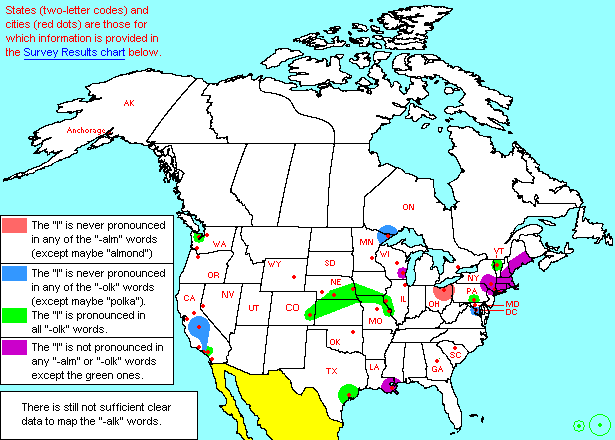
Background Info
In English the number of words which end in “-alm” or “-alms” is limited. The only ones of these which are really common, well-known words are listed in the first column of the first chart above, although obviously there are other words derived from these that are also common, like “embalm” or “becalm” or “psalms”. (This web site lists a few more, but they are so rare they don’t even show up in standard dictionaries. The word “realm” doesn’t count, since its pronunciation is completely different.) So, the list is short, though it is clearly a pronunciation pattern. Now, around the world most English speakers, including myself, do not pronounce the “l” in these words, and these words contribute to the short list of words containing the /ä/ vowel for those speakers who do not rhyme the words “father” and “bother”, as discussed in the previous section. For this reason this list of words, though short, is somewhat important when discussing how many vowels a particular speaker has. 19-May-2011
Until 2011 I had assumed that historically the “l” in all of the red words above was completely lost in all English dialects, and that the few speakers who did pronounce the “l” did so because it had been reintroduced based on a “bookish” pronunciation. However, I seem to have been quite wrong. A number of contributors to this page have written in and told me so, after seeing the “-alm” words listed in the previous section, and marked as having a “silent l”. Thus, contributor Jon from Sacramento, California disagrees: “I would also note that all of the words that you list with a silent ‘l’ in your father-bother distinction (balm, psalm, palm, alms, calming) I would say with a swallowed but still present to varying degrees “l” sound, and I think the majority of people I grew up with in Sacramento would too.” Thus he pronounces “balm” as /bŏlm/ ([ˈbɒɫm] (he does not distinguish “cot” and “caught”), with a “dark l”, which would sound almost “swallowed”, as he describes it, though clearly there. 15-May-2012
I should have realized that it wasn’t a bookish pronunciation, since it only applies to certain groups of words, as shown in the first chart above, not to all words with silent “l”, of which there are many. I have listed the main groups in the first chart above. 3-June-2011
After I was challenged by these two contributors, I went looking on the Internet, and found that there is indeed one American dictionary that lists a pronunciation of some of these words with the “l” pronounced, the Online Merriam-Webster dictionary, in all of these words: calm, palm, balm, psalm, qualm, alms, and napalm, and even provides audio samples of the “l” pronunciation. This was surprising to me, since most dictionaries, both American and British, give only a pronunciation with no “l”. (Merriam-Webster also gives another pronunciation /kăm/ for “calm”, which would evidently be the Scottish pronunciation, like “palm” mentioned above.) 16-May-2011
Contributor Y.I. has pointed out to me that the ANAE Ch. 2, p. 14 had also observed this phenomenon: “Words with vocalized /l/ formed a part of this class: calm, palm, balm, almond, though a large number of North Americans have retained or restored the /l/.” Like me, they are apparently unsure whether the “l” was retained or restored, and unfortunately they have not provided any help about the regional distribution. (In this book, also found by Y.I., the assumption is simply made that these “l”s are retained because of spelling pronunciations, without providing any evidence.) I had not previously thought of the word “almond” as belonging to this class, since I myself pronounce the “l” in this word, as /ôlmənd/ ([ˈɒlmənd], quite different from my “calm” /kŏm/ ([ˈkʰɑm]. (I distinguish “cot” and “caught” but not “father” and “bother”.) However, after consulting my many dictionaries, none of them recognize such a pronunciation, but say that the proper pronunciation is either /ämənd/ or /ămənd/! I checked with my wife, who is from Nebraska and does not pronounce the “l” in “calm”, though she does in “balm”, and she does pronounce it in “almond”, just as I do. The Online Merriam-Webster dictionary comes the closest to our pronunciation, at least recognizing that some people do pronounce the “l”, but they give the options as /ämənd/, /ămənd/, /älmənd/, or /ălmənd/. I find the third of these four options extremely unlikely, and speculate that perhaps a speaker for whom /ä/ = /ŏ/ = /ô/ may have worked on this entry.) Most American dictionaries give both /ämənd/ and /ămənd/, and according to contributor Marna Ducharme, her grandmother who always lived in New York City said /ămənd/ [ˈæmənd]. Not only that, but several contributors (Emmor Nile, James Divine, John Kelly), have told me that it has the /ămənd/ [ˈæmənd] pronunciation throughout California’s Central Valley, where they grow lots of them! In any case, it seems clear that “almond” often does not go along with the other “-alm” words. 2-Oct.-2011
Later I realized that a lot of people also pronounce the “l” in “folk” and “yolk”, as shown in the Initial Survey Results chart below. Almost all of these also pronounce the “l” in “calm”, suggesting that the two word groups are part of the same pattern of “l” retention. 8-June-2011
So this seems to be a conservative feature harking back to a time when the “l” in the red words was pronounced by all speakers, and as such, is probably a regional feature like the others on the map. 8-June-2011
If this is a conservative feature, then it must have been brought over to the U.S. from some region of Great Britain or Ireland. However, there is almost no trace of this “l” anywhere in this area, not even in Scotland or Ireland, from which many of the conservative features in American English came. However, my trusty contributor Y.I. has been able to track down one possible source: what is called the West Country of England (really the extreme southwest) apparently continues to pronounce this “l”, according to John Wells in The Accents of English, page 346, in a section describing the vowels in the West Country. According to this article, <<The West Country accent is probably most identified in American English as “pirate speech” - cartoon-like “Ooh arr, me ’earties! Sploice the mainbrace!” talk is very similar. This may be a result of the strong seafaring and fisherman tradition of the West Country, both legal and outlaw.>> Clearly this accent could have had influence in the Americas (as suggested in this linguistics book tracked down by contributor Y.I.), though why the influence has been so pervasive is unclear. 6-Sep.-2011
In any case, the retention of this “l” thus does not seem to depend on whether or not “cot”=“caught”, since it occurs across the continent. However, I am fairly certain that all speakers who are systematic r-droppers always lack the “l” in the “calm” group, and that all speakers with the father-bother distinction do too. This makes sense, since the resulting vowel is /ä/, which mainly occurs as the result of r-dropping. It is less clear why the “yolk” group would drop the “l” for this group, since the resulting vowel /ō/ [oʊ] does not normally occur as a result of r-dropping. 2-Oct.-2011
Initial Survey Results
Unlike the other data on the main map, this data is not from audio or video sound samples, but from self-analysis and direct interviews, since finding individual words in sound samples is almost impossible. It appears that the vast majority of Americans pronounce the “l” in “calm”, except for those in systematic r-dropping areas (as mentioned in the previous section), and nearby areas like Poughkeepsie and Port Chester, New York, in the Eastern North dialect. (New Orleans seems to have followed GNYC in this as in many other features, at least as far as the common words go.) So it would seem that I am in a small minority! Evidently my dialect was influenced by my parents more than I realized: my Dad was from Port Chester, New York, an area that does not pronounce the “l”, and my mother was originally from Australia, which is a systematic r-dropping area, and so again does not pronounce the “l”. Even so, I can’t believe I didn’t even notice such a widespread pattern for so long! As for Canada, it seems likely that many or most there also retain the “l”, though so far I only have data for one location. 6-Sep.-2011
We now seem to have enough data that the geographical pattern is becoming clear for the “calm” group and to a lesser extent for the “yolk” group, though the “talk” group remains unclear. However, we clearly still need more data to map these patterns fully. In particular we need more locations where the “l” in these words is definitely not pronounced. Help me out, people. This is a very simple thing for you to write in and tell me: “I grew up in X, and I pronounce the “l” in all these words,” or “I grew up in Y, and I don’t pronounce the “l” in any of these words except ‘almond’,” or whatever the case may be. 15-May-2012
|
Person |
Raised in |
“cot”= “caught”? |
Other info |
Pronounce “l” in “calm”, etc. |
Pronounce “l” in “almond” |
Pronounce “l” in “yolk”, etc. |
Pronounce “l” in “talk”, etc. |
|
Yuri |
Toronto, Ontario |
yes |
contributor 6-Sep.-2011 |
yes |
yes |
no (only “Polk” yes) |
most no “baulk” yes “caulk” yes |
|
Amanda Hocking |
Sacramento (Citrus Heights), California |
yes |
contributor 23-July-2011 |
yes |
yes |
yes |
“talk” no “walk” no “stalk” no “chalk” yes “balk” yes “caulk” yes |
|
Jon |
Sacramento, California |
yes |
contributor |
yes |
no: /ămənd/ [ˈæmənd]? |
? |
? |
|
Je.Ha. |
Oakland, California |
yes |
Info from contributor M.M. Thanks! 18-May-2011 |
yes |
? |
yes |
? |
|
James Divine |
Fresno, California |
yes |
contributor 20-May-2011 |
yes |
no: /ămənd/ [ˈæmənd] |
no |
? |
|
Ju.Ar. |
Ventura, California |
yes |
Info from contributor M.M. Thanks! 8-June-2011 |
yes |
? |
no (only “Polk” yes) |
? |
|
Fe.Mo. |
Oxnard, California |
yes |
Info from contributor M.M. Thanks! 18-May-2011 |
yes |
? |
yes |
? |
|
M.M. |
Los Angeles, California |
yes |
Info from contributor M.M. Thanks! 18-May-2011 |
yes |
yes |
no |
most no “caulk” yes, “Falklands” yes |
|
Yu.k.Jo. |
Pomona, California |
no (!) |
Info from contributor M.M. Thanks! 18-May-2011 |
yes |
? |
yes |
? |
|
Ma.Pa. |
Upland, California |
yes |
Info from contributor M.M. Thanks! 18-May-2011 |
yes |
? |
yes |
? |
|
Ma.Cu. |
Escondido, California |
yes |
Info from contributor M.M. Thanks! 8-June-2011 |
yes |
? |
no (only “Polk” yes) |
? |
|
Jonathan |
California |
yes |
on this website |
yes |
? |
? |
no |
|
Sabrina Badger |
Carson City, Nevada |
yes |
contributor 30-Nov.-2011 |
yes |
yes |
no (only maybe “Polk” yes) |
most no “balk” yes, “caulk” yes, “Falklands” yes |
|
Brett Deibel |
Tulsa, Oklahoma |
yes |
contributor 16-May-2012 |
yes |
yes |
“yolk” no “my folks” no “folk song” yes “Polk” yes “polka” yes |
most no “Falklands” yes |
|
Ma.Ca. |
Houston, Texas |
yes (!) |
Info from contributor M.M. Thanks! 18-May-2011 |
yes |
? |
yes |
? |
|
Za.Ri. |
Gettysburg, Pennsylvania |
no |
Info from contributor M.M. Thanks! 18-May-2011 |
yes |
? |
yes |
? |
|
Ali King |
Portland, Oregon |
yes |
contributor 18-Nov.-2011 |
yes |
yes |
yes (“yolk” no) |
most no “balk” yes, “caulk” yes |
|
(friend of Jennifer Nagel) |
Oregon |
yes |
|
yes |
? |
? |
? |
|
Randy Howell |
Kelso, Washington |
yes |
contributor 19-May-2011 |
yes |
? |
“yolk” no sometimes “folk” yes |
“talk” no “walk” no “stalk” no “balk” yes “caulk” yes |
|
Christina Aschmann |
Bremerton, Washington |
yes |
my daughter-in-law 8-June-2011 |
yes |
yes |
yes |
yes |
|
Gerald Erichsen |
Snohomish, Washington |
yes |
contributor 17-May-2013 |
yes |
yes |
yes almost all, “polka dot” no |
“talk” no “walk” no “chalk” no “caulk” yes “corn stalk” no “stalk” (verb) yes “balk” yes “Falklands yes |
|
“OhKaty” |
Utah |
yes |
on this website |
yes |
? |
? |
? |
|
“Jaques S” |
Anchorage, Alaska |
yes |
on this website |
yes |
? |
? |
? |
|
Kirk Sniff |
Lamar, Colorado |
yes |
contributor 30-Nov.-2011 |
yes |
yes |
yes |
yes |
|
Tom Brokaw |
South Dakota |
no? |
according to this website; he moved around the state too much for me to use him as a local sample |
yes |
? |
? |
? |
|
Larry Unruh |
Wallace, Nebraska |
yes |
my brother-in-law 21-Oct.-2011 |
“calm” no, others yes |
yes |
“yolk” no “my folks” no “folk song” yes “Polk” yes |
“talk” no “walk” no “chalk” no “caulk” no “corn stalk” no “stalk” (verb) yes “balk” yes “Falklands yes |
|
Sharla Unruh |
Casper, Wyoming |
yes |
my brother-in-law’s wife 16-Dec.-2011 |
“calm” no, others yes |
yes |
“yolk” no “my folks” no “folk song” yes “Polk” yes |
“talk” no “walk” no “chalk” no “corn stalk” no “stalk” (verb) yes “balk” yes “caulk” yes “Falklands yes |
|
Arlene Unruh |
Axtell, Nebraska |
yes |
my mother-in-law 21-Oct.-2011 |
yes |
yes |
yes |
Yes |
|
Rebecca Ratzlaff |
Omaha, Nebraska |
no |
contributor 28-Oct.-2011 |
yes |
yes |
yes |
most no “Falklands” yes |
|
Jennifer Nagel |
Minneapolis, Minnesota |
no |
contributor |
yes |
? |
? |
? |
|
Les Mattson |
Grand Marais, Minnesota |
yes |
contributor 15-May-2012 |
yes |
yes |
no |
no |
|
Lewis Thorwaldson |
Rothschild, Wisconsin |
no? |
contributor |
yes |
yes |
no (only “Polk” yes) |
most no “balk” yes, “Falklands” yes |
|
Robert Edwards |
Central Wisconsin |
no |
contributor |
yes sometimes “calm” no |
yes |
no |
no “balk” yes only in sports, “caulk” yes only as a verb |
|
Daniel Mathews |
Columbia, Missouri |
no |
contributor |
yes |
? |
? |
? |
|
Tim |
St. Louis, Missouri |
no |
on this website 17-May-2011 |
yes |
? |
yes |
? |
|
Y.I. |
Quincy, Illinois |
no |
contributor |
yes |
? |
yes |
no |
|
Richard R. |
Chicago, Illinois |
no |
contributor 14-Dec.-2013 |
yes “malmsey” no |
yes |
“yolk” no “my folks” no “polka dot” no “Polk” yes “folk song” yes “polka” yes |
most no “Falklands” yes |
|
“windy city” |
Chicago, Illinois |
no |
on this website |
yes |
? |
? |
? |
|
ma.ba. |
New Orleans |
no |
Info from contributor M.M. Thanks! 9-June-2011 |
“calm” no, “palm” no, “balm” no, others yes |
yes |
no |
“talk” no, “walk” no, “chalk” no, others yes |
|
Nicholas Miller |
Camden, South Carolina |
no |
contributor 18-May-2011 |
yes |
? |
? |
? |
|
Melissa Gordon |
Byron, Georgia |
no |
contributor 2-June-2011 |
yes |
yes |
yes |
yes |
|
Alex Coblentz |
Frederick, Maryland |
no |
contributor 16-Dec.-2011 |
yes |
yes |
“yolk” no “you folks” no “folk music” yes “Polk” yes |
no |
|
Janet McConnaughey |
Suburban Washington, D.C. |
no |
contributor 15-May-2012 |
yes |
yes |
no |
no |
|
Marna Ducharme |
Burlington, Vermont |
no* |
contributor |
yes |
yes |
yes |
yes |
|
Ann Roubal |
Milwaukee, Wisconsin |
no |
contributor 8-Sep.-2011 |
no |
no |
no |
no |
|
To.Ba. |
Cleveland, Ohio |
no |
Info from contributor M.M. Thanks! 18-May-2011 |
no |
? |
yes (!??) |
? |
|
Herman Aschmann |
Port Chester, New York |
no |
my father |
no |
? |
no |
no |
|
Marna Ducharme’s grandmother |
New York City |
no |
father-bother distinction, systematic r-dropper |
no |
no: /ămənd/ [ˈæmənd] |
no? |
no |
|
Larry S. |
Poughkeepsie, New York |
no |
friend 1-Sep.-2011 |
no |
? |
no? “Polk” yes? |
no “balk” yes |
(16-May-2011)
* Although she grew up in Burlington, she was strongly influenced by her NYC relatives, and retains the distinction. 23-May-2011
Inland and Lowland Southern and their relationship to the extent of slavery before the Civil War
What’s the Difference
between Inland Southern and Lowland Southern?
Before discussing the distribution of Inland Southern and Lowland Southern, I need to define them more clearly, since I find that there is a lot of confusion as to what I mean by Inland Southern versus Lowland Southern. 17-Apr.-2013
Inland Southern has full monophthongization of long /ī/ [aɪ] to [a]. This means that all long /ī/ vowels are not diphthongs [aɪ], but essentially pure vowels, usually [a] (which is clearly distinguished from /ŏ/ [ɑ]). Thus, the “i”s in “ride”, “buy”, and “right” are all the same, and all sound quite Southern! However, this doesn’t mean that “ride” [ˈɹad] is pronounced the same as “rod” [ˈɹɑd], or that “right” [ˈɹat] is pronounced the same as “rot” [ˈɹɑt]: these words still have distinct pronunciations, though Yankees may have trouble hearing the difference! 27-Apr.-2013
Lowland Southern is similar, except that Lowland Southern only has partial monophthongization of long /ī/ [aɪ] to [a]. This means that the vowels of “ride” and “buy” have the Southern vowel [a] just like Inland, but the vowel of “right” is a diphthong [aɪ], with a pronunciation a bit more like other parts of the United States. The specific rule is this: before voiceless sounds the vowel is a diphthong, but elsewhere it is not. Voiceless sounds are /p,t,ch,k,f,s,sh,th/ (as is “python” /pīthən/ [ˈpʰaɪθən], where it is voiceless, not as in “lithe” /līŧħ/ [ˈlaɪð], where it is voiced). Why does it work that way? Ah, that kind of question doesn’t have a good answer in human language! However, to put it another way, how is it that they follow such a technical rule without knowing it? That does have an answer: patterns such as this are common in human language, even though the speakers are totally unaware of them at a conscious level. 17-Apr.-2013
Thus, to determine if a particular speaker speaks Inland or Lowland Southern, first make sure he speaks Southern at all by listening to words like “ride” and “buy”. If he does, then listen to words with voiceless sounds like “ripe”, “bite”, “righteous” (which has a /ch/ sound in spite of the spelling), “like”, “life”, “ice” (s sound), “python”, etc.
The ANAE chapter 18 uses more complex criteria to distinguish their varieties of Southern, but I find theirs to be unwieldy, so I have gone for the simpler criterion, which seems to be sufficient, as seen in the next paragraph.
My Theory of the Settlement
of the American South
A surprising pattern seen on the map is the peculiar way in which the two Southern dialect areas are intertwined. It turns out that the current pattern of Lowland Southern matches to an amazing degree the areas with a high percentage of slaves before the Civil War, as shown by this famous antique map (viewable in one piece and downloadable here). Granted, there are a few minor surprises, but what is astonishing is not the occasional surprises, but how few the surprises are! 8-Nov.-2013
What seems likely is that the Inland Southern dialect spread west and south first, and then the Lowland Southern dialect was spread later by the slaveholding “aristocracy”, but never penetrated into areas unsuitable for large plantations, such as mountainous areas or dryer areas in the west. An exceptional area is Virginia and West Virginia, where Lowland Southern spread westward into non-slaveholding areas (see My Theory about the Original Area of Inland Southern below for more on this). Another exceptional area seems to be south Georgia and north Florida, which no Inland Southern speakers apparently ever reached. Other exceptional areas are discussed below in Southern Areas Settled after the Civil War. 8-Nov.-2013
The “r-dropping” areas (the green lines) and “Tidewater raising” (the pink line) also seem to be restricted to these slaveholding areas.
One result of this later spread of Lowland Southern is that Inland Southern was nearly broken into two sections, divided by what might be called the “Nashville-Florence Corridor”. If you look at a satellite map of this area, you can actually see this corridor in a lighter color outlined by darker forests, a fascinating geographic demonstration of my theory. This is not to say that, as a general rule, Inland areas are forested and Lowland areas are not, though this is often the case, and holds true in this case. The forested area to the east of the corridor matches rather precisely the Cumberland Plateau, a stretch of higher and often rugged land which often rises abruptly from the flatter land to the west. In fact, the line dividing Inland Southern from Lowland Southern seems to follow exactly the northwest edge of the Cumberland Plateau from just west of Monterey, Tennessee all the way to Hackleburg, Alabama, with the entire plateau being solidly Inland Southern (except for its southern tip in Alabama, which was mostly settled later). 16-Mar.-2013
A narrow neck around Iuka, Mississippi remains to connect the two sections of Inland Southern. 16-Mar.-2013
However, as more data comes in an expected result of this should be that there will be occasional islands of one dialect surrounded by the other. I had thought that Chattanooga, Tennessee was such a case. This is an important city in southeastern Tennessee. I most recently spent some time there in October, 2011, and was able to listen to many native speakers, all of whom spoke Lowland Southern. However, I have since realized that these speakers were all higher class speakers, since my exposure was socially quite limited. Since then I have heard various working class speakers from Chattanooga (mainly policemen) on TV, and have confirmed that Chattanooga is Inland Southern, and that Kevin Burke, whom I had originally assumed was not from Chattanooga, is actually a native, and represents the dialect quite well. However, many higher class speakers speak Lowland Southern, as discussed below in Possible Southern Class Distinction?. So we will have to look for another example of such a linguistic island! 11-Aug.-2014
The obsolete terms Tuckahoe and Cohee, used in the northeastern part of the South before the Civil War, seem to have been used to reflect the strong cultural and linguistic differences between these two groups, though again West Virginia was clearly Cohee without getting the Inland Southern dialect. The article confirms my analysis of the settlement patterns, saying, “As the frontier moves westward, the third zone (slave-based plantation society) moves into land formerly held by the second (the frontier society).” 8-Nov.-2013
One interesting corroboration of my theory is political: After the Civil War, the former slave states tended to elect exclusively Democratic Party candidates, rejecting the Republican Party as the party of Lincoln. This phenomenon is referred to as the Solid South, which remained so at least up into the 1960’s. However, certain areas of the south, primarily in mountain areas like the Appalachians and the Ozarks, where little or no slavery had existed, resisted this tendency, and aligned themselves with the Union and with the Republican Party, consistently electing Republican candidates throughout this period. The fascinating map on this web page shows what areas of the south these were, at least in the 1940 election. (Notice particularly the circled areas, and the discussion about these.) Notice the correlation between these areas, my map, and the slavery map mentioned above: If we exclude the areas in Texas (which apparently represent later German immigration, at least according to the discussion on the web page), none of these areas is Lowland South (except for Sampson County, North Carolina, for which I have no explanation). Instead, ignoring the exceptions mentioned, they are all Inland South, except for part of Missouri, which is Midland! Winston County, Alabama, is in fact famous for the degree to which it opposed secession during the Civil War, being known as the “Free State of Winston”!
This is not to say that Inland South areas in general voted Republican: they didn’t, and in Texas and Oklahoma they were as Solid South as anywhere else. I am only saying that such areas are consistently in the Inland South region. (Nowadays, of course, everything has changed, and the south overwhelmingly votes Republican.) 9-Mar.-2012
Charleston is clearly a special case of Lowland Southern, as is clear by listening to it. The Down East & Outer Banks dialect doesn’t sound very Southern at all, but does at least have the “Tidewater raising”. Florida doesn’t count, since it had a huge influx of Yankees in the 20th century. In fact, Florida is effectively upside down: the farther south you go in Florida, the more Northern people sound! 19-Nov.-2011
Southern Areas Settled
after the Civil War
Obviously areas in the South settled after the Civil War may not follow this pattern, especially those which are near the border between the two subdialects. The Birmingham, Alabama area is a case in point. Birmingham did not exist before the Civil War, but was founded in 1871 as a steel production center, and grew so fast between 1880 and 1920 that it was given its well-known nickname “The Magic City.” It lies in a very mountainous area (part of the Cumberland Plateau mentioned above), and thus was probably originally in the Inland South, but because of the huge influx of people from all over the South, it is now Lowland Southern. Trussville was founded much earlier, around 1820, but remained small until it was swamped by the growth of Birmingham, and now follows its pattern, as do the other nearby towns, but towns just a little farther removed like Odenville or Jasper do not. 16-Mar.-2013
Anniston Alabama has a similar history. It was not really settled until 1872, and for various reasons attracted many people from outside the local area, ending up as Lowland Southern. 28-Mar.-2012
However, it turns out that there is at least one town south of Birmingham and Anniston which speaks Inland Southern and which was definitely settled before the Civil War, the town of Sylacauga, which was originally incorporated in 1838, though it had been a Creek (or Shawnee?) Indian village as far back as 1748. The name of the town is pronounced /sĭləkŏgə/ [ˌsɪləˈkʰɑɡə], not /sĭləkôgə/ [ˌsɪləˈkʰɒʊɡə], in spite of the spelling: it was originally called Syllacoga, which in turn was derived from the Indian name Chalaka-ge, according to the Wikipedia article). So far I have not been able to find any good sound clips for Sylacauga (if you know of one please send it me!), but I made a visit there in the spring of 2012, where I met a native who clearly spoke Inland Southern, and who had lived there all her life. In November of 2012 I met two more natives of Sylacauga and talked with them at length, and they also spoke clear Inland Southern. As can be seen by looking at a map of the Talladega National Forest, which runs in a northeast to southwest direction just to the east of Anniston, and which includes the highest point in Alabama, Mount Cheaha, Sylacauga lies at the tail end of the southernmost ridge of the Appalachian mountains. (This ridge can also be clearly seen on this map and this map.) 12-Aug.-2014
Because of all this, the Inland South line makes several
sharp curves along its southern edge in Alabama. Presumably at the time of the
civil war, Inland Southern was spoken throughout the entire Cumberland Plateau
and the southern part of the Appalachian Mountains, shown fairly well on this
map, whereas the Piedmont was mainly Lowland Southern. 26-Aug.-2014
Another example is the Asheville-Waynesville area of North Carolina. Both of these towns existed before the Civil War, but they both saw massive growth after the war, Asheville more than tripling in size between 1910 and 1930, apparently because of strong growth of manufacturing, and Waynesville only beginning to grow after the arrival of the railroad in 1884. In both cases this seems to have brought in Lowland Southern speakers, whereas the surrounding towns are still solidly Inland Southern. (The one exception seems to be Burnsville: why it is Lowland is unclear.) 8-Nov.-2013
Possible
Southern Class Distinction?
It has been often been suggested (or assumed) that in some areas there is also a social-status distinction between what I have called “Inland Southern” (sometimes referred to as “hillbilly” or “country”, as in “He sure talks country!”) and “Lowland Southern”, with people from higher-class family backgrounds favoring the “Lowland Southern” pattern, and this would make sense if my hypothesis as to its spread is true. Even so, evidence of such a social distinction does not appear in very many places, and only near the border between these two regions. 11-Aug.-2014
Two such areas are an area surrounding Dallas and Fort Worth in Texas and an area around Greenville in South Carolina, which are evidently Inland Southern areas, but in which a number of people born and raised there (like Ross Perot, Jr. or Kenny Marchant) have Lowland Southern accents, mostly people in the middle and upper socioeconomic class. 11-Aug.-2014
A third such area is Little Rock, Arkansas, which is clearly a Lowland Southern area, but in which several samples of people born and raised there show traces of Inland Southern, notably people in what are often viewed as working class professions. 11-Aug.-2014
Recently (2014) I have realized that Chattanooga, Tennessee is a fourth area where this holds true, which makes it unusual in that it is not on the border between the two dialects, but is surrounded on all sides by solidly Inland South areas, though Lowland South areas are not far away, such as Decatur and Florence (and partially Huntsville) down the Tennessee river. 4-Nov.-2015
Most such areas are marked on the map surrounded by a dotted
red line, and with both background colors as alternate bars. Samples showing
this variation will often refer to the Possible Southern Class Distinction? 4-Nov.-2015
If only one town seems to have both Inland and Lowland speakers, with this presumed class distinction distinguishing them, then rather than the dotted line I simply run the dialect boundary through the middle of the town. Examples of this are Huntsville and West Blocton, Alabama and Kannapolis, North Carolina. 4-Nov.-2015
Very rarely I run the dialect boundary through the middle of a town if the only sample I have is highly mixed, as in the case of Junior Johnson from Ronda, North Carolina. 4-Nov.-2015
However, “Inland Southern” is NOT equivalent to “hillbilly”, nor do people who talk “really, really southern” or even “really, really country” necessarily speak Inland rather than Lowland. Some people who sound “really, really Southern” actually speak Lowland Southern based on the definition I am using, which seems to match high slave density areas, whereas some people whose speech doesn’t sound quite as “strong”, or who are obviously well educated and sophisticated, actually speak Inland Southern. Even so, it is true that areas generally recognized as more “hillbilly”, such as the Appalachians or the Ozarks, do indeed fall within Inland Southern, so one could say that “hillbilly” is definitely a subset of Inland Southern and not of Lowland Southern. As for “redneck”, this term has absolutely no linguistic meaning, so don’t try using this map to find out where the “rednecks” live! 12-Dec.-2011
According to contributor A.T.W., in Texas the status of Inland Southern is different from its status in the east:
I hadn’t realized, until I heard the Fess Parker clip, that the Inland Southern accent is the same as the west/central Texas accent I often hear in Houston. It’s odd, but I think you’re absolutely correct: they’re almost identical.
The interesting point is
that this is actually a high status
accent here, although regarded as a “hillbilly” accent in the East. When I
moved to Texas 30 years ago and decided to adopt a slightly more local “voice” in
my law practice, this was the accent I adopted -- it was the dialect of the
senior lawyers and judges, oil men, and others with whom I wanted to
communicate. Many of them came from wealthier ranching families in central
Texas and settled in Houston as the first post-war generation of professionals
and white-collar business people. I suspect this is a somewhat dated status
distinction today, but that dialect still tends to receive something similar to
the automatic credence which an educated English accent used to get in the
northeast. 10-Mar.-2011
Who woulda thunk it?
My Theory about the
Original Area of Inland Southern
But all this leaves the question: Where did Inland Southern start out? What was its original area? If we look at this map showing settlement as of 1800, we see that the earliest settled areas of what is now the Inland South region are located on either side of the Cumberland Gap, which allowed easy crossing of the Appalachian Mountains and through which nearly all of the western settlement from the South took place after the Revolutionary War in 1776. This settlement process would have involved much mixing of populations and dialects, and it seems likely that Inland Southern was the result of this mixing, thus distinguishing it from the more settled Lowland Southern. I have marked the Cumberland Gap on my map, and it can be seen that it lies almost exactly in the center of the northernmost node of Inland Southern, which would have been its original area. The Appalachian Mountains themselves, including the Cumberland Gap area, were not settled until later, since it was not desirable land, but the settlers were evidently speakers moving south from this original area, as the map suggests. 7-Nov.-2013
Technically the Cumberland Gap allowed easy crossing of the western ridge of the Appalachian Mountains, called at this point the Cumberland Mountains, not the eastern ridge, which is called the Blue Ridge. This western ridge (technically the eastern escarpment of the Appalachian Plateau) was generally harder to cross than the eastern ridge. Between the two runs the Appalachian Great Valley (the map on that page shows fairly clearly the two ridges and the valley). As can be seen on the map mentioned in the preceding paragraph, part of this valley, the upper reaches of the Tennessee River valley, was settled fairly early, in the Overmountain Settlements from the late 1760s, in what is now the extreme northeast corner of Tennessee. It is possible that these settlements formed the original melting pot that created Inland Southern. 8-Nov.-2013
Does this mean that Daniel Boone and Davy Crockett spoke Inland Southern, since they lived in this area? Well, in spite of the fact that many of us grew up hearing Texan Fess Parker play him on television with an Inland Southern accent, Daniel Boone certainly did not have the accent, for two reasons. One is that he was born and raised in Pennsylvania, not in the South at all, and didn’t move to the south until he was 16, in 1750. The second is that he lived way too early, long before Inland Southern would have even formed according to my theory, being born in 1734. He was one of the prime movers in encouraging the population movement that would have created it, but he would have been an old man before it really coalesced. His grandchildren probably did speak it. 12-Aug.-2014
What about Davy Crockett? His is a different story, and he very likely did speak it. He was born about 50 years after Daniel Boone, in 1786, and was born in the heart of the Inland South area, in the Overmountain Settlements mentioned above, during the existence of the short-lived State of Franklin. 8-Nov.-2013
This does not explain why Inland Southern is almost non-existent in West Virginia (except for the Hatfield-McCoy area), which speaks almost entirely Lowland Southern in the southern part, in spite of being almost entirely mountains, and Midland in the north. It turns out that its settlement pattern was different from the rest of the Appalachians (check out this interesting 1861 voting map, which lines up very closely with my map, showing that most of those who voted for statehood spoke Midland, not Southern). In any case Inland Southerners apparently tended to move east and south into new lands, not north. 8-Nov.-2013
Classical Southern and African American Vernacular English (AAVE)
The r-dropping areas in the Lowland South (marked with a
dark green line) could be described as “Classical
Southern”. This is the accent that Scarlett O’Hara (Vivien Leigh) is
attempting to imitate in this clip from Gone with the Wind. This area
represents the heart of the old plantation system, as can be seen on the map mentioned above. However, this feature seems to only
occur in older settled areas, and does not occur in western areas on the
Mississippi River or farther west that were settled after about 1825. 23-Sep.-2015
Within this area older speakers seem to be consistent in maintaining this pattern. However, many younger ones in this area seem to be pronouncing all of their r’s, and I will include some of these with a comment. Outside of this area (but always within the Lowland Southern area) there will occasionally be much older speakers who do speak Classical Southern. I will comment individually on each of these, and will mark their city surrounded by a dotted green line. 23-July-2011
African American Vernacular English (AAVE), the dialect of most African Americans in the United States, is derived from Classical Southern, and shares its main features and many other features. However, it also has a number of distinctive features. I have not generally included AAVE in this study, since its geographical distribution tends to be independent of “white” dialects, primarily because after the Civil War large numbers of former slaves moved to all parts of the U.S., and tended to form their own communities, retaining their unique dialect. However, in many areas of the Lowland South no such migration occurred, and in these areas AAVE and “white” dialects share features and clearly have developed together, so in these areas I have sometimes included AAVE samples. AAVE tends to retain r-dropping more than “white” dialects do, even among younger speakers, and throughout the United States in African American communities. 2-Jan.-2012
[ɜɪ] instead of [ɝ] in some Classical Southern dialects
(23-Sep.-2015)
One feature that was formerly common among (white) speakers of Classical Southern is their special pronunciation of the vowel /ûr/ in words like “hurt”, “turning”, and “concerning” as [ɜɪ], much like Greater New York City, rather than the now more common [ɝ]. Strom Thurmond of South Carolina is an excellent example (see his sample). (Unlike GNYC, this vowel [ɜɪ] is quite distinct from the /oi/ vowel in words like “coin”, which is usually pronounced [ɔɛ] in the South.)
Contributor Jason Reid provides further info: “According to the linguist John Wells in his book Accents of English (1982), this pronunciation was at one time common. Erik R. Thomas in his very detailed phonetic description of Southern speech in A Handbook of Varieties of English (2004) says this pronunciation was at one time very widespread, but very few speakers born after 1930 show it (Strom Thurmond was born in 1902).”
The latter writer’s indicated range seems to cover all of my Lowland Southern area except North Carolina and Virginia (and Florida, though I have personally heard it there also, from African American speakers, many of whom retain it to the present day). This same pronunciation can also be heard in most of the New Orleans samples, from both whites and blacks, and is still heard today. In general, my observation is that it persists today among some African Americans, especially older ones, in many regions, an example being Elizabeth Allen of North Carolina (see her sample).
However, I visited with a number of older white speakers in Augusta, Georgia, in the spring of 2012, and though they all had consistent Classical Southern accents, none of them showed any sign of the [ɜɪ] pronunciation. Nor did I hear it from the Classical Southern speakers I met in Brewton, Alabama in February of 2012. However, the [ɜɪ] pronunciation is not dead among whites in the older south: in November of 2012 I met an older gentleman from Sumter, South Carolina, who spoke Classical Southern and used the [ɜɪ] pronunciation in a number of words.
Not even all Classical Southern speakers from this area born before 1930 have it: George Wallace does not, nor do Jimmy and Rosalynn Carter.
The Pin-Pen Merger, the Kansas-Nebraska Act, and the Texas Cattle Drives
As can be seen on the map, the pin-pen merger is primarily a Southern feature, but has spread well beyond the South. I suspect that this has happened for two principal historical processes, both of them involving Southerners moving west and North. 12-June-2010
1. The first was the settlement of the Kansas and Nebraska territories, driven in part by the political issues concerning slavery surrounding the Kansas-Nebraska Act of 1854. Evidently the bulk of the Southern settlement stopped at the Platte River in what is now eastern Nebraska, as can be seen by the comment about people “sympathetic towards the Confederate cause” in the Wikipedia article about Lincoln, Nebraska. This is where the pin-pen line runs in Eastern Nebraska: south of the Platte River. (The rest of Nebraska was not really settled until after the Civil War, and the line crosses to the north side of the Platte River west of Grand Island, though it does return to it briefly between Gothenburg and North Platte. At North Platte the river splits into the North and South Platte, and as the pin-pen line moves west it stays north of the North Platte.) 7-Nov.-2011
2. Farther west the line runs much further north, and, I suspect, was spread north up the cattle drive trails from Texas in the late 1800’s, presumably by Texas cowboys who hired on for a drive and decided to settle down somewhere along the trail home. This can be seen by comparing the pin-pen line with this map of the cattle drive trails (replaced bad link). (The sites I originally had for this map are all gone, and no full-size map seems to be available except for purchase.) This map is quite accurate, even though the red trails were added to show details from a fictional book, and the “Hat Creek Cattle Company” is fictional. Other maps corroborating the northern extent of the cattle trails are: commons.wikimedia.org/wiki/File:Cattle-trails.jpg and nps.gov/hfc/carto/RELIEFS/GRKOrelief3_c.jpg (replaced bad link) (from nps.gov/hfc/cfm/carto-detail.cfm?Alpha=GRKO (replaced bad link)), which shows a trail going as far north as Buford, though neither shows the full course of the Bozeman Trail, which can be seen here: en.wikipedia.org/wiki/Bozeman_Trail. See also en.wikipedia.org/wiki/Cattle_drives_in_the_United_States, where Miles City, MT and Medora, ND are specifically mentioned. 26-Sep.-2016
In fact, the pin-pen line seems to only have been stopped in its northward progress by the Canadian border! Apparently none of the cattle drives felt free or were invited or were contracted to cross that border. 26-Sep.-2016
Most of these trails stayed in the Great Plains, not venturing into the mountains, because it was much easier to move cattle on the flatlands. However, Nelson Story certainly used the Bozeman Trail to bring cattle from Texas to Bozeman, which is west into the mountains. And one trail shown on the nps.gov/hfc/carto/RELIEFS/GRKOrelief3_c.jpg map, the 1870-78 Kohrs Trail, also moves west into the mountains, but apparently this was only used by en.wikipedia.org/wiki/Conrad_Kohrs to move cattle to his ranch at Deer Lodge, which is west of Helena and Butte and is not in the pin-pen merger area. In any case, these movements may partly explain why the pin-pen line bends west of the western edge of the Great Plains line to encompass all of Wyoming and parts of Idaho. Adj. 2-May-2018
This doesn’t quite explain why the pin-pen merger also reached the Salt Lake City area, which was solidly Mormon throughout this period and would not seem to have had much settlement by Texas cattle drivers. Contributor Trevan Richins suggested the following: «I think the answer is because of the Mormon missionary program and their desire to “gather in Zion”. Up until the turn of the century (1900), almost all converted Mormons would move to Utah. In the 1870 census, it showed that 1 in 3 Utahns were born outside of the United States. There was an extensive missionary program at that time to convert people from all of the United States, Canada, Europe, and elsewhere. So, the pin/pen probably reached Utah on the tongues of Southern converts.» Seems reasonable… Adj. 14-Sep.-2017
Other Areas with the
Pin-Pen Merger
(16-Jul.-2016)
In addition to these two major influences, there are several additional areas for the pin-pen merger. One, which is no surprise, is that there is a small area of pin-pen merger that spreads west from the tail end of the Southern area. This seems to reach as far west as Arizona, but does not reach California. This area was settled by a mixed population even before the Civil War, but these included a large proportion of southerners, and during the Civil war the southern half of what became Arizona and New Mexico seceded from the Union, as discussed in the Wikipedia article on Traditional Arizona. 29-Apr.-2011
Another very interesting area is the San Joaquin Valley in California, which apparently adopted the pin-pen merger during the Great Depression, as a result of over a million “Okies” who moved there in the 1930’s. The ANAE had marked just Bakersfield as “pin”=“pen”, but the merger appears to cover the entire valley. However, obviously older speakers do not have it: contributor James Divine, who grew up mostly around Fresno, and was born in the mid 1940’s, has “pin”≠“pen”. (I had previously thought that this merger also extended north to include parts of the Sacramento Valley as well, which is the northern part of California’s Central Valley, but contributor Jon, a native of Sacramento, assures me that in Sacramento “pin”≠“pen”). 20-May-2011
The following is from contributor Branden Collingsworth (thanks!):
My wife and I are from Nebraska. She was born in Omaha and I was born in Lincoln. More than once I’ve asked her to “hand me that pen” and she replies “The pen or the pin?” I’ve tried to convince her that there is no difference in the pronunciation: of course, I don’t hear it. I was pretty amused to learn that we speak different sub-dialects. 14-Feb.-2011
New York City and Its Offspring
The Greater New York City dialect is the second most unusual dialect in all of North America (after New Orleans). It has many unusual features, and, more than any other city, New York seems to have historically shown great variation by social class, which is why I give so many audio examples. The following descriptions explain the classes marked in the chart with **: 10-May-2011
The classic working class dialect has “curl”=“coil”, and “dese” and “dose”; the latter is still heard in the modern working class dialect. Bennett Cerf and Humphrey Bogart are classic middle class, and have “curl”=“coil”, but not “dese” and “dose”. The curl-coil merger has nearly died out, according to William Labov, though there are plenty of well-known examples in recent history. Actually, it hasn’t completely died out! I have recently found two clips of people from Greater New York City who do still retain the curl-coil merger, Tommy DeVito and Skip Tollefson. And even Regis Philbin still seems to use the old pronunciation of the “curl”/”coil” vowel in a few words, like “circus” in his video clip. 3-Mar.-2011
Franklin Roosevelt and Teddy Roosevelt both speak what is sometimes called Mid-Atlantic English, (quite distinct from what the ANAE chapter 17 calls Mid-Atlantic, which I am calling Atlantic Midland). According to the Wikipedia article, Teddy speaks more “naturally” than Franklin, but structurally I see little difference between their dialects. They do not seem to have the had-bad distinction of Greater New York City, reflecting instead the British 15-vowel system. Eleanor Roosevelt, Teddy’s niece and Franklin’s wife, went to an even greater extreme, and spoke almost pure Standard British English. (She was raised mostly in the U.S., but was educated with private tutors, and went to finishing school in England.) Another sample, that of Doris “Granny D” Haddock, shows the Eastern New England variety of Mid-Atlantic English, with only the 14 vowels of Eastern New England. 14-Apr.-2011
The ANAE chapter 17 says that “One of the most startling facts about New York City is the narrow extent of its influence in the surrounding area,” and that its boundary “has remained fixed for more than two centuries... This geographic restriction appears to be associated with the negative prestige of the New York City vernacular...” In other words, everybody thinks the New York City dialect is really weird, even though we are all fascinated with it!
The differences are of class, not section of town, according to William Labov: The ANAE chapter 17 says “Within this metropolitan linguistic area, there is no reliable evidence for geographic differentiation. The stereotype Brooklynese is used to refer to working-class GNYC speech, whether the speaker is a resident of Brooklyn, Queens, the Lower East Side of Manhattan, or Jersey City. Many members of the public are convinced that they can recognize a Queens or Bronx or Jersey accent, but it appears that these geographic labels are in fact labels for perceived social class differences.”
Though its influence on the surrounding area has been limited, it has had a lot of effect on the speech of Cincinnati and of New Orleans (see the Dialect Description Chart), and shares the short-a split with the Atlantic Midland region.
New Orleans
The various dialects of New Orleans make it the most unusual dialect situation in all of North America. Some neighborhoods speak Classical Southern, and other neighborhoods speak a dialect which doesn’t sound Southern at all, but instead sounds exactly like Greater New York City until you listen for a while, and others are somewhere in between. I have taken several dialect samples from this clip from the “YEAH, YOU RITE” documentary. This clip is a dialect student’s dream, and explains in some detail the dialect situation in New Orleans. I used four samples from this clip because it was clear what neighborhood of New Orleans they were each from, and now I have tentatively added the guy on the park bench. I would have used more, but it was impossible to determine what part of town the other speakers were from, or else they had too much General American to be a useful sample. 17-Dec.-2015
The entire documentary does not seem to be available on the Internet, except for purchase. I did, however, find a transcript, which helped a bit in identifying speakers. 14-Jan.-2011
New Orleans seems to be the only city in North America that has more than one distinct dialect.[56] In this respect it is like London of the early 1900’s, as is implied by the speaker on the park bench who refers to “’Enry ’Iggins or Higgins”, the dialect expert in the movie My Fair Lady. This fact, explained in some detail by several of the speakers in the “YEAH, YOU RITE” documentary, seems to have been missed by the ANAE (Ch. 18) (see pages 259 and following), since they treat the city as a whole in their descriptions. 17-Dec.-2015
Thanks to samples that many of you sent in, and others that I have found, I now have a much clearer picture of the New Orleans neighborhoods and their dialects. Even so, I would still like to know who the guy on the park bench is, and where exactly he grew up. (Contributor Charles Meeks cited below has at least confirmed that he is evidently Uptown, so I added him tentatively to the map.) 11-Mar.-2016
Actually, my biggest question now is about what I am calling the Downtown New Orleans dialect, the only New Orleans dialect with no Southern features at all (most importantly, all of her long /ī/ vowels are [aɪ], making her not Southern by the definition we are using here), and which I have listed under the Greater New York City dialect. I only have one sample for this, Deborah Chauvin, which is very short, and the transcript suggests that this is the only time she speaks, even in the full documentary. Every other New Orleans sample I have found has at least some long /ī/ vowels reduced to [a], which reduces my Downtown New Orleans dialect to just the Ninth Ward. Is this valid? For now I will continue to assume that it is, but I need more data to confirm this. 11-Mar.-2016
|
So, I have now identified five distinctive New Orleans dialects, plus two that are not unique to New Orleans, as shown on the right. They are listed from top to bottom according to how close they are to the Greater New York City dialect as opposed to Southern. (Irish Channel and St. Bernard are probably about equal on this scale, and Cajun English is just a special variety of Lowland Southern.) Those without the pin-pen merger can be grouped together as Central New Orleans dialects. All are Southern (specifically Lowland Southern and Classical Southern) except Downtown New Orleans, as discussed in the previous paragraph. 11-Mar.-2016 For more details about each of these dialects, the best thing is to go my discussion of individual New Orleans sound samples. New! 15-Sep.-2017 |
|
Distinctive |
Downtown New Orleans |
|
|
Greater New York City |
|
|
New |
St. Bernard Parish New Orleans* |
Central |
(“pin”≠“pen”) |
|
|
|
|
Orleans |
Irish Channel New Orleans |
New Orleans |
|
Southern |
|
|
|
Dialects |
Mid City New Orleans |
|
|
(Lowland Southern, |
|
|
|
|
Peripheral New Orleans |
(North N. O.) |
|
Classical Southern) |
|
|
|
Not unique |
Standard Lowland Southern |
(Uptown) |
(“pin”=“pen”) |
|
|
|
|
to N. O. |
Cajun English |
(Belle Chasse) |
|
|
|
|
|
* This is the only one of these dialects that has the Tidewater raising. Adj. table 15-Sep.-2017 |
|||||
Wards: It is not uncommon for New Orleanians to identify
where they are from by their ward number, and several of the speakers do so.
These are not neighborhoods, but voting wards, and seem to radiate away from
the Mississippi River in long strips. For a map
of the wards see: wards.pdf.
(This map was originally at www.louisianarebuilds.info/files/wards.pdf,
but this link is no longer valid.) 26-Jan.-201
The following is from contributor Charles Meeks (thanks!): 17-Dec.-2015
Ran across your dialect map and found it fascinating. I’m from New Orleans and always thought the variance was crazy. The guy sitting on the bench in the park is Uptown for sure. Hard to pin point the exact park, but I suspect it’s Audubon Blvd.
The southern accent (1:50 m) in New Orleans is dying out. It’s only heard in older people now. [I wonder if he means specifically the Garden District variety, or all of them. If the latter, then I am skeptical. If the former, then it’s probably true.]
It’s absolutely true that you can tell pretty much where anybody is from. I’m white, so I can pick out where any white person is from. Harder to distinguish black people. But it is extremely neighborhood and financially based.
Where do they speak without an accent? Or where do they speak “General American”?
This question implies that there is an accepted standard of spoken American English which is perceived as not having any strictly regional features. In other words, any features which are distinctly northern, southern, eastern or western would be excluded. And indeed there is such a standard, used by most radio and television news staff throughout the U.S. Applying such a definition rigorously leaves us with the orange striped areas on the map, in parts of the Central Midland and South Florida, and the southern fringe of the North. Applying a slightly less rigorous definition would also include some neighboring areas on the map, although these all have some noticeable regional features. For instance, San Francisco and East Midland both sound just a little bit too eastern, areas below the pin-pen line sound just a bit southern, etc. The Wikipedia article on General American covers the question fairly well, and in some detail, and I recommend reading it. The area mapped in that article covers the same general area in the Midwest as mine, but I would not include all of the cities included there.
The Canadian standard dialect is obviously distinct from the American one, and corresponds to what is spoken in most of Canada, excluding the Atlantic Provinces. The dialect of eastern Ontario or of most of British Columbia would probably be considered more standard than the Prairie Provinces and western Ontario, since these are above the bite-bout line, as shown on the map. 15-Aug.-2015
Obviously there are many differences in pronunciation details between Canadian and American English, as explained in the description of the Canadian dialects in the Dialect Description Chart, but most of these are not structural details affecting how many distinct sounds (phonemes) the dialects have. However, there is one very important difference between “General American” and “General Canadian”, and that is the Cot-Caught Merger: “General American” makes the distinction, whereas no Canadian dialect does. People from California might disagree with me, claiming that their dialect is as “General American” as any, but in fact the majority of Americans retain the distinction, as discussed in The Cot-Caught Merger section and in the footnote there. (California also has the distinctly Western fronting of the long /ōō/ [u] vowel which it shares with Canada and not with “General American”.) 15-Aug.-2015
Do some geographic features coincide with dialect boundaries or areas? 17-Dec.-2010
Yes, some do, though obviously many do not. I have included a number of the former on the map, and even a few of the latter. These are all marked on the map in Dark Blue, or in a few cases in Rust.
The following geographic features (arranged more or less from west to east) seem to have a direct correlation with some dialect area, boundary, or feature: 1-Nov.-2011
Suisun /səsōōn/ [səˈsun] Bay: This bay, along with the Carquinez /kärkēnəs/ [ˌkʰɑɹˈkʰinəs] Strait, San Francisco Bay, and the Golden Gate (which are not marked) define the northern border of the San Francisco Bay dialect. 28-Apr.-2011
The San Joaquin /săn wŏkēn/ [ˌsæn ˌwɑˈkʰin] River: See The Pin-Pen Merger, the Kansas-Nebraska Act, and the Texas Cattle Drives. 28-Apr.-2011
The Sierra Nevada (California): The dip in long o fronting in the Great Basin (possibly represented by Mormon settlement) stopped at the Sierra Nevada.
Death Valley: Obviously a geographic barrier to travel! Continues the Great Basin line. 5-Mar.-2011
Grand Canyon: Obviously a geographic barrier to travel! Continues the Great Basin line. 5-Mar.-2011
The western edge of
the Great Plains: (Thanks to en.wikipedia.org/wiki/United_States_physiographic_region
for a map of the U.S. portion of this line.)
One thing that is
immediately obvious about this line is that most of the West dialect in the U.S. is found
to the west of it, but that this dialect also spills over a hundred miles or so
east into the Great Plains for most of its length (except in the far south).
This dialect was probably created in the rough country to the west of this
line, in a great melting-pot process in the late 1800’s with tremendous
population movements. Then it appears that it spilled back over the mountains
into the Great Plains for some distance, as part of those same population
movements, leveling from that point all of the dialects that had travelled west
from the eastern seaboard. Adj. 2-May-2018
This happened everywhere except
in the far south, where Inland Southern had already spilled over the mountains
onto the western side, a process which probably began before the Civil War.
(See The Pin-Pen Merger, the Kansas-Nebraska Act,
and the Texas Cattle Drives.)
16-Jul.-2016
A couple of bulges in the
eastern edge of the
West dialect which push it farther east can be seen. One is the Black Hills,
discussed immediately below, which had a gold rush that brought people from all
over. Another is Dodge
City, Kansas, which became famous as a Wild West town with many famous
gunfighters, and may have been a magnet for people from farther west. New! 2-May-2018
But besides this fact,
this line seems to affect only one other dialect feature, and only in extreme
northern United States and Canada: Adj. 5-Oct.-2017
When the bite-bout line hits the Rocky Mountains in
Wyoming as it moves west, it turns north and mostly follows the edge of the
plains all the way into northern British Columbia, suggesting that the Rocky
Mountains tended to block the continued westward movement of speakers from
north of this line, and that points west were settled primarily by speakers
from south of the bite-bout line.[57]
If we look at a map of the Oregon Trail, by which the vast majority of early
settlement (mainly 1846-1869) of the northwest took place, we can see that this
was true, whereas there were no major trails north of the Oregon Trail, either
in the U.S. or in Canada. After 1869 the First Transcontinental Railroad replaced the Oregon Trail
as the primary means of travelling west, but followed approximately the same
route across the Great Plains and for the first part of its path into the
mountains. The funneling effect that these two processes had on western
settlement can be seen on this map and this map
showing where western settlement had reached in 1890. 19-Aug.-2015
It would appear that even
most of British Columbia was primarily settled from the south or by
the Pacific Ocean, not from the east: Coastal B.C. was apparently already well
settled when it joined the Canadian Confederation in 1871, before any of the Prairie
Provinces did, and there had been a huge influx of Americans in 1858
because of the Fraser Canyon Gold Rush. Even the first railroad
connecting B.C. to the rest of Canada was only completed in 1885. Even so,
over the decades these transplants seem to have fully accepted their Canadian
identity and even adopted the “Badge of Identity”!
I had originally thought that
the western edge of the Great Plains also blocked further westward expansion of
the Inland South dialect from southern New Mexico all the way to the Mexican
border, but contributor Karl Gerlach has informed me that this is not so, but
that the Inland South dialect reaches as far west as Fort Hancock, and he was
able to find me a sound sample for Marfa. Thus the mountains apparently had
little or no effect on settlement in this area.
19-Aug.-2015
This leaves El Paso as the only city in Texas that does not have a
Southern accent. Gerlach says, “This makes sense historically, since settlement
patterns traditionally moved toward El Paso along established routes, but never
from it. I can’t speak for southern New Mexico, but I can at least assert that
the ‘Midland island’ section of deep West Texas likely only includes the city
of El Paso County and its immediate surroundings, but that the rest, at least
where Anglos are concerned, sound like the rest of Texas.” Even so, the El Paso
dialect probably owes the fact that it is east of the cot-caught line and south
of the pin-pen line to influence from the South, but it clearly is not Southern
by the definition of that dialect, and must have had significant admixture from
the West and the Midland. 19-Aug.-2015
The Black Hills (South Dakota): The purple pin-pen line bends around these on the west side. Thus they avoided the pin-pen merger, not being on the route of any of the cattle drives from Texas, for obvious geographic reasons. Another reason they avoided it is that they were settled very rapidly during the 1875-1878 gold rush, by people from all over the place! In 1880, the area was the most densely populated part of Dakota Territory. This gold rush also probably pushed the eastern edge of the West dialect farther east to include it, so it is more similar to areas much farther west than it is to those that are closer. Adj. 5-Oct.-2017
The Nebraska Sandhills: See The Unique Position of Nebraska.
The North Platte River: See The Pin-Pen Merger, the Kansas-Nebraska Act, and the Texas Cattle Drives. Also, the Oregon Trail followed this until the point where it bends southwards in Wyoming, and this may be part of the reason that the bite-bout line stayed north of it, as discussed under the western edge of the Great Plains above. 9-Oct.-2011
The Platte River: (Not labeled for reasons of space, though its tributaries the North and South Platte are labeled.) See The Pin-Pen Merger, the Kansas-Nebraska Act, and the Texas Cattle Drives. 7-Nov.-2011
The Lake of the Woods: This lake forms part of the border between the U.S. and Canada, but a piece of Minnesota, the Northwest Angle, lies north of the lake. This happened because of geographical confusion affecting the Treaty of Paris in 1783. Do the people there talk like Americans or Canadians? Americans! 29-Dec.-2010
The Appalachian Mountains, Ozark Mountains, Ouachita Mountains, and St. Francois /frănsĭs/ [ˈfɹænsɪs] Mountains: These are all mountain ranges associated with the Inland South.
The Ohio River:
For a long time I have been saying that this marks the border between the South
and the Midland for much of Kentucky, but it really doesn’t! In fact, the line
follows the river very little, spending most of its time north of it, but
dipping south of it near Cincinnati. Larry Bird, the
Hick from French Lick finally did that notion in! (That’s really his nickname,
I didn’t make it up!) Even so, there still seem to be a few stretches where it
follows the river. How much of this was due to geography (it was easier for
settlers to stay on their own side of the river as they went west), and how
much was due to politics (slavery was only allowed on the south side of the
river) is unclear. Probably mostly the latter, since the line only dips south
of the river once. 17-Apr.-2013
Abraham Lincoln is
reported to have had a southern accent, often called a “Kentucky accent” as here, but in fact he moved to Indiana when he was six. However, there was
evidently a large influx of southerners, so he probably spoke a lot like Larry
Bird. Thus, he spoke Lowland Southern, the same dialect spoken by most of the
slave owners. 22-Nov.-2012
The Cumberland Gap: According to my origin theory, this was the area where Inland South originated and spread. 23-Sep.-2015
The Hudson River and the Erie Canal: The North dialect, and its central subdialect the Inland North were largely spread westward by way of these two waterways, as discussed in ANAE Ch. 14, pp. 212-213. This partially explains the strange hourglass shape of the Inland North subdialect, since all of the settlement came by boat to Buffalo and then continued up Lake Erie. (Originally the hourglass did not have quite so tight a waist, since originally Erie, Pennsylvania and probably also Ashtabula and Painesville, Ohio were part of the Inland North, as explained in Shared Features Across the U.S. - Canada Border.) 11-Feb.-2011
I have also included a few geographical features which do not seem to have any correlation with dialect features:
The Sacramento River: Unlike the San Joaquin River above, this does not seem to have any special features. 28-Apr.-2011
The South Platte River: See The Pin-Pen Merger, the Kansas-Nebraska Act, and the Texas Cattle Drives.
The Mississippi River: In spite of being the greatest river in the U.S., and forming state boundaries for almost its entire course, it has had absolutely no effect on dialect patterns! Of course, it stood perpendicular to the entire western settlement flow, so people had no alternative but to find a way across!
The Tennessee and Cumberland Rivers: (Not labeled for reasons of space.) These rivers run mostly through rugged mountains or broken plateau country, and for the most part do not have a wide flood plain suitable for plantation agriculture, required, according to my settlement theory, for the spread of Lowland Southern. The only areas that do are the middle section of the Cumberland River, centered on Nashville, one section of the Tennessee River in Alabama, and the small area around Chattanooga. 23-Sep.-2015
Do state or provincial borders coincide with dialect boundaries?
No, they don’t! From the map it is clear that the dialect boundaries totally ignore state and provincial borders, except for a very few exceptions. One of the few places where a dialect boundary does seem to follow a state boundary is certain sections of the northern border of Kentucky, which also mark the northern border of the South. However, even in this case it is not the state border that is being following but a geographical feature, the Ohio River, and even then the line doesn’t follow it all that much. 4-Sep.-2012
In spite of this, one often hears people refer to a “Texas accent” (there are really three, just considering the blue and red lines!), or a “Massachusetts accent” (there are really four!). In fact, there isn’t a single dialect area on this map that could be described as a “state dialect”: they are all either significantly larger or smaller than a state! 17-Aug.-2010
Which states are the most linguistically complex?
As for which state has the most distinct dialect areas (defined by the blue and red lines), the winner appears to be Pennsylvania, with five dialect areas, though Louisiana may also have five, depending on how New Orleans is treated. 17-Aug.-2010
The runners up, with four, are: Illinois, Kansas, Massachusetts, Nebraska, and Ohio, and possibly also Maryland and New York (data is lacking for the latter two). It could also be argued that West Virginia has four, since in all other cases I have treated the loss of a vowel phoneme as grounds for defining a new dialect, but I am hesitant to introduce a new dialect on these grounds alone, “Allegheny Lowland Southern”, since this phoneme loss here may be viewed as a minor spillover from up north. 23-Mar.-2011
The Unique Position of Nebraska
|
The state of Nebraska is unique (besides the fact that my wife is from there) in that it is the linguistic center of North America, where east, west, north, and south meet. Thus, besides the fact that it has four dialect areas based on the blue and red lines, 2 major linguistic divisions also run through it: the light blue cot-caught line (running north to south, separating the blue hatched area from the non-hatched area), which divides the U.S. into western and eastern regions, and the purple pin-pen line (running east to west), which divides the U.S. into northern and southern regions. The 7 towns shown in the chart on the right serve to determine the exact linguistic center of North America, which is found at some point between Gibbon and Grand Island. 5-Nov.-2010 Do people who live in Kearney say, “Oh, yes, the people in Grand Island really talk different from us!”? No! They don’t even notice the differences until these are pointed out, even though these differences are easily demonstrated through word comparison, and make a difference phonemically. Even people from Grand Island don’t notice them, and they would have more of a reason to do so, since it involves the loss of distinctions that they retain. (I have personally interviewed many people from this whole area, and these lines are very real and well-defined!) Most people’s internal filters prevent them from being aware of such differences: they adjust what they hear to their own sound system. 4-Sep.-2010 The blue line separating The North (the pale green area) from The Midland (the white area) makes some very sharp bends in Nebraska. These suggest that Grand Island, St. Paul (number 4), Henderson (number 8), and York were settled by people from The North, but that places farther east and west were not. And this proves to be the case for the data available: Grand Island was settled in 1857 by people from Davenport, Iowa (just across from Rock Island, Illinois), after which the town was moved in 1862 (or 1866 according to the preceding link) to its current site. Columbus (7 on map), just to the east of Grand Island, was settled by people from Columbus, Ohio in 1856. As the map shows, the dialects of Columbus, Ohio and Columbus, Nebraska are basically identical, including the fact that both are north of the pin-pen line.[58] (York, Nebraska was founded in 1869, though it does not appear that its early residents came from any particular area. I can find no information about the founding of Henderson, Gresham, Thayer, or Utica.) The origin of the settlers east of York and south of the pin-pen line has already been discussed under The Pin-Pen Merger, the Kansas-Nebraska Act, and the Texas Cattle Drives. 9-Feb.-2012 West of Grand Island the differences are even more abrupt, with both the pin-pen line and the yellow dots indicating the backing of the /ō/ [o] vowel bending sharply north, and the cot-caught line splitting Nebraska into two parts at the same place. Part of the explanation for this is that the Nebraska Sandhills (whose outline I have now marked on the map) remained essentially empty until much later than other areas of Nebraska, with little settlement until the 1904 Kinkaid Act, and were apparently settled primarily from the south and west, by people interested in cattle ranching. This explains why the bulge of the West Midland goes so far north, reaching to the northern edge of the Sandhills along its entire length (specifically, I realized in early 2016 that it reaches as far north as Valentine). But it does not really explain why the lines turn sharply north just west of Grand Island, since Broken Bow and Ravenna are south of the Sandhills. However, dates of settlement still seem to provide the explanation, since Broken Bow (1882) and Ravenna (1886) were settled much later than Grand Island (1857-1862) or St. Paul (1871). Even Kearney, a much larger town which was originally settled as early as 1871, grew so rapidly that its original population was evidently swamped by the newcomers. North Platte was settled even earlier, in 1866, as the winter stopping point for the transcontinental railroad, which built a major depot there in 1869. Thus both Kearney and North Platte were founded and grew rapidly as a result of the First Transcontinental Railroad, whereas Grand Island was founded much earlier, and grew more slowly after the arrival of the railroad, apparently allowing it to retain its original dialect. 11-Mar.-2016 Another oddity is the fact that Hastings has “cot”=“caught”, but Ayr, some 15 miles to its south, has “cot”≠“caught”, as does Grand Island, some 30 miles north. The result of this is that the cot-caught line twists east around Hastings. I interviewed a couple now living in Kearney, of which the wife grew up in Hastings and clearly has “cot”=“caught”, but the husband grew up in Ayr and has “cot”≠“caught”, except before the letter /n/ (e.g. “Don”=“Dawn”), precisely the situation in which the distinction is most likely to be lost according to the ANAE Ch. 9 (pages 58 and 59). They were both amazed that the other pronounced the words in the cot-caught list differently, though they had been married for decades! So why does the cot-caught line twist around Hastings in this way? Part of the explanation may be that Hastings was founded in 1872 as a railroad town, whereas Ayr was not on the railroad. 26-Sep.-2016 I have no idea why the towns between North Platte and Gothenburg (9 on map) lie north of the pin-pen line while a group of towns around Kearney lie to the south, but I have interviewed many people from both North Platte and Kearney, and done spot checks in the other towns, so there is no uncertainty! I also cannot explain the double twist the pin-pen line makes as it moves farther west, but I have interviewed two different natives of Stapleton (2 on map), and it definitely has “pin”=“pen”. Now that I have mapped the outline of the Sandhills, I suspect it may have to do with the settlement of the Sandhills, which I have already theorized was settled from the south and west, which apparently dragged the pin-pin line up towards the middle of the Sandhills. 11-Mar.-2016 (I had earlier stated that the importance of North Platte and Kearney was due to their location on the Oregon Trail, but in fact they did not exist that early, only Grand Island did. When the transcontinental railroad was completed in 1869, it essentially did away with the Oregon Trail, something I had not considered. I also stated that Grand Island was off the trail because it was north of the river, but this was also incorrect.) 9-Nov.-2011 |
Towns that Determine the Linguistic Center of North America
z 5-Nov.-2010
|
|
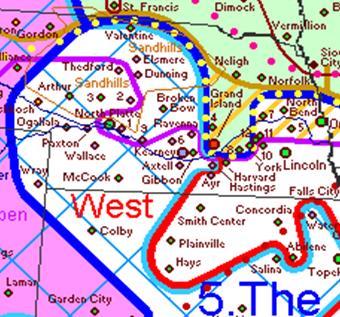
The U.S. - Canada Border and the “Badge of Identity”
How about the national border between Canada and United States? This is a different story, and in fact this border is also the southern boundary of the Canadian dialect for its entire length. This dialect’s notable characteristic is the “Canadian raising” of the vowels in words like “out” and “house” (where the vowel is followed by a voiceless consonant), but not in “loud” and “now”. This feature appears to be viewed by Canadians as a sort of badge of identity, and defines the border rather clearly! Granted, it also occurs in the Tidewater South, but since this is far from the Canadian border, and since their dialect bears no other resemblance to Canadian English, it doesn’t matter! Adj. 4-Oct.-2017
I suspect that historically the retention of this badge of identity has been to some degree conscious and intentional: It is important for Canadians to counter the idea that many Americans have that “Canadians are really just like us”, and to have some kind of distinct identity. I really like Pierre Trudeau’s famous quote: “Living next to you is in some ways like sleeping with an elephant. No matter how friendly and even-tempered is the beast, if I can call it that, one is affected by every twitch and grunt”. 15-Apr.-2011
However, this doesn’t fully explain the situation. At least two Canadian contributors have written in and begged to differ with this analysis, saying that the vast majority of Canadians are totally unaware of how they pronounce things, and are certainly not consciously putting on the Canadian raising as a kind of affectation. And of course they are absolutely right! The vast majority of speakers of any language are totally unaware of the fine detail of their pronunciation system, and most Americans and Canadians cannot tell what side of the border someone is from simply by their pronunciation. So why hasn’t this feature seeped across the border to the U.S. side at any point? Other features have crossed the border freely, as the next section shows, but this one has not. Well, part of the explanation may be that a small percentage of people are able to discern features like Canadian raising, and perhaps some of these people, perhaps on both sides of the border, have lit on this particular feature as being a badge of identity for Canadians, and have helped keep it from crossing the border. So maybe it’s as much the Americans as the Canadians who have kept it a Canadian feature! 6-Sep.-2011
On the other hand, at least one section of Canada, southern British Columbia, was evidently settled mostly by Americans or Europeans, with little direct immigration from previously settled areas of Canada, since the center of the country was still largely unpopulated, as discussed in the “Do some geographic features coincide with dialect boundaries or areas?” section under the discussion of the bite-bout line. And yet all of these settlers adopted the Canadian raising, and the line follows the U.S.-Canadian border all the way to the Pacific. Why did this happen unless at least some people felt that this was a badge of identity for Canadians? 15-Apr.-2011
However, there is one exception to this rule about Canadian raising and the national border: Newfoundland and Labrador do not have Canadian raising. Again, since they are nowhere near the national border, in a way this doesn’t matter, but it is unexpected, given how solid the feature is throughout the rest of Canada and even in the Maritimes! However, contributor Bob Goudreau has pointed out that there is really a simple explanation that actually bolsters my badge of identity theory: “The province of Newfoundland and Labrador did not even join Canada until 1949. ‘Newfies’ would have had no reason to sound self-consciously Canadian, because they were NOT Canadian until then (just a British colony a la Bermuda, etc.).” Cool. (Parts of Baffin Island also seem to follow the Newfoundland / Labrador accent, as can be seen by the various lines in this area. This presumably resulted from greater influence from this area than other parts of Nunavut.) Adj. 2-Oct.-2017
For a while I had thought that there was a second exception,
because I thought I had found an area in Southeastern Quebec where Canadian
raising did not apply, specifically the cities of Montreal and Sherbrooke.
However, the samples I had selected were ethnic French speakers, and even though
their English showed no trace of a French accent, Chris Harvey says that ethnic
French speakers are not the best samples of the native English Montreal accent.
Check out the two samples I have now included for
Montreal. It seems my entire idea was wrong that, because the Stanstead area
was settled by Americans, they would still speak like Americans rather than
Canadians. Chris Harvey assures me that they do not. Apparently the “Badge of
Identity” applies here, too! However, I am still looking for good
sound samples for Sherbrooke and Stanstead. Please send me some if you have
them! 17-July-2010
Because native French speakers do not typically have the Canadian raising, I have now explicitly shown the pink Canadian-raising line as excluding the French-speaking area in Canada. (Earlier I had simply not shown it in this area, but the result was confusing even to me, so I put it in.) Adj. 4-Oct.-2017
This is not to say that this is the only feature that
distinguishes Canadian from American English: The Canadian shift, discussed in
detail in ANAE Ch. 14, affects many Canadian vowels. However, the
Canadian raising is what most people tend to notice, which is why I think that
it has become the badge of identity. 29-Dec.-2010
Read the next section for more insight on this question. 15-Apr.-2011
Shared Features Across the U.S. - Canada Border
Another thing that suggests that Canadian raising is a badge of identity is that plenty of other dialect features cross the border freely. If we look at the map we see that in the west several dialect feature lines cross the border, in particular the bite-bout line, making parts of British Columbia sound more like the neighboring Americans than the neighboring Canadians, except of course that they do have the Canadian raising. In the Great Lakes area the bite-bout line again crosses the border three times, making Windsor similar to its neighbor Detroit in only this one feature, and farther north making the twin cities of Sault Ste. Marie share this feature as well, but on the other side of the line.
But of course the big thing shared by Canadians with many Americans, in both the east and west, is the cot-caught merger. In fact, this feature is shared along the western two-thirds of the border, and it seems almost certain, simply by a quick look at the map, that the North Central dialect borrowed this feature from Canada, since this is the only feature that distinguishes North Central from the North. How much the West derived this feature from Canada is uncertain, but it must have been significant, since they not only share this feature, but also the fronting of the long /ōō/ [u] vowel.
In the east there are two areas along the border where this
feature is shared across the border. Obviously the border shared by the
Maritimes and Quebec with New England is one of them, and it is extremely
probable that this feature was shared across this border very early in the
history of the two nations, or even before they split into two nations in 1776!
The other area is Lake Erie, where there are a line of cities on the American
side that have the cot-caught merger. Was this due to Canadian influence? It
would seem unlikely, except that another dialect feature crosses into Canada at
this same point: one of the long o fronting lines of dots (the pink ones), and another dialect line is split
at this point, the bite-bout line. So who knows? On the other hand, the ANAE Ch. 14, pp. 203-206 suggests that there was no such
influence, since the city of Erie, Pennsylvania was originally part of the
Inland North (and presumably Ashtabula and Painesville were also, though these
are not mentioned in the ANAE), and only later became Allegheny Midland.
Because of this I have not shown the cot-caught line crossing Lake Erie. 12-Mar.-2013
However, even with various features crossing the border, this does not mean that towns on opposite sides of the border will sound particularly similar. As mentioned above, Windsor and Detroit sound extremely different, sharing only one important feature. But even towns sharing more features don’t really sound that close: Tammy Faye Bakker Messner from International Falls, Minnesota, and Duncan Keith from across the river in Fort Frances, Ontario pronounce their /ō/ [o] vowels the same, and also their /ou/ [ɑʊ] vowels in words like “down”, but many of their other vowels are very different. The fact that they are neighboring towns in a remote area doesn’t seem to matter: one is American and the other Canadian, and that matters more! 8-Aug.-2014
A Description of
the Layers in the Layers File
The information in most of these layers is described in the legends on the map and elsewhere on this site.
You can make each layer visible or invisible by clicking the checkmark for that layer in the Layers window. You should usually keep layers 1, 2, 3, 13, and 15 visible (those outlined in red below), except when you really want to see something without the clutter. However, even then you should leave level 1 visible, because otherwise you get a weird cross-hatching which is the “invisible color”. Level 10 (outlined in blue) is the most important data on the map, but it can be made visible or not depending on whether you want the main dialect lines over or under the other lines, since all of the data in level 10 is also included in level 2. This data can only be made completely invisible by making both layer 2 and layer 10 invisible. 12-Aug.-2014
|
Layer |
Name |
Description (if needed) and suggestions |
Repetition |
|
L15: |
coastlines & political boundaries |
Can be laid over the other lines or not, in which case they will be under them if 1 or 2 is displayed. |
Included in 2. |
|
L14: |
geographic features |
|
|
|
L13: |
cities & towns with names |
Without this, you really can’t see what’s what! |
|
|
L12: |
long o fronting lines |
|
|
|
L11: |
the “on” line |
|
|
|
L10: |
dialect boundaries (red, blue, & orange lines) |
Can be laid over the other lines or not, in which case they will be under them if 2 is displayed. |
Included in 2. |
|
L09: |
indigenous language names & boundaries |
This requires 2 for full information. |
Partly included in 2. |
|
L08: |
r-droppers |
|
|
|
L07: |
Canadian & Tidewater raising |
|
|
|
L06: |
pin-pen line |
|
|
|
L05: |
bite-bout line |
|
|
|
L04: |
cot-caught line & hatching |
|
|
|
L03: |
gray boxes & arrows |
Contains the outlines of two of the insets, plus the boxes. |
|
|
L02: |
main map: all dialects & boundaries |
This contains the main data for the map, and includes different color backgrounds for the different dialect areas. |
1, 10, 15, and part of 9 repeated. |
|
L01: |
base map: coastline & water |
Plain map of North America, including only land, water, coastlines, and boxes. |
Included in 2. |
(31-Aug.-2015)
(Oops, I only recently, 20-Oct.-2016, realized that I had swapped the order of layers 10 and 11 on the map, though the intended order was correct in the chart above. I don’t know how long I had it wrong. I have now adjusted these.) 20-Oct.-2016
About Me
I am a professional linguist and a Christian missionary, working in indigenous Amerindian languages. My work has nothing to do with English, so that is why this project is just a hobby.
A few readers have asked where I am from, and what dialect I speak. Actually, I am the total opposite of the kind of people I am looking for for the sound samples on my map: They have each been born and raised in one specific place in the U.S. or Canada. I was born in Mexico City, the son of Christian missionaries, and moved back and forth between Mexico and various places in the U.S. throughout my childhood, spending most of my time in the U.S. in the Oklahoma City area. My parents met in Mexico. 6-Nov.-2015
My father was born and raised in Port Chester, New York. He spoke a number of different languages. He did not have a Port Chester accent (Eastern North; check out the two sound samples I have listed), but instead spoke essentially General American, the one relic of his Eastern North upbringing being that he distinguished words like “merry” /mĕrē/ [ˈmɛɹi] and “marry” /mărē/ [ˈmæɹi].
My mother had an even more interesting background. She was born in Sydney, Australia, of parents who emigrated there from Scotland. When she was 10, the family moved to Berkeley, California. When she arrived, she had a strong Australian accent, but due to the ridicule of her peers, she quickly adopted a Bay Area accent, and sounded thoroughly American for the rest of her life. However, the Australian system had apparently established itself in her subconscious, because after I got interested in English dialects, I asked her if the words “father” and “bother” rhymed for her (see The Father-Bother Distinction above). She said, “Oh, no, they are quite different!” “Really?” I said. “Say them for me.” And when she said them, they both had the very same vowel, rhyming perfectly, following the Bay Area pattern. But they still felt different to her, because in her childhood she had pronounced them with very different vowels, and that phonemic system was apparently still there, though covered up by a Bay Area surface system. She also clearly distinguished “merry” and “marry”, which is not a Bay Area feature, but evidently a remnant of her Australian childhood. She also rhymed “on” with “Don”, which matches both Berkeley and Australia. (For other cases in which a phonemic system can be fixed by the age of 10, see the footnote for John Hoeven). 12-Aug.-2014
So, what accent do I have? I turns out that I speak fairly pure General American, probably because all of my schooling was in English in an American style school, even when I lived in Mexico. For the most part I don’t follow my parents’ speech patterns. For instance, they both distinguish “merry” and “marry”, and I do not. Specifically, in my dialect “cot”≠“caught” (with a clear Central Midland pattern, not the raised /ô/ [oə] of the northeastern U.S.), “pin”≠“pen”, and “on” rhymes with “Don”. Even though I spent seven years in the Oklahoma City/Norman area between the ages of 7 and 18, I didn’t pick up any influence there, since in this area “pin”=“pen” and “on” rhymes with “Dawn”. 8-June-2011
The one area in which I seem to have followed my parents, and differ from most Americans, is that I don’t pronounce the “l” in “calm” or “yolk” or “talk” (see The Pronunciation of “-alm” and “-olk” and “-alk”). 8-June-2011
So what area matches my dialect? No area matches my dialect exactly, though the closest seems to be South Florida, especially the southern part below the “on” line, though I think my native pronunciation of the long /ō/ [oʊ] vowel is a bit more backed, and I don’t know yet how South Florida handles the words in The Pronunciation of “-alm” and “-olk” and “-alk”). (I had previously thought that Canton, Ohio was also a close match, but it has a strongly raised “bat” vowel, whereas I do not.) I suspect that many others who moved constantly in their youth, such as “army brats” or missionary kids like me, will have a similar pattern, which could be called something like “Transient General American”. (South Florida was populated by transients, especially the southern half, so the fact that it has this dialect should not be surprising.) On the other hand, most people who grow up in those Central Midland areas which have a General American accent as their native dialect normally rhyme “on” with “Dawn”, not “Don”. 12-Aug.-2014
To hear a sample of my speech, listen to the CBC interview Nora Young did with me. 26-Mar.-2011
|
This web page is hosted by Hypermart, a very reliable host for many years! |